












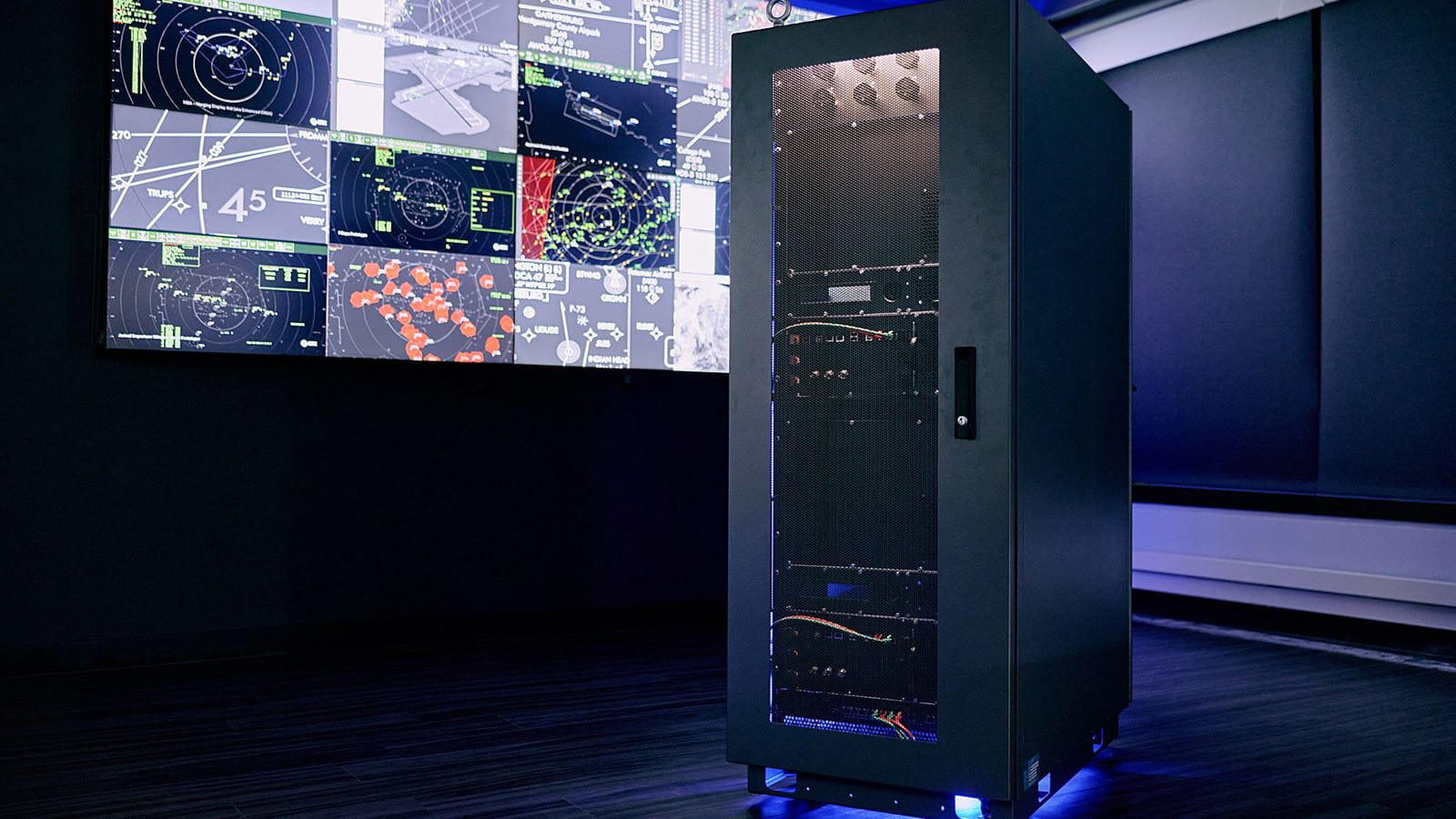


The U.S. Department of Transportation and FAA have picked two companies to replace up to 612 ground-based aviation radars—some of which date back to the 1980s—with “modern, commercially available” alternatives by June 2028.
Transportation Secretary Sean Duffy and FAA Administrator Bryan Bedford on Monday announced that RTX, a subsidiary of longtime agency contractor Collins Aerospace, and Spanish firm Indra won contracts for the Radar System Replacement program. Officials said the work will begin early this year and focus initially on “high-traffic” areas.

The effort, part of the DOT’s multibillion-dollar Brand New Air Traffic Control System (BNATCS) plan, will draw funds from the $12.5 billion Congress allocated to BNATCS in July via the One Big Beautiful Bill Act. In addition to replacing ground-based radar systems, BNATCS calls to install 27,625 new radios, 462 digital voice switches, and 110 weather stations in Alaska.
“Our radar network is outdated and long overdue for replacement,” Bedford said in a statement. “Many of the units have exceeded their intended service life, making them increasingly expensive to maintain and difficult to support.”
Per a description of the Radar System Replacement program published by DOT in October, the FAA uses many cooperative and noncooperative radars that were deployed decades ago. For example, Airport Surveillance Radar-Model 8 (ASR-8) and Air Traffic Control Beacon Interrogator-Model 5 (ATCBI-5) systems were first installed in 1975.
According to DOT, the FAA uses 14 different configurations of surveillance radar that will be consolidated by RTX and Indra. The new systems will be maintained by private contractors, with the option to transition to a government-maintained system.
As of Tuesday afternoon, Indra had not disclosed the value of its contract.
Collins said RTX’s $438 million contract covers the supply of cooperative Condor Mk3 and noncooperative ASM-XR radars. Both are already tracking aircraft in the national airspace system (NAS) and according to Collins are “qualified to meet FAA surveillance requirements through prior test-site certification activities.”
“These systems integrate seamlessly with existing infrastructure, enhance safety and efficiency for air traffic controllers, reduce long-term costs, and ensure the system is prepared for the future,” Nate Boelkins, president of avionics for Collins, said Monday.
RTX and Indra will work with BNATCS prime integrator Peraton, which began work in December after winning a first-of-its-kind contract to manage the entire effort.
New Radars and More
Replacing outdated radar systems is just one piece of the BNATCS project, which also seeks to replace copper wiring with fiber optic cables, transition ATC communications from analog to digital, and build new towers and centers over the next three years.
The FAA invested about $36 million into its NextGen modernization effort, which recently ended after more than two decades. But a government watchdog found the program to be ineffective. Per a BNATCS fact sheet, the FAA recorded three times as many flight delay minutes due to equipment issues in 2025 than it did on average from 2010 to 2024.
The fatal January collision over the Potomac River and radar outages affecting Newark Liberty International Airport (KEWR), meanwhile, have brought renewed scrutiny on the aging system.
In addition to thousands of new radars, radios, voice switches, and fiber, satellite, and wireless connections, the DOT plans to build a new consolidated terminal radar approach control (TRACON) facility. Tying everything together will be a common automation platform that orchestrates more than 74,000 systems and pieces of equipment. It will consolidate existing resources like the Standard Terminal Automation Replacement System (STARS).
The DOT and FAA in December said they had already converted one-third of copper ATC infrastructure to fiber, satellite, and wireless systems. Sharon Pinkerton, senior vice president of legislative and regulatory policy for Airlines for America (A4A), said in November that about 100 sites per month are making the switch.
The FAA has also deployed surface awareness systems to 44 airport towers, electronic flight strips to 13 towers, and 148 radios to facilities nationwide. A next-generation voice switch has been installed in the tower at Allegheny County Airport (KAGC) in Pennsylvania.
As RTX and Indra join the effort, there is still plenty of work to be done.
Duffy in November said the $12.5 billion from Congress will cover new radars, radios, voice switches, and a “brand-new center.” But it won’t be enough for a common automation platform, which is billed as the brain of the new system.
Duffy has repeatedly called on Congress to provide an additional $19-20 billion for BNATCS, though he has faced pushback.
“I am not just going to throw another $20 billion in their direction if we can’t hold them accountable for the $12.5 [billion],” Representative Troy Nehls (R-Texas), chair of the House Transportation and Infrastructure Committee’s Aviation Subcommittee, said in November.
The DOT will also need to equip aircraft with controller-pilot datalink communications to enable the switch from analog to digital, which Duffy said will be a larger undertaking than replacing copper wiring.

