












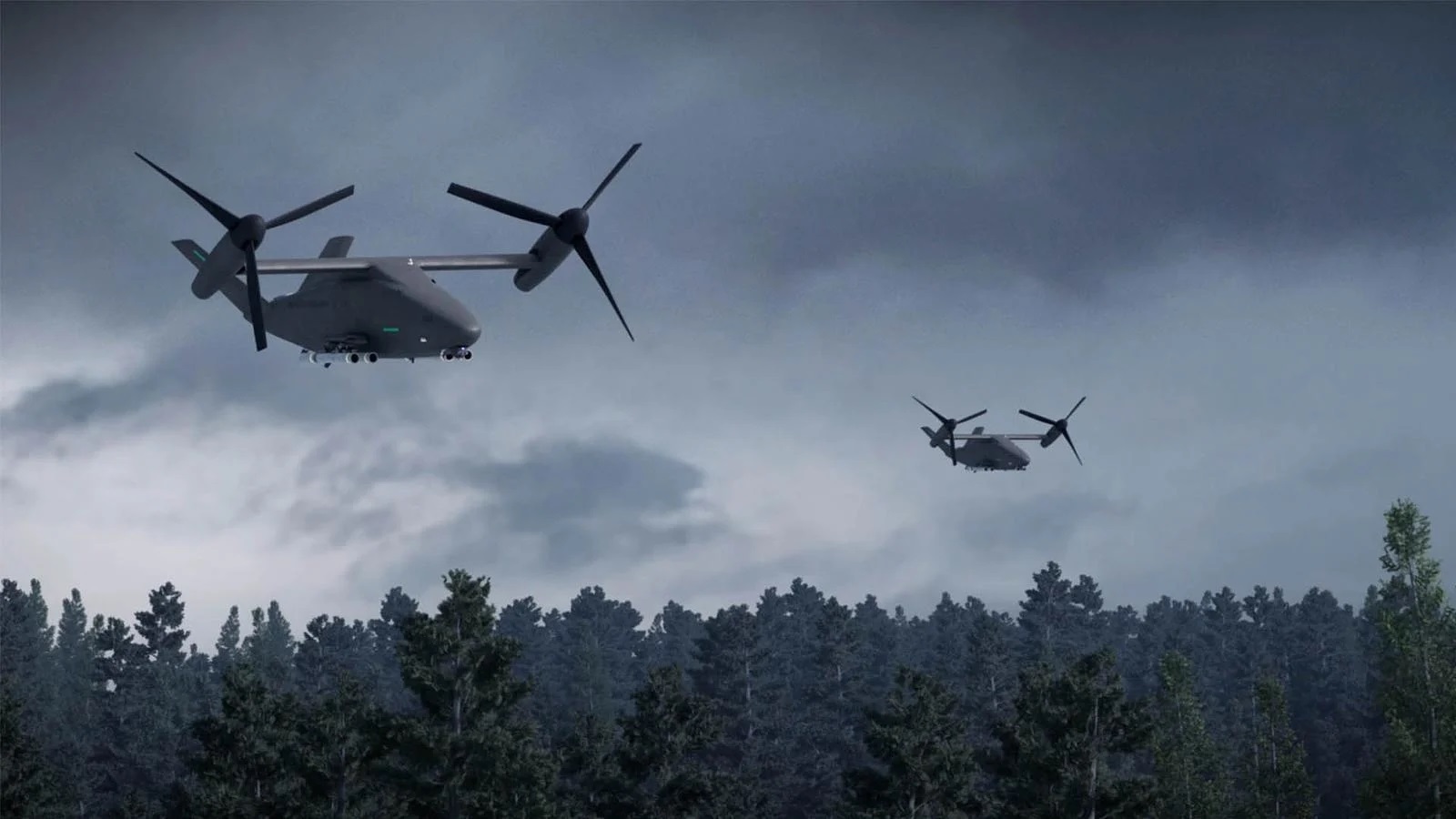


As Boeing works to lift operational restrictions on its V-22 Osprey, the manufacturing titan is exploring a new family of tiltrotor, vertical takeoff and landing (VTOL) drones.
Unveiled this week at the Association of the United States Army (AUSA) trade show in Washington, D.C., Boeing’s Collaborative Transformational Rotorcraft (CxR) concept could be controlled by the crew of an Apache or Chinook helicopter, carrying out missions from logistics to attack, reconnaissance, surveillance, and target acquisition (RSTA). The manufacturer has proposed at least two CxR designs, but the concept’s modularity could allow for more variants in the future.

The CxR craft—which would have a maximum gross weight between 5,000 and 7,000 pounds, payload of 1,000 to 2,000 pounds, and cruise speed of 200 to 250 knots, per The War Zone—could address the survivability concerns of low-speed, low-altitude, short-range attack helicopters. They could also help the Army maintain its capabilities as it phases out the older Apache AH-64D for the AH-64E.
Chris Speights, chief engineer of Boeing’s vertical lift division, told media at AUSA that the drones will fall under the military’s Group 4 or Group 5 category. Aircraft in these categories face no limits on speed and have a maximum gross takeoff weight north of 1,320 pounds. Group 4 drones typically fly below 18,000 feet MSL, while Group 5 aircraft fly above.
“The unique advantages of a modular, tiltrotor concept can provide our customers with a proven high-speed vertical takeoff and landing option that also maintains the low-speed handling qualities that are comparable to a helicopter,” Speights said in a statement. “Our CxR concept has the potential to meet any number of mission requirements across all the service branches.”
Kathleen “KJ” Jolivette, Boeing’s vice president and general manager of vertical lift, told The War Zone that the company believes the military will require “many thousands” of collaborative rotorcraft like the CxR. She added that “more than one company” will likely take part in that effort.
Boeing’s Concept
Boeing has plenty of experience with autonomous aircraft such as the MQ-25 Stingray and MQ-28 Ghost Bat. It has also explored the tiltrotor concept through the V-22.
However, the Osprey program has been troubled. Due to a proprotor gearbox defect, the model is flying under restrictions until 2026. Per a September Congressional Research Service report, Osprey mishaps are responsible for the deaths of 65 military personnel, and the military plans to end its production in 2028.
Still, Boeing evidently sees potential in the configuration, such as the ability to take off and land in challenging environments without sacrificing fixed-wing efficiency. The “x” in CxR, it said, stands for “transformational,” alluding to its mission flexibility. It could serve as a Collaborative Combat Rotorcraft (CCR)—acting as a wingman for the Apache—akin to the Army’s concept for Collaborative Combat Aircraft (CCA). Another possibility is a Collaborative Logistics Rotorcraft (CLR) that pairs with the Chinook.
Boeing said the CxR aircraft are intended to work within a “family of systems” framework that allow it to easily upgrade the capabilities of existing aircraft. Apache crews, for example, could manage multiple drones using the Army’s Manned-Unmanned Teaming-Extended (MUMT-X) architecture.
“No single platform wins the fight by itself,” said Boeing vice president of Army systems Tony Crutchfield. “Having a family of systems capability gives operators the situational awareness, resilience, and flexibility of an entire team.”
Per The War Zone, CxR aircraft would feature tiltrotors with a high wing and V-tail. They would be powered by a single gas turbine engine—unlike the multiengine Osprey—that drives a pair of proprotors. Boeing said the drones would be “completely uninhabited” and fly without extensive support. They could be transported in a C-130 Hercules and quickly deployed.
The drones will carry a wide variety of payloads, including sensors, munitions, and electronic warfare equipment. They could even deploy smaller drones with additional capabilities, such as striking or jamming targets.
The CxR family is still in the conceptual design phase, though Boeing said it is “optimizing” the concept to accelerate delivery and reduce production costs. Speights told media at AUSA that the company will share the concept with the Army for feedback.
The Future is Uncrewed
Boeing’s pursuit of a new self-flying model comes at a time when the military is clamoring for the technology.
The Pentagon’s budget request for fiscal year 2026, for example, calls for $13.4 billion for new autonomy platforms and $3.1 billion for counter-drone systems. An official told online news site DefenseScoop that FY26 is the first budget to include a section dedicated to autonomy.
Boeing is not the only aviation manufacturing titan looking to capitalize on that opportunity. Earlier this month, for example, Sikorsky unveiled its concept for the Nomad family of autonomous, long-endurance, runway-independent drones.
Developers of novel advanced air mobility (AAM) technology are also exploring VTOL defense aircraft. Archer Aviation, Joby Aviation, and Beta Technologies are all developing autonomous, hybrid-powered defense variants of their electric air taxis. Like Boeing’s CxR concept, they combine vertical lift propellers with fixed wings.

