










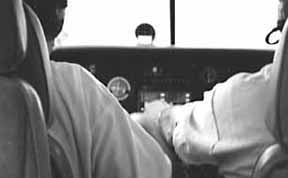
Twos Company
A second pilot on board can be a help or a hindrance. Take a page from the airlines book when flying with a crowded cockpit

A second pilot on board can be a help or a hindrance. Take a page from the airlines book when flying with a crowded cockpit
It would take a clinical psychologist to explain, but there are some people who are not meant to fly airplanes.
It certainly doesnt take a superman or superwoman to become a competent pilot, of course. Like riding a bicycle, most people can learn to do it competently, with a few becoming exceptionally skillful. The flip side of that is that there are also those who cant get the hang of it.
So it is with flying: There are some people who, for whatever the reason, simply can not put it all together and fly competently. The difference is that in aviation, this apparent learning disability costs lives and money, rather than scrapes and bruises.
My first exposure to this phenomenon w…
Consider the pilot – a creature of superior intelligence and drive who tires easily of the mundane in the search for new adventure. The pilot looks to the sky and sees romance where the rest of humanity sees only a place from which rain falls. The pilot is the quintessential lover and like anyone in love is completely blind to the reality of relationships. In our case its the relationship to our passengers.
We pilots havent a clue what passengers expect when they climb into our machines. We assume they share our passion for flying, but we forget that it was we who left the real world to gain our wings. Whenever we make that occasional foray back to share our gift, the recipients might…
General aviation airplanes are great business tools that improve our efficiency by allowing us to do more work that is productive in the same total time. However, a self-piloted businessperson – primarily an instrument-rated private or commercial pilot who flies him/herself in a high performance single or light twin on business trips – can end up in trouble if they dont use that tool correctly.
Perhaps the most common problem experienced by the self-piloted business flier is fatigue. The flexibility of the GA airplane tempts them into scheduling themselves into situations in which they cannot get adequate rest before flying.
How About This…
Lets say you have a 10:00 a….
When the pilot woke up, he was soaking wet, and cold rain was pouring down on him. He couldnt see out of one eye. His leg and arm were killing him. There were pieces of something in his mouth. He took them out. They were two of his front teeth.
It was about dawn. As he looked around, things were still fuzzy, but he realized that he was in his Comanche. The windshield was broken out, the cabin door was open, and they were sitting in a muddy cornfield.
Six months later the pilot, who also was a flight instructor, was telling the story to a group of people at the airport. How hed changed. His face was heavily scarred now, and he needed a cane to get around.
He was a poignant reminde…
Healthy fear can turn to paralyzing panic if youre unprepared for an emergency. With preparation, its all second nature
Most people would agree that flying costs a lot of money and, if youre like most general aviation pilots, that cash drains right out of your pocket. Most pilots are willing to pay the price for the rewards of flying, but few want to throw money away on their aerial pursuits.
It only makes sense to try to get the most for your money – and that means maximizing the amount of time you do the kind of flying you like and minimizing the amount of time you spend droning through the maneuvers essential to maintaining your proficiency.
With the right attitude, its easy to do. You can make money while you fly by simply not wasting it. That takes study, preparation, forethought and practice.
Last month we looked at the philosophy of being your own CFI and emphasized how you could maintain your knowledge, skills and bankroll by approaching your flying as though you were both instructor and student.
This part continues the explanation of by using the tips, techniques and fundamentals from FAAs Advisory Circular 60-14, the Aviation Instructors Handbook. Application of these time-tested tips will help your flying to be more cost-efficient and much more enjoyable.
Learning has a few rules of the road. Learning is change in behavior, improvement in expertise or capability – getting better at what you do. But sometimes you hit learning plateaus or you cant seem to get somet…
Airplanes seem to like cold weather. They pick up speed more rapidly on the takeoff roll and lift off with little or no effort. The controls have a crisp, quick feel thats lacking during the summer months. The engine(s) sound at the peak of strength.
Cold air and airplanes do well together. Well, most of the time. There are a few drawbacks.
One of the biggest problems for cross-country fliers is that reliable icing forecasts are as rare as honest crooks. Icing sometimes shows up where none was supposed to be and is frequently absent from where its supposed to be.
The inaccuracy of the weather predictions leads many people to ignore icing forecasts in favor of going and taking a…
Pilots in the traffic pattern worry enough about looking for other airplanes that many ignore helicopters, even when tower controllers call out the traffic. The reasoning may be something like: They dont fly patterns that interfere with airplanes, so theyre not a collision threat, and theyre so much smaller than an airliner, how bad could a wake vortex really be?
The risk of collision is something only the pilot in the pattern can assess, but the threat of wake vortices from helicopters is actually much more ominous than most pilots realize.
Real-world research into the effect of helicopter rotor vortices on general aviation aircraft shows that some of the characteristics are the sa…

Get the latest stories & special offers delivered directly to your inbox.
SUBSCRIBE