Register

Accident Probes

Undoing An Upset

Lets start by dispensing with the obvious: Loss of control in flight is a lousy explanation, and not much better as a description. Eventually well come up with something better, which hopefully will reflect the myriad ways pilots can let aircraft get away from them. Spatial disorientation in IMC is as different from a moose stall as wake turbulence is from sloppily flown S-turns on final. At best, the ICAOs accident taxonomy-adopted by the FAA and NTSB, presumably in the name of harmonization-provides snapshots of how accident sequences end with negligible insight into what triggered them or how they developed. As a safety strategy, Dont lose control is about as useful as Dont let the engine quit.

Read More »

Canceling IFR Too Soon

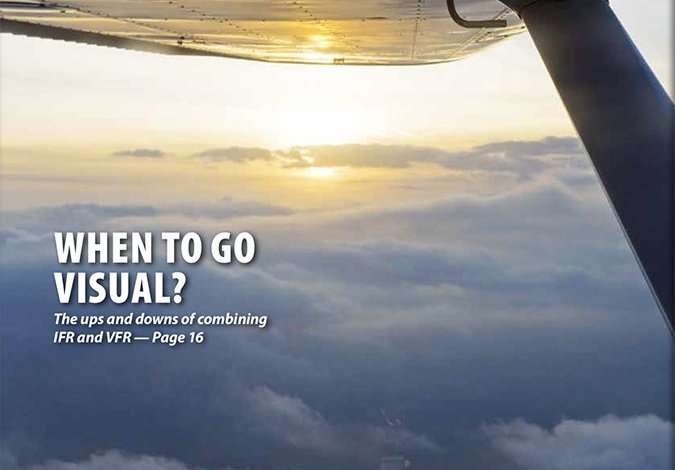
Tom Turners article in the October issue, When To Go Visual, touched on one of my pet peeves about canceling IFR after breaking out on an approach to a nontowered airport: the need to maintain VFR to the runway in an IMC environment. While we all need to be courteous and try to expedite other traffic, canceling IFR at, say, 500 agl after breaking out of a 700-foot ceiling puts us 200 feet below the clouds, too close for legal VFR in Class E airspace. And canceling two miles out on the final can provide all the evidence one needs that youre operating in less than VMC without a clearance. Enterprising feds have brought enforcement actions in similar circumstances. And theres always the guy who pulls his pickup truck onto the runway forcing you to go around and fly the miss.

Read More »

The Real Risks Of Engine Failures

Before taking steps to minimize the risk of engine failures, we probably should try to quantify it. Thanks to the way U.S. aviation mishaps are cataloged, its safe to say that engine failures happen more often than the data reflect. The sidebar at the bottom of the opposite page goes into greater detail, but its safe to say engine failures that dont result in substantial damage, serious injury or death arent part of the data. In fact, the NTSBs definitions specifically exclude [e]ngine failure or damage limited to an engine if only one engine fails or is damaged…. The punchline is that official data underestimate the actual and unknown engine-failure rate. Personal experience bears this out.

Read More »

When To Go Visual

I had flown a full day with the new owner of a turbocharged Beech Bonanza, a recently retired airline pilot who also had been a U.S. Air Force tanker pilot. He was IFR proficient from the airline and wanted to focus on visual and hand-flying skills while orienting to his airplanes autopilot and avionics. He did a great job and got markedly more comfortable with the airplane as the day progressed. At the end of the day, I recommended he get more experience with the airplane before going IFR in it. We shook hands and I went to my office to complete my paperwork.

Read More »

ELTs

Those first ELTs, produced under FAA technical standard order (TSO) C91, failed to activate in a crash more than 75 percent of the time. When they did activate, according to AOPA, 97 percent of the time it was a false alarm. By 1985, when the FAA revised the standards and came up with TSO-C91a, a lot of the bugs had been worked out, but the ELTs troubled history painted it with a mostly deserved reputation for unreliability. Those earlier devices still meet the FAAs requirement to carry an ELT (see the sidebar on the bottom of the opposite page), but it perhaps is time they were retired in favor of newer technology.

Read More »

Landsberg Becomes NTSB Vice-Chairman

From the military to his long tenure at the AOPA Air Safety Institute, Bruce Landsberg has a long and respected career in aviation safety, years of experience that will serve him well at the NTSB, said AOPA President Mark Baker. We thank the White House for nominating him and the Senate for its confirmation vote. General aviation is safer than ever, and we look forward to working with him and the NTSB to keep improving and giving pilots the resources and training they need to fly safer.

Read More »

Familiarity, Contempt

If youve been flying for very long, its likely theres a route you frequently use. It could be a quick out-and-back to the nearest $100 hamburger or cheapest avgas, or an hours-long trek to Grandmas house. Its something youve flown often and know well enough to almost do it without a chart. You understand the topography along the way, where the bolt holes are and how any weather may influence the flight. You may even have a couple of the frequencies memorized, along with expected ATC routings.

Read More »

Unregulated

When the aircraft is equipped with VR-1010-24-1A regulators allowed by Service Instruction 0766-354, Rev II, the overvoltage testing procedure is not achievable. The solid-state voltage regulators are not adjustable to a range (over 31.5v) that will adequately test the overvoltage relays. During a ground run and adjustment of the new voltage regulators, one failed and caused an overvoltage condition. It is this technicians opinion that the test procedure for the overvoltage relay should be changed to include removing and bench testing the overvoltage relays.

Read More »

NTSB Reports

The pilot-rated passenger later stated he verified that the flaps were down and the three green landing gear lights were illuminated in the cockpit during the approach. Just before landing, he heard the angle of attack indicator alarm. The airplane landed hard, and he heard a loud pop and felt the left main landing gear fracture. The airplane then slid off the left side of the runway, colliding with PAPI lights, and continued sliding until the right wing dug into the ground. The airplane then flipped over and caught fire. The cockpit canopy was jammed, but several observers helped open it and egress the two occupants.

Read More »
Pilot in aircraft
Sign-up for newsletters & special offers!

Get the latest stories & special offers delivered directly to your inbox.

SUBSCRIBE