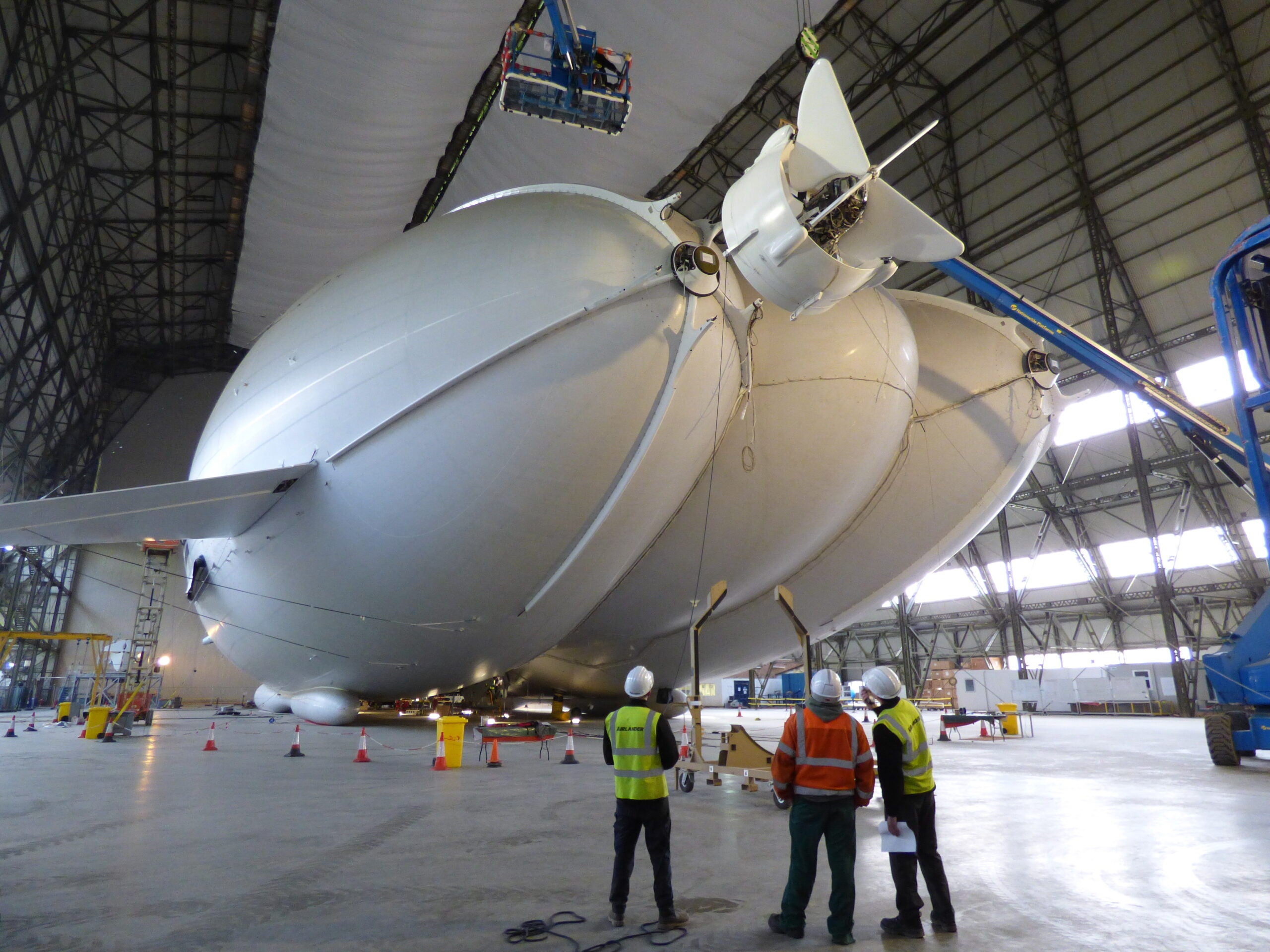
Airlander 10 Gets Ready to Fly

The Airlander 10 is being prepared to take its first flight this spring. Hybrid Air Vehicles
Gemini Sparkle

Key Takeaways:

  • The Airlander 10, a new hybrid airship developed by Hybrid Air Vehicles in Great Britain, is preparing for its first flight this spring, following the attachment of key components and ongoing engine testing.
  • This aircraft employs a hybrid lift system, gaining 60% of its lift from a lighter-than-air helium structure and 40% from aerodynamic shapes and vectored propulsion.
  • Powered by four turbocharged diesel engines, the massive Airlander 10 is designed to hover and land on diverse surfaces like water or sand, reach altitudes up to 20,000 feet, but will be restricted to a speed of about 80 knots.
See a mistake? Contact us.

A new airship-like aircraft called Airlander 10, produced out of Great Britain by Hybrid Air Vehicles, is being readied for its first flight, which the company hopes to achieve this spring.

The engines, fuel module, payload beam (added to carry external cargo), fins and what the company has termed the mission module — the cockpit and payload bay — were recently attached to the Airlander 10’s main hull, and the engines are now in the process of being tested in preparation for the first flight.

As the company’s name implies, the Airlander 10 is designed as a hybrid aircraft, attaining 60 percent of its lift from its lighter-than-air structure and 40 percent from aerodynamic shapes and vectored propulsion. Hybrid Air Vehicles claims the 302-foot-long, 143-foot-wide and 85-foot-tall aircraft will be capable of hovering and landing on its retractable skids on nearly any surface, including ice, water and sand.

The main structure of the Airlander is composed of a material made from layers of fabric, Tedlar and mylar that forms a rigid structure when filled with helium. The mission module, fuel module, ducts and engine support are constructed from a carbon composite material.

The aircraft is powered by four 350 hp turbocharged diesel engines, two up front and two in the rear, capable of bringing the aircraft as high as 20,000 feet. The configuration of the engines allows for thrust vectoring. However, being so massive, the Airlander 10’s speed is projected to be restricted to around 80 knots.

Pia Bergqvist

Pia Bergqvist joined FLYING in December 2010. A passionate aviator, Pia started flying in 1999 and quickly obtained her single- and multi-engine commercial, instrument and instructor ratings. After a decade of working in general aviation, Pia has accumulated almost 3,000 hours of flight time in nearly 40 different types of aircraft.

Ready to Sell Your Aircraft?

List your airplane on AircraftForSale.com and reach qualified buyers.

List Your Aircraft
AircraftForSale Logo | FLYING Logo
Pilot in aircraft
Sign-up for newsletters & special offers!

Get the latest stories & special offers delivered directly to your inbox.

SUBSCRIBE