












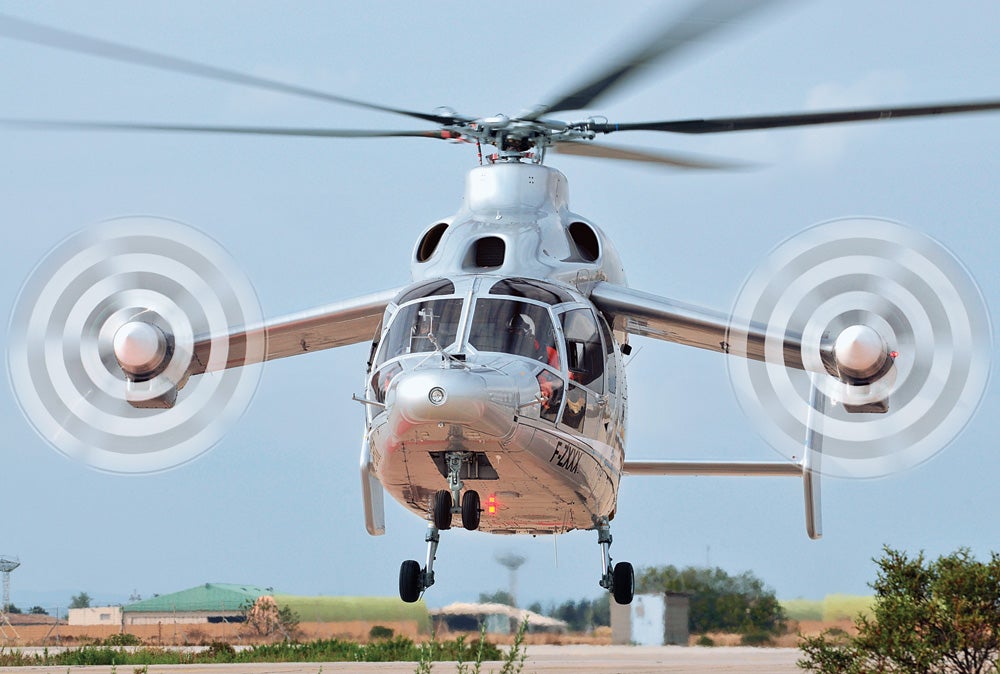


Eurocopter X3

Eurocopter
Gemini Sparkle

Key Takeaways:

  • Eurocopter's X3 helicopter uses two forward-facing propellers on stub wings to progressively shift lifting and thrusting duties, a design aimed at compensating for "retreating blade stall."
  • This unique configuration allows the X3 to achieve a top speed of 220 knots, significantly surpassing the cruise speed limitations of conventional helicopters.
  • The X3 is part of a trend in high-speed rotorcraft development, competing with designs like Sikorsky's X2 (coaxial rotors) and contrasting with tiltrotors such as the Bell-Agusta BA609.
See a mistake? Contact us.

Eurocopter recently took the wraps off its developmental X3 helicopter. What’s unique is it’s configured with two forward-facing propellers on stub wings. At higher airspeeds, the lifting and thrusting duties are progressively shifted to the wings and props. This arrangement is meant to compensate for lost lift on the side of the retreating main rotor blade disk. The X3’s main engines drive the propellers and the main rotor.

The basic physics of the so-called “retreating blade stall” have always capped the cruise speed of conventional helicopters. As the forward speed of the helicopter approaches that of the retreating blades of the spinning main-rotor disk, the blades confront little or no “relative wind” and, therefore, can’t generate lift on that side of their rotational arc. On conventional helicopters, flexible rotor hubs are designed to compensate for this as much as possible by “lagging” the forward moving blades and accelerating the retreating blades to maintain balance. But that design strategy can go only so far.


With its new configuration, the X3 is said to have a top speed of 220 knots, about 80 knots better than that of traditional helicopters. The Eurocopter design seems to be competing with Sikorsky’s developmental X2, which has been flying since 2008. The Sikorsky configuration combats retreating blade stall by incorporating two main rotor disks on the same axis rotating in opposite directions. The X2 has reportedly reached forward speeds of 250 knots. Both developmental helicopters contrast with the Bell-Agusta BA609 civil tiltrotor — a smaller version of the military Osprey. The tiltrotor concept incorporates a pair of engines and hybrid “proprotors” that swing to a copter-like horizontal configuration for takeoff and landing, then rotate forward to a vertical position for high-speed cruise flight. The circa $10 million BA609 has a top speed of about 275 knots and is scheduled for certification next year.

FLYING Staff

FLYING Magazine is a one-stop resource for everything aviation, including news, training, aircraft, gear, careers, photos, videos, and more.

Ready to Sell Your Aircraft?

List your airplane on AircraftForSale.com and reach qualified buyers.

List Your Aircraft
AircraftForSale Logo | FLYING Logo
Pilot in aircraft
Sign-up for newsletters & special offers!

Get the latest stories & special offers delivered directly to your inbox.

SUBSCRIBE
