











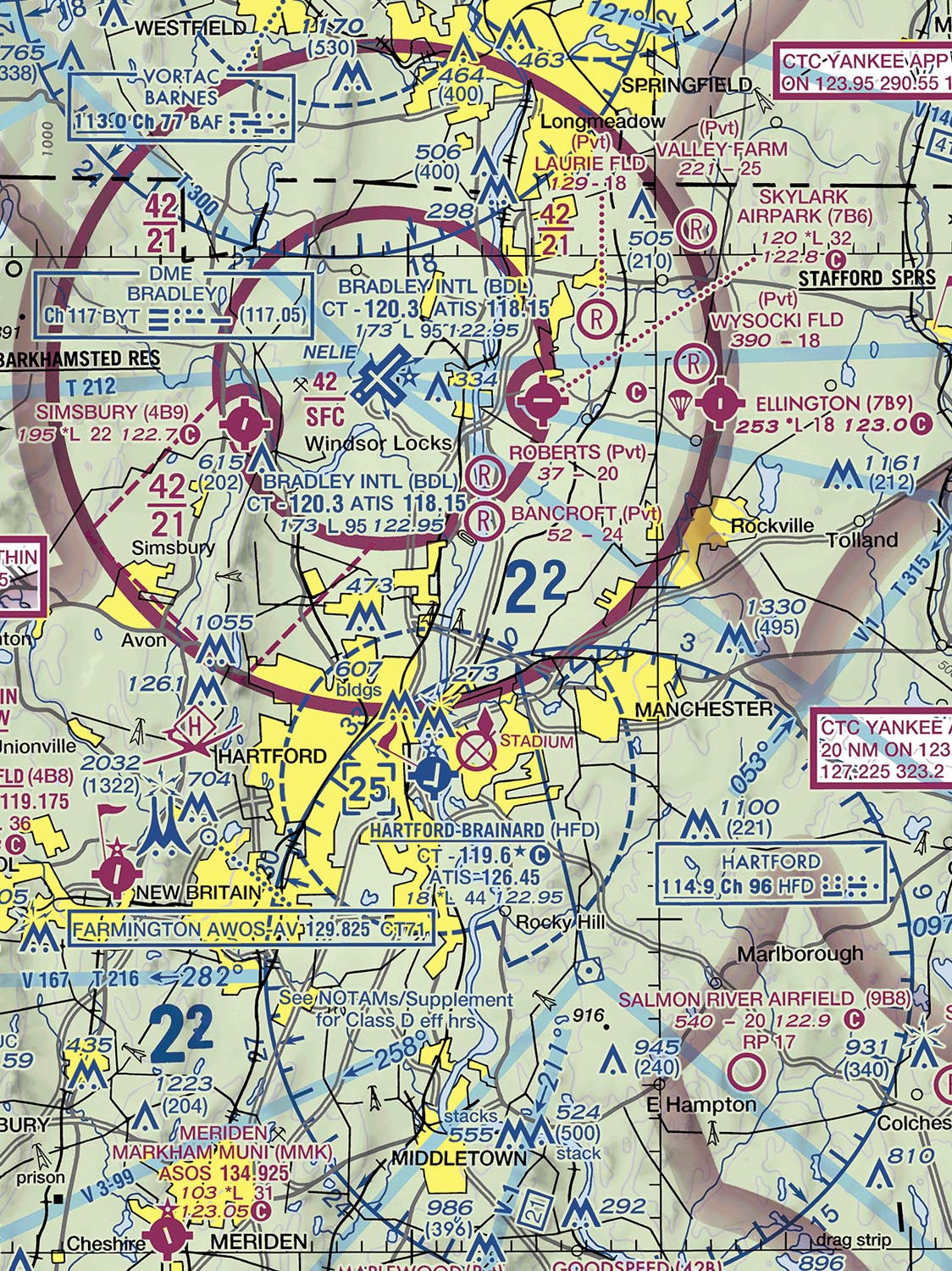


Ellington, Connecticut, has a nontowered Class G airport (7B9) under the edge of the 10-mile ring of the Bradley Class C. Ellington has no instrument approaches. It’s not even displayed on the IFR Low En-Route chart because its 1800-foot runway is less than the 3000 foot minimum needed to be shown.
You’ve planned an IFR flight in a Cessna 172 from Ellington to Long Island MacArthur airport (KISP) to visit family. Your filed flight plan sends you direct to the Hartford VOR where you plan to pick up V1 for the ride to Long Island.

You arrive at 7B9 and complete your preflight checks. The ceiling appears to be about 1000 feet, give or take (closest reported weather is at Bradley). A VFR departure with an in-air pickup doesn’t seem workable. So you call Bradley Approach on your cell phone. Except for an initial 180 degree heading “upon entering controlled airspace,” Bradley clears you “as filed” with a workable void time. You depart, climbing into the overcast. Were you legal? Was it safe? How do you know?
No IAP Means No DP
Let’s begin by understanding what it means when there is no instrument approach procedure at an airport. When an instrument approach procedure is designed and flight checked, the TERPS criteria and the evaluation include obstacle and terrain clearance for both the approach and the departure. If the surrounding terrain allows for a standard departure profile—cross the departure end of the runway at least 35 feet AGL, climb to at least 400 AGL before turning in any direction, and climb at least 200 feet per nautical mile to the minimum instrument altitude—we have a “diverse departure.”
While there may be a list of close-in obstacles and we might see some notes about takeoff obstacles, we will not see takeoff minimums or more detailed ODPs. When obstacles impinge on the standard departure profile, we see some combination of increased visibility, climbs to a certain altitude before turning, higher minimum climb rates, a text or graphic ODP, and visual climb over airport (VCOA) instructions. Some runways may even be “NA,” not authorized for instrument departures due to obstacles or other reasons.
When an airport has no instrument approach, none of this has been done. No official obstacle assessment has been completed at all. If you depart into the clouds below the minimum IFR altitude, you are completely on your own.
So, Is it Legal?
The bottom line regulatory answer for Part 91 is “yes.” There is nothing in the aviation regulations that prohibits a plain vanilla Part 91 flight from departing IFR from anywhere, in any conditions. The reg §91.175 is our go-to for “Takeoff and Landing Under IFR.” It covers a lot. One of the interesting things about Part 91 is that approach and landing is more heavily regulated than takeoff and departure.
If we need to make an approach in instrument conditions, we must use an approved instrument approach procedure per §91.175(a). Although it may seem obvious, there’s even a specific regulation that requires us to use the highest minimums provided by the procedure and our equipment—no LPV minimums without WAAS-enabled RNAV and LPV annunciated! We cannot descend from the DA or MDA unless we have the minimum visibility shown in the chart, can do so at a “normal” rate of descent using “normal” maneuvers and can see at least one of the 10 §91.175(c)(3) visual references we memorized for our instrument checkride, which few of us remember, choosing instead to oversimplify as “paint, pavement, or lights.”
In comparison, instrument departures are the wild West of Part 91. There are default and published takeoff weather minimums and ODPs, but §91.175(f) says they are only mandatory for Part 121, 125, 129, and 135 operations. That gives Part 91 pilots the dubious benefit of disregarding procedures designed to prevent us from hitting something on the way up (unless the ODP is assigned) and being allowed to depart when the conditions are zero-zero on the ground.
It also means we may depart IFR from places that have not been assessed at all. There is a regulatory prohibition on Part 135 IFR operations “outside of controlled airspace or at any airport that does not have an approved standard instrument approach procedure,” but §135.215(a) only applies to Part 135 operations and there are exceptions involving FAA-approved operations specifications (OPSPECS). But the point remains—there is not one word prohibiting it for those of us flying in the Part 91 world. So, yes it’s legal but we should ask ourselves if it’s safe.
“Legal” Except When It’s Not
The black and white answer was easy. The nuances are more difficult. Section §91.13 is the catch-all prohibition on careless or reckless aircraft operation. It is almost always added when another rule is violated (referred to as a “residual” or “derivative” violation). But §91.13 can also stand alone (an “independent” violation) if the conduct actually or potentially endangers the lives or property of others, even if no specific rule has been violated.
An interesting example is FAA v. Langford. An impatient LearJet pilot was found to be careless and reckless when he turned ten feet in front of a Cessna 152 holding short and spooled up his engines. There was at least some indication that blasting the C152 was deliberate, but simple carelessness would be enough to support a certificate suspension.
A more germane IFR example comes from two cases in which pilots departed in IMC from an uncontrolled airport without an IFR clearance, expecting to reach VFR conditions before entering controlled airspace. In both cases, FAA v. Vance in 1986 and FAA v. Murphy in 1993, the NTSB, which acts as an administrative court reviewing FAA certificate actions, dismissed alleged violations of the VFR cloud clearance rules. It is, said one decision, “not illegal for an instrument-rated pilot in a properly equipped instrument airplane to take off and fly in instrument conditions [in uncontrolled airspace] without a clearance.”
However, the tribunal upheld the independent §91.13 careless and reckless violations because of the “unacceptable hazard” created by the pilots to aircraft operating IFR in nearby controlled airspace or making an instrument approach to the airport.
With this as background, the FAA Chief Counsel was asked in 2015 whether it was “safe and legal for a pilot to accept responsibility for obstacle clearance [departing from an airport with no instrument approaches] when he cannot see obstacles on the ground but could ‘likely avoid’ obstacles due to his knowledge of the area or his charts….” The answer should not have been a surprise. Referring only to the §91.13 catch-all, the interpretation warns it “may” be deemed careless and reckless according to the 2015 Weiman Interpretation.
The Weiman “may” is not a prohibition; it’s a warning. IFR departures from airports with no departure assessment take place regularly and have for many years. Before GPS gave the FAA the ability to create RNAV approaches almost anywhere, there were many airports with no approaches where instrument training took place.
That opening scenario? I did my instrument training at 7B9. We regularly filed IFR, often departed in marginal conditions in order to train in actual instrument conditions. Absent the cell phone (it was 1992), the scenario was my first solo IFR flight after I received my instrument rating.
The availability of RNAV may have reduced the number of airports with no IAPs and departure assessments, but “brown” airports still exist on the en-route chart. In addition to airports with short runways like Ellington, there are private airports and airparks throughout the United States that might or might not be charted at all.
By the way, that initial 180-degree heading was not a vector. Whether ATC asks if you can maintain your own terrain and obstruction clearance or not, the responsibility is 100 percent yours until you reach the minimum IFR altitude. The OROCA in the area is 4200 MSL. Bradley’s minimum vectoring altitude is 2500 MSL. Always remember that a vector requires two things: direction and radar contact. Until ATC says the words “radar contact” and then a heading, obstruction clearance remains the pilot’s responsibility. Diverse vector areas may be an exception, but Ellington lacks one.
Doing it Safely
My flight was 30 years ago but speaking with airpark residents, instrument flight instructors at similar airports, and others, there are common threads. The two considerations cited most often are acceptable visual conditions and familiarity.
Whether we call for our clearance on the ground or in the air, weather that allows us to depart in good VFR conditions is an obvious “go.” In contrast, if there ever is a time for a zero-zero takeoff, an airport with no departure assessment for obstacles is not the ideal place for it. Nor, for that matter, is it a good place to be scud running in marginal conditions hoping to pick up IFR in the air.
Some will point to the availability of the terrain and obstruction displays available in both certified panel GPS units and non-certified navigators and EFBs. Terrain data comes primarily from the NASA/US Geological Survey’s SRTM 1 Arc-Second Global Terrain Elevation data; obstruction data from the FAA’s Digital Obstruction File (DOF).
Looking at the ForeFlight profile view for our departure from 7B9 for example, it looks like we are okay, once we get to pattern altitude. But even if we were in a completely flat and treeless area in the Great Plains, I’d hesitate to pop into the clouds based solely on this picture. How about our certified avionics? Same answer. The AFMS for the latest Garmin GTN xi-series navigators warns us in the Limitations section, “Maneuvers and navigation must not be based solely on the display of terrain, obstacles, or wires on the moving map terrain displays.”
The job of the DOF team is to maintain data on all structures over 200 feet AGL and lower structures in the vicinity of airports with approach procedures. More significantly, maintaining an accurate and current database depends upon structures being reported to them. Exactly who do you think is making reports about new or changed structures near low-use and private airports with no approaches? These terrain and obstruction graphics are definitely helpful for planning purposes. But even assuming reliable reporting, we are not looking at the level of obstruction detail provided by one of the FAA King Airs flying multiple approaches for the purpose of discovering relevant obstacles.
Ultimately, safe departures require a healthy combination of familiarity with the airport and its surroundings and good personal risk management. The folks who are departing safely in marginal visual and instrument conditions from airports like this are creating DIY departures based on their familiarity with the airport and personal minimums for ceilings and visibility. Multiple visual flights have told them that a normal climb in certain directions will keep them from hitting something on the way to the minimum IFR altitude. It was true when I trained at 7B9 30 years ago and it’s still true today.
Mark Kolber is a pilot, CFI/CFII, and retired aviation lawyer old enough to remember getting drenched running between an airplane and a phone booth to pick up an IFR void-time clearance—in the rain!


