











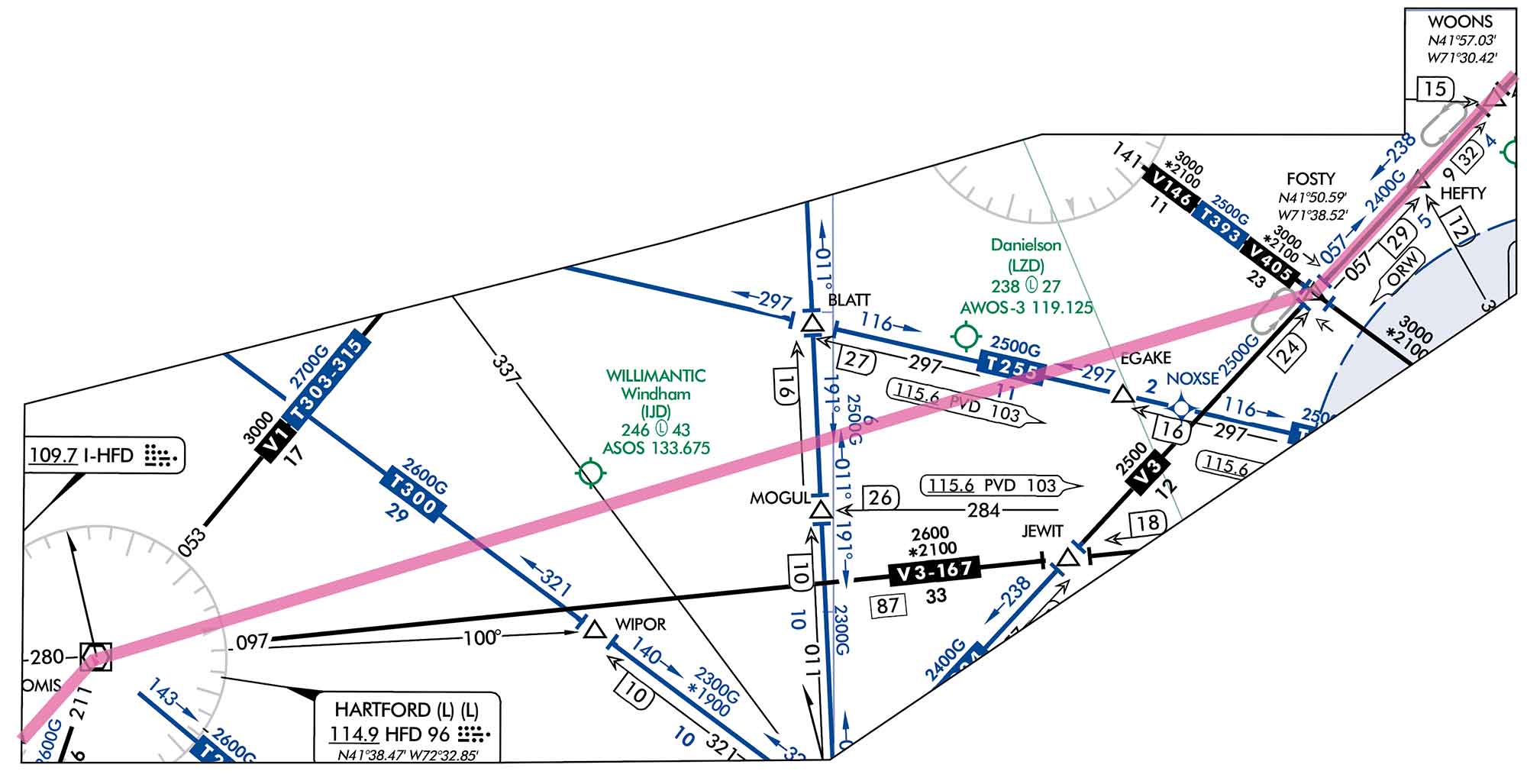


You are IFR from Republic Airport in Farmingdale, New York (KFRG), to Norwood, Massachusetts (KOWD), in your Piper Arrow. It’s IMC all the way. The clearance is a common one. Initial vectors to Bridgeport VOR (BDR), direct to Hartford VOR (HFD), then to FROSTY and WOONS intersections northwest of the Providence Class C. Although the flight should take only a bit over an hour, it is your practice to round up, so you filed 2 hours as your ETE.
Departing, you enter the clouds at 900 feet AGL. As the forecasts predict, your 7000-foot cruise altitude keeps you in a solid stratus layer. Soon after turning at Hartford, you hear nothing but static from your GTN 650. Your old KX 155 isn’t any better. Changing frequencies doesn’t help. Guard on 121.5 is silent. Nothing from nearby AWOS so it’s you and not them. Fortunately, the nav side of both units seems to be unaffected—so far. You figure maybe it will clear up. It doesn’t.

You are still in solid cloud, but the last METAR shows that, like your destination, nearby Willimantic (IJD) and more distant Pawtucket (SFZ) have instrument approaches and are comfortably above minimums. If push came to shove and your navs quit too, the last reported ceilings at those potential diversions would lessen the clenching sensation in your butt if you needed to use your EFB to get down.
Do you continue to your planned destination or divert? If you continue to Norwood, what do you do when you get there? What are the consequences?
Regulations and Reality
Code of Federal Regulations, Title 14, Section 91.185, “IFR Operations: Two-way Radio Communications Failure” was written in the days when radar coverage wasn’t as extensive as today and vacuum-tube radios weren’t as reliable as we might have wished. I’ve seen regulatory references to IFR communications failure as early as the 1938 version of CAR Part 60, and the regulation has been in substantially its current form since at least 1961.
§91.185(b) VFR Conditions
If the failure occurs in VFR conditions, or if VFR conditions are encountered after the failure, each pilot shall continue the flight under VFR and land as soon as practicable.
In contrast, lost comm today is rare. (Temporary inability to get through to ATC on a busy day is not lost comm.) Our equipment is quite reliable … and redundant. It is the unusual IFR aircraft that doesn’t have two radios. Radar coverage is widespread; in most of the NAS, controllers aware of our inability to communicate are watching us, able to clear traffic from our path.
The FAA Chief Counsel has been invited to reinterpret §91.185. Nothing doing. It should not be surprising that the Chief Counsel has held firm to the current language, even where it conflicts with current reality.
In the 2018 response to former IFR editor Jeff Van West’s inquiry, for example, the Chief Counsel said the estimated time of arrival we file is something “on which the ATC relies to make other safety-based determinations.” The reality is that controllers don’t even know our filed ETA and make no decisions based on it. Yes, in theory, realizing we are lost comm, a controller could ask to retrieve the filed ETA. But, as more than one controller has said when asked, “We would never do that.”
The Rules—Visual Conditions
Pull out your regs and let’s review what §91.185 tells us to do. First and foremost, if we are in or encounter VFR conditions, we are to “continue the flight under VFR and land as soon as practicable.” As the AIM explains, “under VFR” in the lost comm context means conditions which permit you to continue visually, rather than strictly adhere to VFR cloud clearance rules. “Continue under VFR,” applies even in Class A airspace where VFR is generally not permitted. “The primary objective of this provision,” the AIM explains, “is to preclude extended IFR operation by [NORDO] aircraft within the ATC system.” If you can get out of the IFR system and land visually while being able to fulfill your §91.113(b) see-and-avoid responsibilities, do it.
When we are in “IFR conditions”—non-visual conditions—§91.185 becomes more complicated. The regulation talks about three things: route, altitude, and when to descend and fly an approach.
The Route In the Soup
First let’s consider what we might reasonably expect to happen if we had not lost comm. If the forecasts for northeasterly surface winds and ceilings between 900 and 1200 feet hold, we can anticipate flying the RNAV 35 into Norwood. We might ask or be given lower altitudes as we near WOONS, but even without an enroute descent, we could arrive at WOONS at 7000 feet, descend comfortably to 3000 feet during the over 20 NM to CURLI, and turn inbound. Simple? Sure. Reasonable? Absolutely. What §91.185 tells us to do? Not so fast!
Section 91.185(c)(1) directs us to continue the flight to the destination via the last route assigned by ATC. If the last assigned route was a radar vector, we head to the fix or route specified in the vector. In our scenario flight to Norwood, if we lose comm during those radar vectors to Bridgeport VOR, §91.185 tells us to proceed direct BDR and continue along our cleared route.
If we lose comm after receiving an instruction with a clearance limit other than the destination, such as a hold at Hartford, we are to wait for our EFC time and continue as otherwise cleared. Absent any of those options, §91.185 tells us to fly the route we filed. That’s not an issue in our scenario, but like the ETA, ATC has no idea what we filed if different than our clearance. Nor do they care.
With our clearance and the pilot’s choice to continue to the destination, the §91.185 route priority makes sense, at least until we get in the vicinity of Norwood. Once there, however, rather than do the obvious—fly the transition from WOONS and fly the approach—§91.185 orders us to delay. Per our clearance, we are to fly from WOONS direct to Norwood airport before we do anything else.
§91.185(c)(1) Route Priority
(i) By the route assigned in the last ATC clearance received;
(ii) If being radar vectored, by the direct route from the point of radio failure to the fix, route, or airway specified in the vector clearance;
(iii) In the absence of an assigned route, by the route that ATC has advised may be expected in a further clearance; or
(iv) In the absence of an assigned route or a route that ATC has advised may be expected in a further clearance, by the route filed in the flight plan.
Altitude In the Soup
Section 91.185(c)(2) tells us to fly the highest of the last assigned altitude, the minimum IFR altitude, and the altitude ATC advised can be expected.
The altitude rules generally make sense. While we have airways with MEAs, and charts with published OROCAs, continuing enroute at the highest of the minimum, cleared, and expected altitude means we are unlikely to hit anything or anyone. But the rule also keeps us artificially high once we reach the approach environment. Like the route rule, the altitude rule blocks the use of the WOONS approach transition. Instead, we not only must delay our exit from the system by flying to Norwood first, but we must continue to maintain 7000 feet. We must fly around for a while within the busy Boston Class B before we may descend.
§91.185(c)(2) Altitude Priority
At the highest of the following altitudes or flight levels for the route segment being flown:
(i) The altitude or flight level assigned in the last ATC clearance received;
(ii) The minimum altitude (converted, if appropriate, to minimum flight level as prescribed in § 91.121(c)) for IFR operations; or
(iii) The altitude or flight level ATC has advised may be expected in a further clearance.
Approach In the Soup
We’ve reached Norwood at 7000 feet. What now? The rule distinguishes between a clearance limit which begins an approach and one which does not. Since Norwood airport is neither an IAF nor a transition fix, it is covered by §91.185(c)(3)(ii). We are to fly “to a fix from which an approach begins and commence descent or descent and approach as close as possible to the estimated time of arrival.” Upon arrival over KOWD, strict adherence to the rule requires us to roll our own course reversal, maintain 7000 feet, and head to…
The rule doesn’t specify which fix to use, so it’s up to us, so long as an approach begins there. Although some may argue otherwise, that means one of the two IAFs, DODNE or BURDY, or the published transition beginning at WOONS (CURLI is an intermediate fix). Our rule-based choices come down to (1) returning to exactly where we came from to begin the same descent and approach we could have accomplished a half hour or so earlier, or (2) flying to DODNE or BURDY at 7000 feet where we have the very first opportunity (assuming we are near or after the ETA ATC doesn’t know or care about) to descend in another DIY holding pattern or slam dunk on the transition from the IAF to CURLI.
If you are not particularly fond of that result, I don’t blame you. The only two things you accomplished were to delay the approach and increase your workload. More importantly, despite what the Chief Counsel said, it is not what ATC wants or expects.
§91.185(c)(3) Leave Clearance Limit
(i) When the clearance limit is a fix from which an approach begins, commence descent or descent and approach as close as possible to the expect-further-clearance time if one has been received, or if one has not been received, as close as possible to the estimated time of arrival as calculated from the filed or amended (with ATC) estimated time enroute.
(ii) If the clearance limit is not a fix from which an approach begins, leave the clearance limit at the expect-further-clearance time if one has been received, or if none has been received, upon arrival over the clearance limit, and proceed to a fix from which an approach begins and commence descent or descent and approach as close as possible to the estimated time of arrival as calculated from the filed or amended (with ATC) estimated time en route.
ATC
If you listen to virtually any discussion of lost comm by controllers, you will hear three interrelated themes. First and foremost, while they probably have not read the AIM, they do want you to, “preclude extended IFR operation.” Second, ATC has no idea why you lost comm. Whether you think it is one or not, ATC will treat you as an emergency aircraft. That leads directly to the third. ATC does not know what you are going to do.
ATC wants you to get down as expeditiously as possible consistent with safety. That doesn’t mean don’t continue to your destination. At the very least, however, it does mean don’t delay your descent and approach based on what you incorrectly think ATC expects you to do. They are watching to route other traffic away based on what you actually do.
The decision to follow §91.185 to the letter by flying to KOWD first, then returning to fly the approach, remaining at 7000 feet until WOONS or one of the IAFs will have a major impact on both Boston and Providence arrivals and departures. Being uncertain what you will do next, both facilities will route traffic in their approach/departure corridors to give the NORDO airplane a very wide berth until it is safely down.
Why not choose to descend at WOONS when you reach it the first time, fly the approach, and let ATC know when you are safely on the ground? Don’t worry. The controllers will not be reporting a “pilot deviation.” On the contrary, they may be so thrilled they just might throw you a party! Potential enforcement for “violating” §91.185? Not likely. It is exceedingly rare for the FAA to challenge pilots who successfully extricate themselves from sticky situations unless the pilot clearly created the situation or acted fraudulently.
AIM 6-4-1
It is virtually impossible to provide regulations and procedures applicable to all possible situations associated with two‐way radio communications failure. During two‐way radio communications failure, when confronted by a situation not covered in the regulation, pilots are expected to exercise good judgment in whatever action they elect to take. Should the situation so dictate they should not be reluctant to use the emergency action contained in 14 CFR Section 91.3(b).
Taking AIM
How do we reconcile the strict mandates of §91.185 with what seems a more reasonable solution, one ATC prefers? My answer lies in the very first sentences in the AIM discussion of lost comm. It is my favorite statement in the entire AIM. It applies to far more than lost comm. As a pilot I try to keep it always in mind; as an instructor I wish more pilots did too.
I don’t think delaying an approach and tying up the approach/departure corridor of a Class B primary is either contemplated by the regulation or displays particularly good judgment. Plus, my risk tolerance may be lower than yours. If I am flying a light piston with dual nav/comms and lose comm capability in both, I am expecting it to be an introduction to bigger problems—loss of navigational capability, an electrical failure, or, worse yet, the smell of burning insulation.
I am treating it as an emergency before it becomes a bigger one. I’m diverting to the nearest suitable airport. All other things being equal, I’d probably select a towered airport over a non-towered airport if only because ATC facilities are communicating with each other and with other aircraft to keep them out of my way all the way to my safe landing.
The Choice is Yours
I am not suggesting being anti-authority by ignoring regulations. But I am suggesting that our application of the lost comm rules be tempered with the reality of instrument flight in the twenty-first century. Section 91.185 as refined by the AIM’s guidance allows choices other than delaying our approach and landing. Having decided to continue to KOWD, our scenario pilot could have flown the approach into KOWD the first time around. They could also have diverted to a suitable airport along the way. If ADS-B or XM was providing weather showing VFR weather not too far away, heading there was yet another option.
Every flight and every lost comm situation is different. We looked at a single scenario and still came up with multiple answers. The important takeaway is to have the tools and understanding to consider the options realistically and make a good decision if it happens to you.
CFI/CFII and retired aviation lawyer Mark Kolber believes rules and regulations are necessary, but they need not be straightjackets.

