












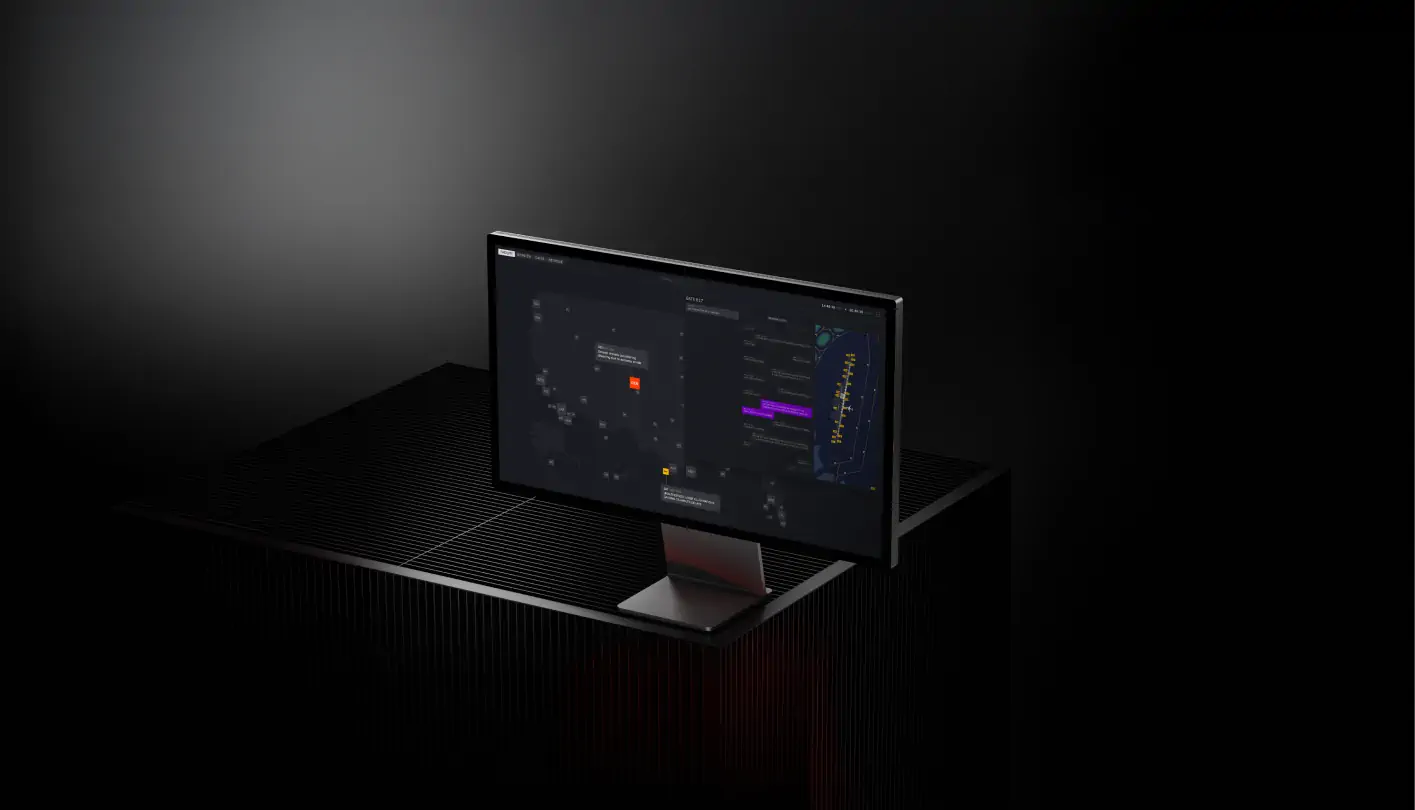


United Airlines Ventures (UAV), the investment arm of the U.S. carrier, is funding a little-known startup that says it delivers quicker, clearer, fuller insights for more efficient airport and airline operations.
FLYING readers may know Enhanced Radar as the company behind the ATC app, responsible for hundreds of viral social media videos capturing air traffic control (ATC) interactions, from emergencies to humorous exchanges.

But Enhanced Radar co-founder and CEO Eric Button, also a Pilatus PC-12 and Gulfstream G280 pilot, describes the app—which he said uses a “lightweight” version of the company’s proprietary artificial intelligence (AI) model—as a side project.
The firm’s primary offering is an enterprise software that transcribes millions of daily air traffic control (ATC) transmissions. It flags key events and organizes audio into easily digestible snippets, providing a clearer picture that helps aviation decision makers navigate unexpected conditions.
Rather than simply knowing that an airplane has not yet taken off, for instance, an airline worker could understand the reason for the delay and react accordingly.
Enhanced Radar on Wednesday raised $7 million, with UAV contributing, to expand the deployment of the software, as well as its audio collection hardware that is installed at about 80 North American airports.
The funding round was led by Initialized Capital with additional participation from Y Combinator, Decisive Point, ForeFlight co-founder Tyler Weihs, and individual investors who have backed companies such as Google and OpenAI.
With fresh funding, Button said the company intends to add more airports to the network, grow its software engineering and business development teams, and pursue other strategic opportunities. He told FLYING that ultimately, the technology will be used to augment both efficiency and safety functions not just for airlines and airports, but also in the control tower.
Per Button, airport and airline personnel are seeing success in early enterprise deployments of the software.
From ATC App to AI Platform
Social media users may already be familiar with the ATC app, whose sleek, user-friendly interface lends itself to short videos on platforms such as TikTok or X.
The app first gained traction around the time of the Pentagon’s testing of an anti-drone laser near El Paso International Airport (KELP) in Texas. Before the news reached major media outlets, ATC users were discussing the first of two February incidents involving the laser in a Discord group.
“So why is ELP on a 10 day TFR?” one user wrote in the early morning of February 11, just a few hours after the FAA closed the airspace due to the testing.
The app combines the audio of LiveATC with the real-time location data of platforms such as FlightAware or FlightRadar24, using AI to transcribe ATC conversations in real time and show where they took place. Similarly, Enhanced Radar’s enterprise software is designed to give airport and airline workers a quicker, more robust picture of the operating environment.
Beyond sifting through heaps of ATC transmissions, the platform is designed to analyze a number of data sources to deliver actionable insights to customers who have blind spots in their operations. Down the line, the objective is to deliver systems which serve the nation’s roughly 14,000 ATCs, giving them a new tool to address a chronic shortage.
Button in February said Enhanced Radar’s proprietary hardware was installed at 71 airports. That number is now 80 and growing. With each installation, the company’s AI model gains new training materials and expands in scope.
Enhanced Radar in February released a new model, Y4, that Button said is designed to tackle aviation-specific challenges such as choppy audio, rushed speech, accents, and dozens of aircraft sharing the same frequency. Per a news release, Y4 is better at differentiating between controllers and pilots and understands audio with accuracy greater than 98 percent.
AI in the NAS
Button and Enhanced Radar have not indicated any plans to offer their technology to federal customers. But the FAA and U.S. Transportation Department (DOT) are exploring the use of AI for a variety of purposes.
In March 2025, Transportation Secretary Sean Duffy said the FAA is using AI to find “hot spots” at airports, a response to the fatal collision between a passenger jet and U.S. military helicopter over the Potomac River near Washington, D.C., in January 2025.
The agency is also transitioning ATC communications from analog to digital as part of its $12.5 billion Brand New ATC System project.
Duffy in April said officials will need even more funding to develop the Strategic Management of Airspace Routing Trajectories (SMART) system. Officials during an event at DOT headquarters said SMART will use AI to predict airspace conditions and minimize delays and cancellations.
The FAA is reportedly testing the system, which an executive of Thales—one of the three firms reportedly developing SMART—told FLYING is envisioned to predict weather, traffic, and other conditions up to six months in advance.
“What the agency is trying to do is figure out a way to do strategic deconfliction with schedules first, then look across the National Airspace System [NAS] to see which sectors of the airspace may be overloaded throughout the course of the day,” said Frank Matus, director of uncrewed aircraft system (UAS) integration for Thales.
Both Matus and Nick Daniels, president of the National Air Traffic Controllers Association (NATCA), emphasized that SMART will not be involved in “safety critical” functions such as separating aircraft.
“Humans will separate airplanes,” Daniels said in April. “Humans will be responsible for human lives. What we haven’t had is a system that helps us manage the [NAS] before the day even begins.”
Though Enhanced Radar’s initial focus is on improving efficiency, Button said it will assist with safety critical functions in the future.

