











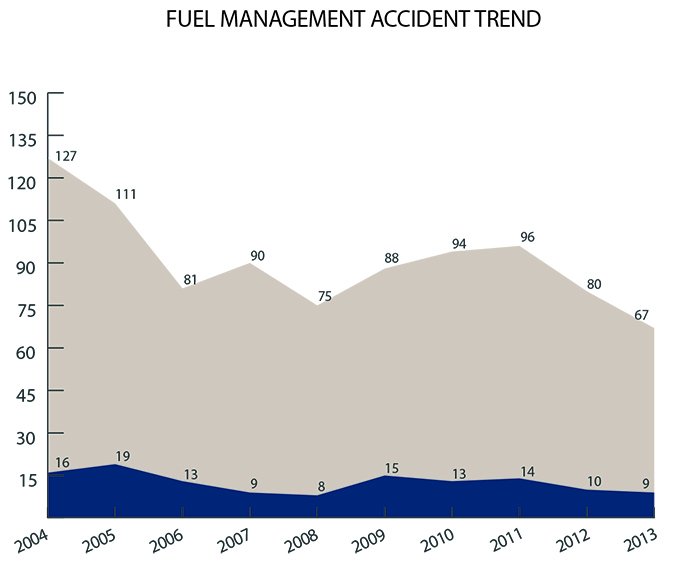


The good news about fuel-related accidents is they seem to be stable in occurrence year over year, and perhaps trending slightly downward. It’s a bit too soon to tell if a recent downturn is an aberration or the new normal, but we’ll know more in a couple of years. The bad news is they continue to be preventable. In fact, a thorough understanding of the fuel system for the aircraft you fly is critical to further minimizing these kinds of accidents. Perhaps unsurprisingly, the three basic categories of fuel-related accidents—planning, systems operation and contamination, according to the AOPA Air Safety Institute’s 25th Nall Report—seem to occur more frequently as aircraft system complexity increases.
According to the Nall Report, “Retractable-gear and multiengine models made up 45 percent of the airplanes involved in fuel-management accidents. This is more than one and a half times their proportion of non-commercial fixed-wing accidents overall, in which they accounted for less than 30 percent.” In other words, when an airplane is equipped with multiple fuel tanks, multiple engines, boost pumps, transfer pumps and switchable gauges, the opportunity for mistakes grows. Let’s see if we can simplify things.

