














WATCH: NASA’s Supersonic X-59 Pushes the Envelope

Researchers are validating the aircraft’s performance before propelling it to supersonic speeds.

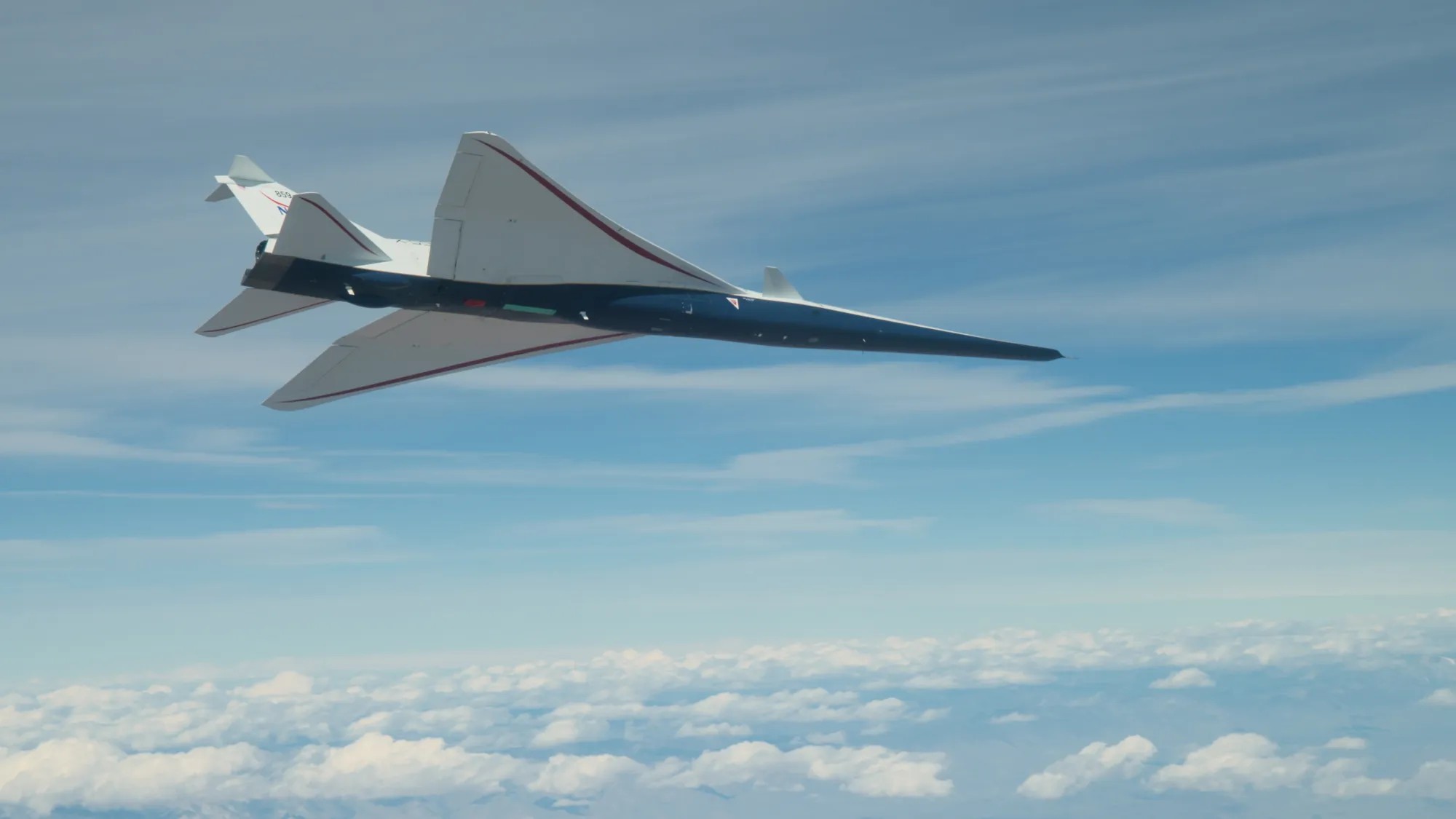
NASA Lockheed Martin X-59 experimental supersonic test aircraft
The X-59 conducts a bank-to-bank autoroll maneuver during a recent test flight in California. [Credit: NASA/Lori Losey]
Gemini Sparkle

Key Takeaways:

  • The NASA and Lockheed Martin X-59 is an experimental supersonic aircraft designed to achieve a "sonic thump" instead of a loud sonic boom.
  • The aircraft is currently undergoing envelope expansion testing, performing various maneuvers to validate its performance before reaching its target speed of Mach 1.4.
  • The project's ultimate goal is to gather public feedback on its quiet noise levels through community surveys, aiming to provide regulators with the data needed to potentially overturn the ban on overland supersonic flight.
See a mistake? Contact us.

NASA and Lockheed Martin’s experimental supersonic X-59 is demonstrating that envelope expansion testing is about more than flying faster and higher.

Ultimately, the goal is to bring the aircraft to a speed of Mach 1.4 and altitude of 55,000 feet, under which conditions it is expected to produce a “sonic thump,” or quiet sonic boom. A planned community survey of the X-59’s noise levels could give regulators and lawmakers the evidence they need to chart a return to commercial supersonic flight.


But before pushing the aircraft to its intended limits, researchers have been conducting an array of maneuvers over California’s Mojave Desert to validate its performance. NASA shared some of these in a video on Thursday.

Credit: NASA

The X-59’s debut flight on October 28 lasted over an hour and was the first test of its performance. A second flight on March 20 ended “prematurely” before the aircraft hit its intended targets of 260 mph and 20,000 feet, due to a “return-to-base call,” NASA said.

After a brief hiatus that began April 14, the X-59 returned to the skies last week. Per Lockheed, as of April 28, it had flown more than 11 hours across 10 test flights, reaching a top speed of Mach 0.95, altitude of 43,000 feet, and peak endurance of about 1.7 hours.

Per FlightAware, it made three more flights in the past week since then, two Thursday and one Tuesday morning. ADS-B Exchange flight history shows that the test flights are typically spaced every other day.

NASA told FLYING that as of Tuesday, the X-59 has completed 13 flights.

Now we know what the experimental aircraft has been up to.

NASA uses chase planes, such as a pair of F-15 Eagles, to capture imagery of the X-59 in flight. Around the 20-second mark of the video released Thursday, the aircraft can be seen conducting a “roller-coaster” maneuver, pitching up and down like an amusement park ride. The test is intended to evaluate stability and control.

To further measure handling, X-59 test pilots extended the aircraft’s landing gear at controlled airspeeds, introducing variations in drag, pitch, vibration, and airflow. That can be seen around the 2:12 mark.

About 30 seconds into the video, the X-59 completes a bank-to-bank autoroll, tipping its wings from side to side in a gentle shimmy. A pilot—whose perspective can be seen at the 57-second mark—communicates “right turn, left roll” before smoothly but quickly rolling back to the right.

A flutter excitation maneuver, visible at the 1:42 mark, saw researchers introduce intentional vibrations to gauge safety margins across the flight envelope. To test longitudinal stability, pitch response, and trim characteristics, teams used a wings-level push maneuver. At the 1:55 mark, viewers can see the pilot angle the X-59’s nose down before leveling off.

To watch the aircraft come in for a landing, skip ahead to the 2:45 mark.

What’s Next for the X-59?

The primary goal of the X-59 envelope expansion phase, which officially began last week, is to test the aircraft’s performance under both high-and-fast and low-and-slow conditions.

Once they feel comfortable, NASA and Lockheed will push it past the sound barrier to its intended speed of Mach 1.4—or more than 1,000 mph—and altitude of 55,000 feet. After that, it will head to the supersonic test range at Edwards Air Force Base (KEDW) in California, where NASA will validate its sonic boom-cancelling capability.

Unlike Boom Supersonic’s XB-1 supersonic prototype, which creates a normal sonic boom but is designed to prevent sound waves from reaching the ground, the X-59 aims to reduce noise at the source.

The most eye-popping feature is the X-59’s Pinocchio-esque nose that extends about one-third of its nearly 100-foot length. The long nose is designed to disperse shock waves in front of the aircraft. It also blocks the pilots’ view in the cockpit, requiring windows to be replaced by an external vision system that feeds imagery from high-resolution cameras to a monitor.

A modified, top-mounted F-18 Super Hornet F414-GE-100 engine gives the X-59 a smooth underbelly to break up shock waves in its wake. The airframe is composed primarily of aluminum. Other flight-proven components include life support systems from the F-15, landing gear from the F-16 Fighting Falcon, control stick from the F-117 Nighthawk, and cockpit canopy from the T-38 Talon.

Ultimately, the X-59 will be vital to NASA’s effort to help regulators such as the FAA chart a future for supersonic flight over land, which has been banned in the U.S. since 1973 due to noise concerns.

Concorde, retired in 2003, is history’s only successful commercial supersonic airliner—and successful might be an exaggeration. But Boom and a handful of other manufacturers are angling for a return to travel at the speed of sound. The White House last year even ordered the FAA to reverse its ban.

Once the X-59 is ready, NASA will conduct five one-month surveys in locations across the country, during which people below the flight path could hear sonic booms—or not—close to 80 times.

If Americans are sufficiently unbothered by the noise, the effort could convince lawmakers and regulators to reconsider the FAA’s ban. NASA is coordinating to share survey results with the FAA and International Civil Aviation Organization (ICAO) to harmonize standards globally.

The idea is that the X-59’s design choices could be replicated by commercial developers. However, Boom at least plans to stick to its own noise mitigation strategy, which it has dubbed “Boomless Cruise.”

Jack Daleo

Jack is a staff writer covering advanced air mobility, including everything from drones to unmanned aircraft systems to space travel—and a whole lot more. He spent close to two years reporting on drone delivery for FreightWaves, covering the biggest news and developments in the space and connecting with industry executives and experts. Jack is also a basketball aficionado, a frequent traveler and a lover of all things logistics.

Ready to Sell Your Aircraft?

List your airplane on AircraftForSale.com and reach qualified buyers.

List Your Aircraft
AircraftForSale Logo | FLYING Logo
Pilot in aircraft
Sign-up for newsletters & special offers!

Get the latest stories & special offers delivered directly to your inbox.

SUBSCRIBE
