













VFR Corridors

Many Class B or C airport have special VFR routes charted to help us get around or through them. Sometimes, IFR is easier.

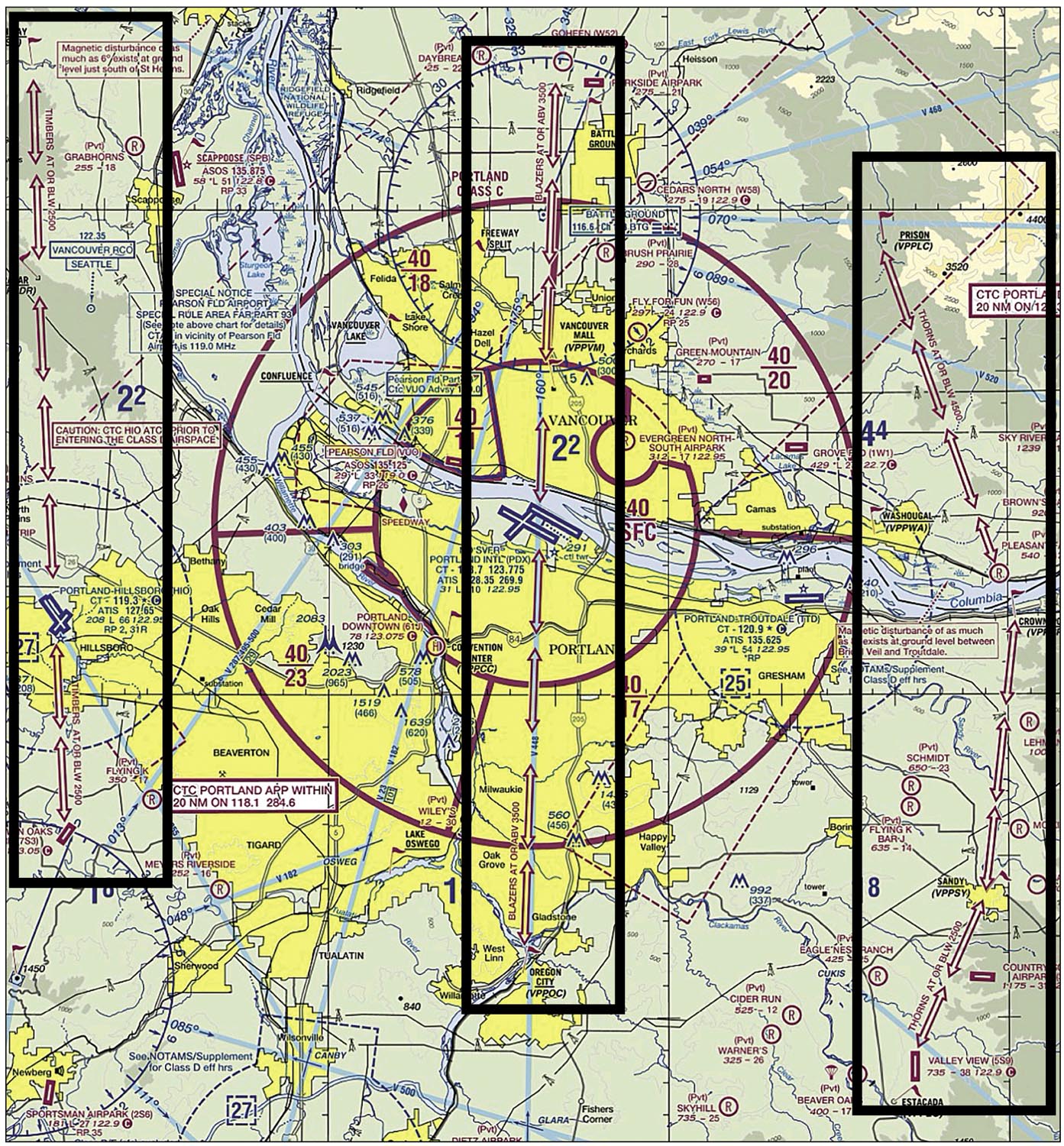
The transition routes for the Portland International Airport (KPDX) are shown within the black-bordered rectangles in this chart excerpt. All three of them—Timbers, Blazers and Thorns, from left to right—provide an organized way to get from the top portion of the chart to the bottom, and vice versa, but do nothing for an east/west transition. Also, the Portland-Hillsboro Airport, at the south end of the Timbers Transition, has its own Class D and an entry in the Chart Supplement’s special notices section for “intensive flight training.” And if you’re planning to use the Pearson Field Airport (KVUO) across the river in Vancouver, Wash., it has its own special flight rules area, thanks to its proximity to KPDX.
Gemini Sparkle

Key Takeaways:

  • Navigating busy Class B/C airspace under VFR can be complex and stressful due to high traffic and intricate boundaries.
  • Pilots should utilize charted VFR transition routes available for many Class B/C airports, which simplify navigation and facilitate safe coordination with ATC.
  • Thorough pre-flight planning, including identifying and programming these routes, is essential; in some complex scenarios, filing IFR may be a simpler and safer option than VFR.
See a mistake? Contact us.

It seemed like an easy flight, ferrying a King Air B200 from Mesa, Ariz. (KIWA), to Scottsdale (KSDL), two airports near Phoenix (KPHX). It was a beautiful VFR day. I’ll fly VFR! With a little work I picked a route that went outside of, and then under, the Phoenix Class B airspace. There were some Class D areas to avoid, too. I programmed some waypoints, double-checked the altitudes, and, in the only good decision of the morning, decided to fly at a much slower airspeed than the airplane’s capabilities and the regulations allowed.

There were airplanes almost everywhere. The places with no airplanes were filled with helicopters, balloons and mountains. I did not have enough eyes. I needed to look outside for traffic. I needed to look at charts inside to make sure I avoided the airspace. I needed to look into my soul to try to understand how I could have made such a poor decision: I should have filed IFR.


The black rectangle-bordered Tampa Terminal Area Chart excerpt highlights the “Bridge Transition,” a published way to get across TPA’s Class B airspace. You’ll be in the Bravo, but flying the depicted route, so ATC will know who and what you are. After being cleared for the transition, just fly the TPA Runway 10/28 centerline.

Charting Charlie And Bravo

Where is the Class B or Class C airspace nearest your home field? It could be dozens, or hundreds, of miles away. If the airspace is close by, you probably know how to get through it safely and with minimal fuss because pilots pass that lore by word-of-mouth when hangar flying. If it’s far away, or you are on a long cross-country, you may well have no idea how to get through. By definition, this is busy airspace, and while there are never any guarantees, without ATC help the risk of a bad scare or even a collision rises.

To help pilots and controllers out, most Class B and many Class C airports have charted VFR transitions. These are on sectional and terminal area charts, but not on IFR charts. Remember, charts change, and current charts are absolutely necessary.

Some of the charts are difficult to find. In Foreflight’s Documents folder, to name one, look for “Visual Chart Supplemental” charts in the FAA section. You can look at these by tapping on them in the Documents list.

A few Class B airports also have “U.S. VFR Flyway” charts. Some appear as such in the Layers tab. Many busy terminals have FLY charts. There are probably other ways to find these charts. All of this will probably change with the next update to your charting app. When a chart is hard to find I take a screenshot. That makes it easy to find again.

Doing It The Hard Way

My closest Class C is KPDX. I have had many flights through that airspace, almost all IFR in well-equipped cabin-class twins or turbine aircraft. I recently set for myself the challenge of flying the airspace in the lowest-performance airplane I could get my hands on—a steam-gauge Cessna 150—using handheld avionics. I had a GPS/ADS-B receiver and a tablet paired to it running Foreflight. This airplane only has ADS-B out.

Portland has three charted VFR transition routes, each named after a local sports team. (What’s with ATC and sports? I grew up near the Bosox intersection outside of Boston.) These are only a couple of years old, and local pilots told me that before the transitions were charted, ATC usually had north- and southbound VFR airplanes cross KPDX at mid-field.

The Blazers transition does just that, saving you and controllers from detailing and verifying the route. The altitude is specified “at or above 3500.” The top of the Class C is at 4000 feet msl, so sometimes one can overfly the airspace without talking to ATC. But the whole point is to let ATC know that you are there and what your intentions are so they can point out traffic or other factors that may affect you.

The transition routes for the Portland International Airport (KPDX) are shown within the black-bordered rectangles in this chart excerpt. All three of them—Timbers, Blazers and Thorns, from left to right—provide an organized way to get from the top portion of the chart to the bottom, and vice versa, but do nothing for an east/west transition. Also, the Portland-Hillsboro Airport, at the south end of the Timbers Transition, has its own Class D and an entry in the Chart Supplement’s special notices section for “intensive flight training.” And if you’re planning to use the Pearson Field Airport (KVUO) across the river in Vancouver, Wash., it has its own special flight rules area, thanks to its proximity to KPDX.

The other transitions are well east or west of the Class C airspace, so no contact with Portland approach is necessary. Both are charted “at or below 2500.” The east transition is in relatively quiet airspace, and KPDX arrivals are usually well above 2500 msl in that area. The west transition is a different matter, because it goes through an area with lots of flight training and passes through the Class D airspace for Hillsboro, a very busy GA airport.

There is an additional problem with the Blazers transition. The northbound course is 340 degrees magnetic, so by the hemispherical rules the lowest available VFR altitude is 4500 msl. The lowest cloud layer must be a little above 5000 msl, because of VFR cloud separation requirements. That can be a problem on some days, even if the weather is “good VFR.” Southbound, one can fly at 3500 msl. Pilots may request a different altitude—in this area, 3000 feet msl is below the altitude where the hemispherical rules apply — but ATC might not let you, depending on their big picture.

As we neared the entry waypoint from the south, we called Portland approach and requested the Blazers transition at 4500. The reply was a squawk code, “radar contact,” and “altitude your discretion.” There was a handoff midfield over KPDX, and the new controller asked our destination. “Resume own navigation, altitude your discretion.” As a courtesy—courtesy goes a long way with ATC—we informed them when we started our descent and heard, “Squawk VFR, frequency change approved, numerous targets in the vicinity of the destination.”

It was easier than IFR. There was very little need to talk. That’s the point: it was easy and safe.

Still, part of the ease was that it was close to home. The airspace was familiar and the routes are on the charts I look at every time I fly. Things get more complicated when you are on a long cross-country that goes near Class B airports. In the western U.S., the combination of low performance, high terrain and military airspace can force you to go through the Class B. You’re not going above it in a Cessna 150: the Las Vegas Class B goes to 10,000 msl and Salt Lake City’s goes to 12,000.

A pilot passing through these areas might try to piece together a route that squeezes between the mountains and the Class B, but studying the chart that closely while hand-flying a Cessna 150 on a bumpy afternoon might actually be impossible without a second pilot to share the workload.

The easier method is to study the charts during preflight planning, find the charted route, and program it into the electronic gizmos. Then approaching, say, Salt Lake City, call on the published frequency and request, say, the I-80 Transition. ATC will reply with a squawk code, “radar contact,” a Class B clearance, and an altitude. I’ve done this dozens of times and have never had a problem.

Salt Lake used to use an unpublished route that locals knew but aircraft passing through found difficult to navigate. The landmarks weren’t charted. Now the route is charted as the Mountain Road transition with visual waypoints that are probably in your database. It takes real work to change a VFR chart—one specialist compared it to an “act of Congress”—so a big thank you to whoever did the work.

Bringing this tale full-circle, there now are some routes charted to circumnavigate the KPHX area, but they all are below the Class B airspace tiers. Sometimes, filing IFR, if you can, is actually easier to get from one side of Bravo airspace to the other than VFR.

[su_box title=”The Washington, D.C., Special Flight Rules Area” box_color=”#e5eaef” title_color=”#273957″ radius=”6″]

Washington, D.C., Special Flight Rules Area Airspace around the nation’s capital, for security reasons, has different and more stringent rules. The area within 60 nm of the DCA Vortac is designated a Special Flight Rules Area (SFRA). The routes and procedures for this area are complicated and everyone expects that pilots will fly precisely. Special training, available online, is required to go into this area VFR. You need to do this before takeoff. Among other features—like F-16s—there is also a system of ground-based visual aids to warn pilots after entering the airspace without clearance.

The course is required by regulation. You’re not required to carry proof of completing it with you, but it’s a good idea. You never know. I did the training in 2016, and have yet to use it. Even though there is no expiration date, and since the course has been updated, I would do it again, maybe twice, if I were planning to fly anywhere near the Capital, if for no other reason that to make sure I had seen the most recent version.

The DC SFRA offers options for charting, including the Washington sectional and its terminal area chart. An eastern portion of the Washington FLY chart is excerpted at top, and includes some VFR routes under the Class B airspace. The bottom chart excerpt also is from the FLY chart and includes the SFRA warnings.

To take the required course, visit the FAA’s FAASTeam website, faasafety.gov.

[/su_box]

Ready to Sell Your Aircraft?

List your airplane on AircraftForSale.com and reach qualified buyers.

List Your Aircraft
AircraftForSale Logo | FLYING Logo
Pilot in aircraft
Sign-up for newsletters & special offers!

Get the latest stories & special offers delivered directly to your inbox.

SUBSCRIBE