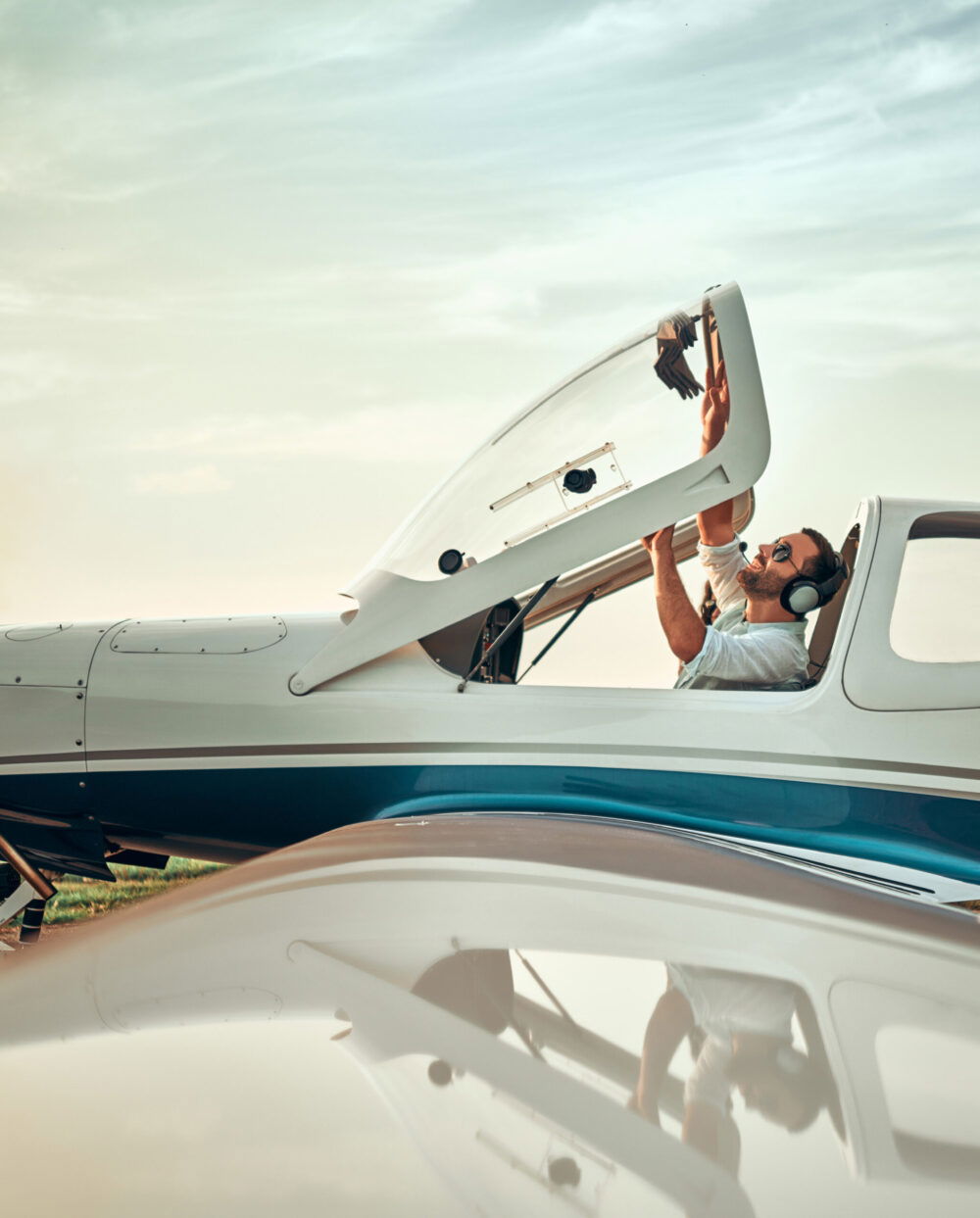
![It’s important to know how to do a go-around. [Credit: Meg Godlewski]](https://flyingmag1.b-cdn.net/wp-content/uploads/sites/2/2023/04/VFR-into-IFR-smoke-scaled-e1681249141756.jpg?width=1200&height=900)


I had a pretty good idea what the day was going to be like when we were No. 3 for takeoff at the nontowered airport and it wasn’t quite 10:20 a.m. on a Sunday. The sky over the airport was clear—to the east was a layer of clouds, and to the south a layer of fog.
That bright yellow thing that infrequently appears in the sky over Seattle in the winter was in the sky, and like it always does, brought out the pilots in droves.
The learner was an instrument candidate. The syllabus called for basic attitude flying and partial panel navigation. We headed to the practice area, he donned the hood, and we kept an ear on traffic in the area by monitoring the practice area frequency and played our part by reporting our location and intentions on frequency.
Soon we were not the only ones, and the transmissions were excellent realistic distractions: “Southeast practice area (tail number) over (landmark) (altitude) (maneuvers being done)” was heard frequently. There was some give and take as those on instructional flights climbed to higher altitudes or moved farther to the north or south to give other aviators more space to do their airwork.
- READ MORE: Why Continuous Learning Is Crucial for Today’s Pilots
- READ MORE: Find It by Feel: A Pilot’s Essential Cockpit Lesson
After an hour plus change of airwork, we headed back for a landing. It took three tries to get it on the ground— not because of poor technique or an unstabilized approach but because of how busy the pattern was. There’s a reason we learn, practice, and teach go-arounds.
Also known as a “balked landing,” a go-around is a rejection of the landing. If the approach is unstable, go around. If you are too fast, go around. If you’re at a towered airport and the tower tells you to, go around. At a nontowered airport it’s often at the pilot’s discretion. If there’s another aircraft on the runway, go around. Don’t guess that it will move in time.
For an instrument candidate, a balked landing in VMC conditions is a bit of a treat. Most of your IFR approaches terminate in either full stop or the published missed approach. For the unfamiliar, the “published missed” spells out the procedure as in the heading you’ll fly and altitude you’ll climb to.
The missed approach sends you to a fix that, with the help and blessing of ATC, can put you in a position to do the approach again and land, hold waiting for traffic to clear, or divert to another airport. Other times ATC tells you where to go—in a good way. See and avoid is also required in IMC conditions, but the “see” part is more difficult when you’re in the clouds.
The VMC go-around, especially at a pilot-controlled airport, means climbing away from the runway and cleaning up your aircraft as you climb out, watching out for the other airplane that just lifted off while being careful not to climb into traffic that may be overflying the field to set up for the 45 into the pattern. Usually you want to offset to the side that gives you the ability to keep visual contact with the aircraft that has just lifted off but doesn’t put you nose to nose with aircraft on downwind.
Knowing what kind of traffic you’re following and if there’s a possibility you’ll overtake them is also key. Bonus points to the pilots of the larger, faster airplanes who self-identify as such, “twin Piper” or “twin Cessna” letting us single-engine pilots know who’s in the sandbox with us.
This particular day we were No. 3 on downwind. We could see the Cessnas from one of the flight schools ahead of us and other aircraft to the west maneuvering for the 45. In addition, there were two helicopters from another flight school churning up the pattern. In short, this pattern would be “festive,” a CFI euphemism for an event that has the possibility of creating a task saturation for the pilot due to the need for extreme situational awareness.
Checklists were applied. Radio calls were made. The pattern was flown with precision. Another voice jumped on the frequency and asked for a pilot or two to extend their downwind to allow some of the aircraft holding short of the runway (three were) a chance to take off.
As the learner rolled onto final, announcing his distance from the runway (farther out than normal as a result of a long downwind for spacing), we heard a discussion between two aircraft over which one of them was taking off first. There were a few transmissions. It was the classic Pacific Northwest “you go…no, you go” moment as we continued on final, and rather than join the fracas, my learner announced, “We’re going around,” in his Dad voice. And we did.
Pitch up, power up, clean up, climb up, fess up—in that order.
Another pattern flown. We noted another aircraft west of the airport doing a 360 turn to avoid crowding the 45 into the pattern. The learner was doing great, and it looked like we’d be landing when we were on short final and an aircraft pulled on to the runway for takeoff. We wondered if the pilot on the ground was sitting in that one spot along the hold short line where, when you look down final, your view is blocked by the corner of the fence. No matter. Go around again.
We had plenty of fuel, so I was not worried. I am happy to say the third time was the charm. We made it down and cleared the runway. I must say the coordination and communication between the pilots was good that day—and learning took place.