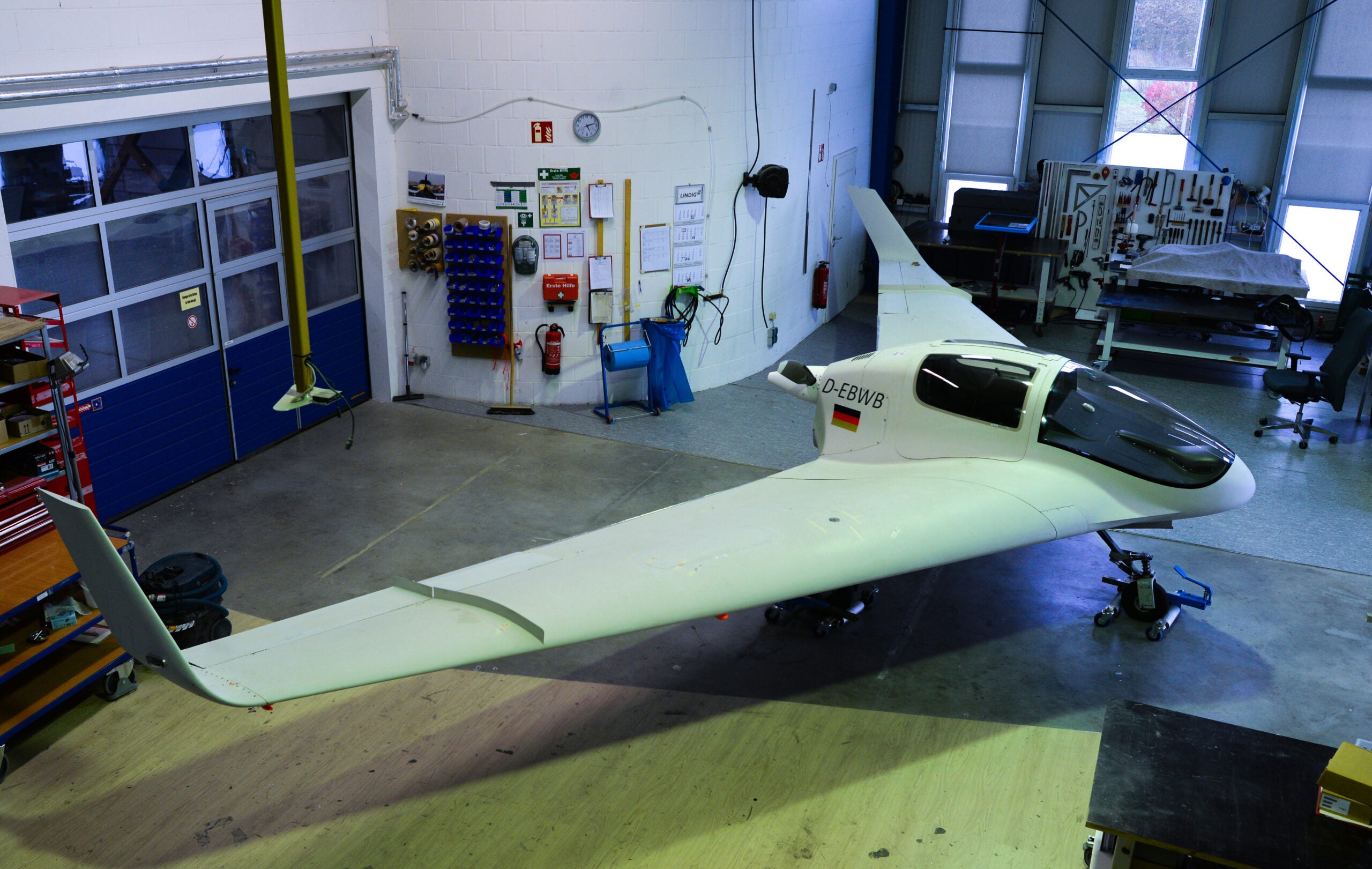
The flying wing was most recently marketed as an ideal platform for unmanned operations with a potential range of 2,175 miles or an endurance of 20 hours.
The sole Horten HX-2 awaits its next test flight in October 2019. [Courtesy: Jason McDowell]
Key Takeaways:
The Horten HX-2 is a unique, small, manned flying wing with a lineage tied to aviation pioneer Reimar Horten, representing a rare aircraft type.
It offers significant advantages for private aviation, including exceptional fuel efficiency (32.8 mpg), stable center of gravity despite generous internal volume, and good crosswind handling.
Envisioned for diverse future applications like kit versions, air taxis, hydrogen power, and unmanned operations, its development has stalled since 2020, with hopes for revival pending new investment.
Cool as they are, flying wings are exceedingly rare.
Among the two dozen or so individual models that have been built over the years, only a few types have been produced in quantities of more than two or three. Fewer still were both manned and powered, and the small Horten HX-2 is a member of that exclusive group.
CREATE A FREE ACCOUNT
Sign up to keep reading
Create a free account to continue. Already a member? Sign in below.
Jason McDowell is a private pilot and Cessna 170 owner based in Madison, Wisconsin. He enjoys researching obscure aviation history and serves as a judge for the National Intercollegiate Flying Association. He can be found on Instagram as @cessnateur.