













Register

The Thunderstorm

Let’s take a fresh look at storms to be ready as winter winds down and we anticipate an active storm season ahead..

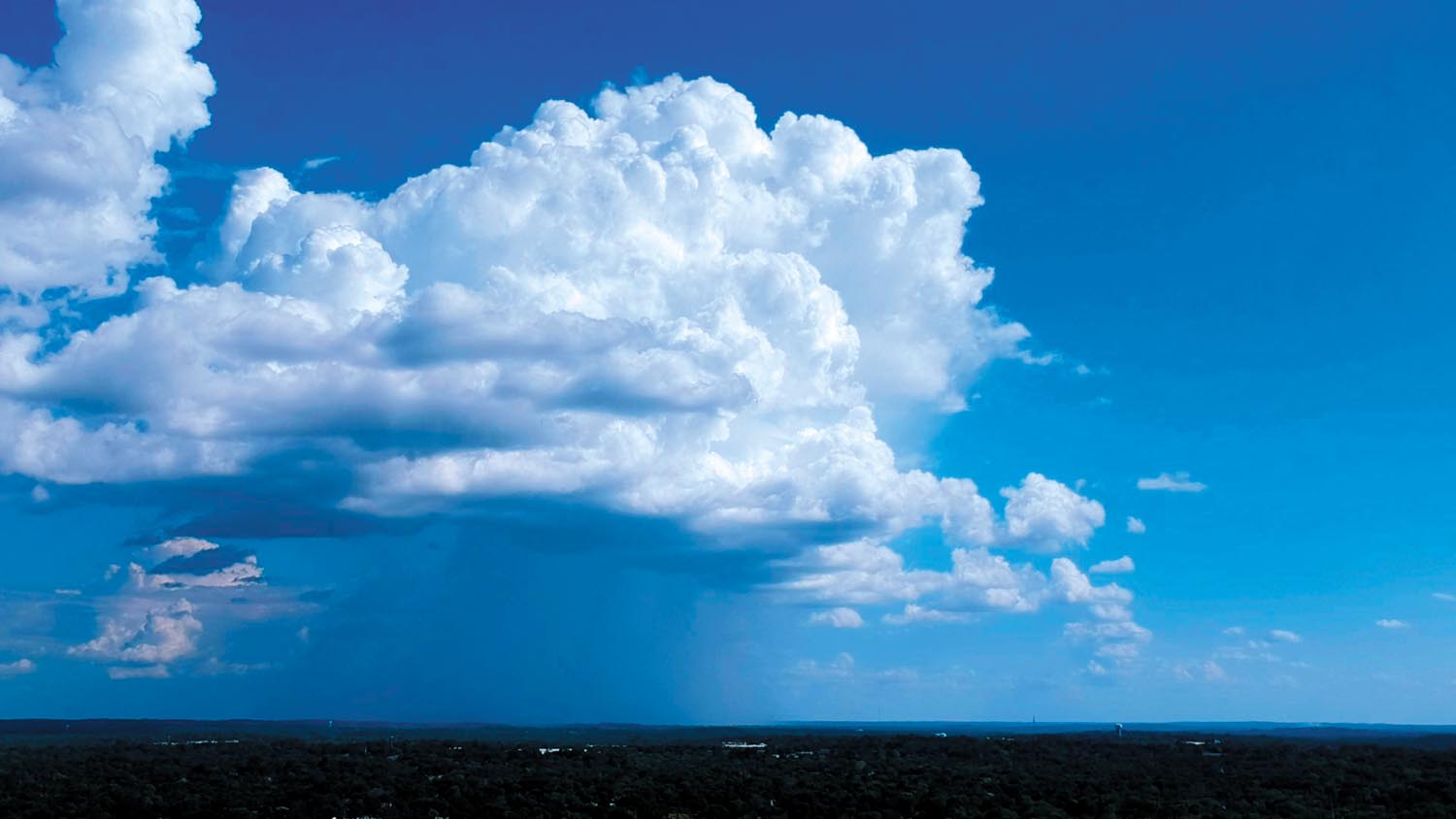
This small convective shower is made up of a towering cumulus cloud (foreground) and downdraft and precipitation (background).
Gemini Sparkle

Key Takeaways:

  • Thunderstorms develop through an updraft (cumulus to cumulonimbus) leading to precipitation, which then creates a downdraft and an outflow, potentially forming gust fronts, microbursts, or downbursts.
  • Pilots can assess a storm's strength and organization by observing visual cues such as the anvil cloud's volume, backshear, and the characteristics of the updraft base.
  • Storms can evolve from simple single-cell structures into more complex and severe organized systems like multicell clusters, squall lines, and supercells, with the latter featuring a rotating mesocyclone.
  • Anticipating severe weather fundamentally depends on two atmospheric conditions: instability (measured by CAPE) which drives vertical motion, and wind shear (bulk shear for longevity, and storm-relative helicity for tornadic potential, often indicated by backed flow).
See a mistake? Contact us.
This small convective shower is made up of a towering cumulus cloud (foreground) and downdraft and precipitation (background).

Turning the chapter from winter to spring, we brace ourselves for a new season of severe weather and all the familiar elements of hail, wind, and tornadoes. In the weather community, lead forecasters, warning coordination meteorologists, and local spotters all have an annual rite of preparation for the upcoming severe-weather season. It’s a good idea for pilots to follow suit and refresh what they know about this capricious hazard, especially those who have that all-important instrument rating. If I, a seasoned forecaster, can find more to learn about thunderstorms and severe weather every year, perhaps you can, too.

Convection, Updraft

Learning about the storm need not be complicated. We can get tremendous insight into thunderstorms by using the single-cell thunderstorm as a conceptual model. It all starts with an updraft. This can originate from the rising thermal produced by solar heating, or from lift embedded within a nimbostratus cloud. For simplicity’s sake, we normally consider the rising thermal under a hot sun. This grows into a cumulus cloud as the air cools to its dewpoint temperature and saturation occurs. If the lapse rate, or the existing temperature change with height, is sufficiently strong and enough moisture is present, the cumulus cloud will grow vertically into a towering cumulus. It can then evolve further into a cumulonimbus cloud.


Ready to Sell Your Aircraft?

List your airplane on AircraftForSale.com and reach qualified buyers.

List Your Aircraft
AircraftForSale Logo | FLYING Logo
Pilot in aircraft
Sign-up for newsletters & special offers!

Get the latest stories & special offers delivered directly to your inbox.

SUBSCRIBE