














Senior leaders of Tesla, SpaceX, Anduril, and AI firm Physical Intelligence are pouring money into an Indian startup that believes it can unlock drone deliveries for as little as 1 cent.
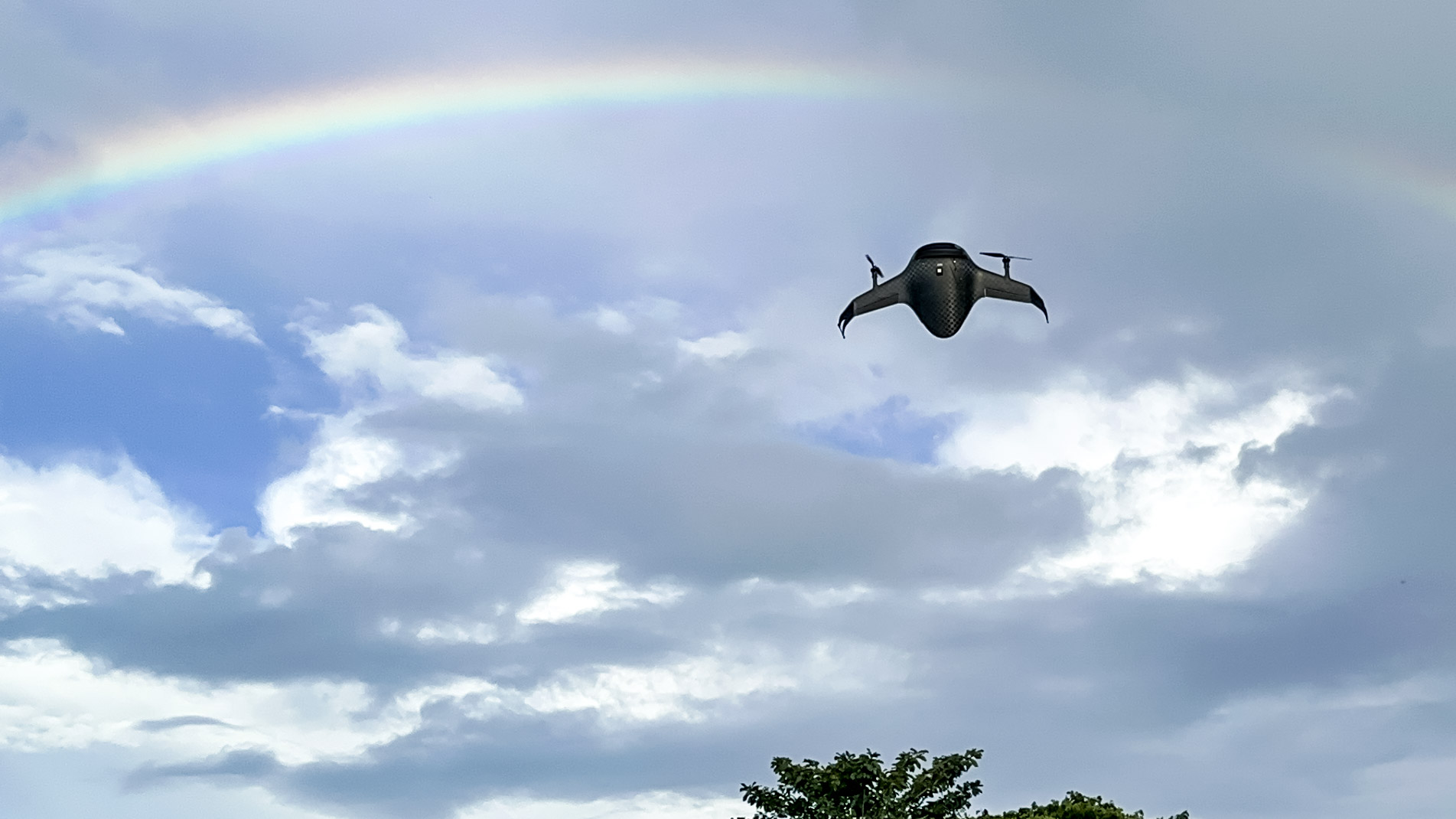
Airbound, which is developing a blended-wing-body (BWB) tail-sitter drone called the TRT, on Tuesday announced it raised more than $8.5 million in seed funding. The startup’s aim is to lower drone delivery costs to the point that geographic distance becomes “irrelevant,” it said in a news release.

As part of that effort, Airbound recently launched a three-month pilot program with India’s Narayana Health. It plans to complete 10 deliveries per day of medical tests, blood samples, and other supplies.
“The healthcare sector represents the perfect testing ground for our technology because it demands both reliability and efficiency,” Naman Pushp, the 20-year-old founder and CEO of Airbound, said in a statement.
The pilot with Narayana Health is intended to validate Airbound’s proof-of-concept in real-world testing conditions ahead of an “expansion into broader logistics applications” such as food delivery. The company anticipates widespread adoption of the TRT by 2026, with a move into the U.S. market in the next three years.
Changing the Drone Calculus
The most popular delivery drones in service typically feature multiple propellers for vertical takeoff and landing (VTOL). Zipline’s Platform 2 (P2) and Wing’s flagship drone, for example, combine fixed wings with arrays of rotors and propellers. Amazon Prime Air’s MK30, which like the TRT is a tail-sitter, also includes several propellers.
Conversely, the TRT has just two propellers. The BWB model takes off like a rocket, but removing propellers keeps the drone’s lift-to-drag ratio high so that it does not sacrifice efficiency in forward flight, Pushp told online news site TechCrunch.
Another advantage, per Airbound, is that the TRT can launch or land “anywhere,” with no need for ground infrastructure such as runways, launchpads, or charging stations. Human intervention is not required to dock, load, or launch it.
The drone has a range of about 25 miles and cruise speed of about 37 mph. In the air, onboard autonomy and precision navigation systems help it combat inclement wind or weather. Powered by lithium-ion batteries, the TRT produces about 60 decibels of noise in operation, per Airbound. According to Pushp, replacing the batteries is the largest cost of operating the model.
Key to the TRT’s low delivery cost is its rare payload-to-aircraft mass ratio. A lightweight carbon fiber frame gives the drone a gross weight of about 3.3 pounds, yet it can carry up to 2.2 pounds of payload. By reducing the total weight, Pushp told TechCrunch, Airbound can reduce energy costs per kilometer by a factor of 20, making one-cent delivery feasible. The energy cost for electric scooters in India, he said, is about 2 cents per kilometer.
Right now, Pushp said, it costs Airbound about $2,000 to produce a drone and about $0.27 per delivery. But the goal is to reduce that to about 5 cents by the end of 2026. By mid-2027, the company aims to achieve 1 million deliveries per day by increasing its daily manufacturing capacity from one to 100 units.
Pushp told TechCrunch the company is developing a second model weighing 2.6 pounds that could carry up to 6.6 pounds of payload. A prototype is expected to fly next year, with production beginning in early 2027.
What Does a Drone Delivery Cost?
Drone operators are largely tight-lipped about their delivery costs. But for comparison’s sake, Walmart offers free Wing and Zipline drone delivery to Walmart+ members, charging nonmembers about $20 per delivery.
DoorDash, which offers delivery from Wing and Flytrex, is waiving its drone delivery fee, per Axios. And Zipline, which in August launched a partnership with Chipotle, is charging a $2.99 delivery fee and 15 percent service fee on those orders.
Per a January 2023 report from McKinsey, the average package drone delivery costs about $13.50, though that figure assumes labor represents about 95 percent of the total cost. That’s in part due to the FAA requirement to have visual observers keep an eye on the drone, which Zipline, Wing, and others have waived. Another factor is that in most cases an operator can only oversee one drone at a time.
The landscape could change with the adoption of the FAA’s proposed Part 108 rule, which would simplify the process for authorizing beyond visual line of sight (BVLOS) operations outside the view of a human observer. The rule could also allow a single operator to manage multiple drones. According to McKinsey, delivery costs could fall to as low as $1.50 with a ratio of 20 drones per pilot.
Until that day arrives, the entrance of a competitor like Airbound threatens to undercut U.S. operators. However, recent White House executive orders aim to prop up domestic manufacturers and increase scrutiny on foreign drone companies. While primarily targeted at Chinese firms such as DJI, the directives could impact manufacturers in other countries deemed to pose a national security threat.

