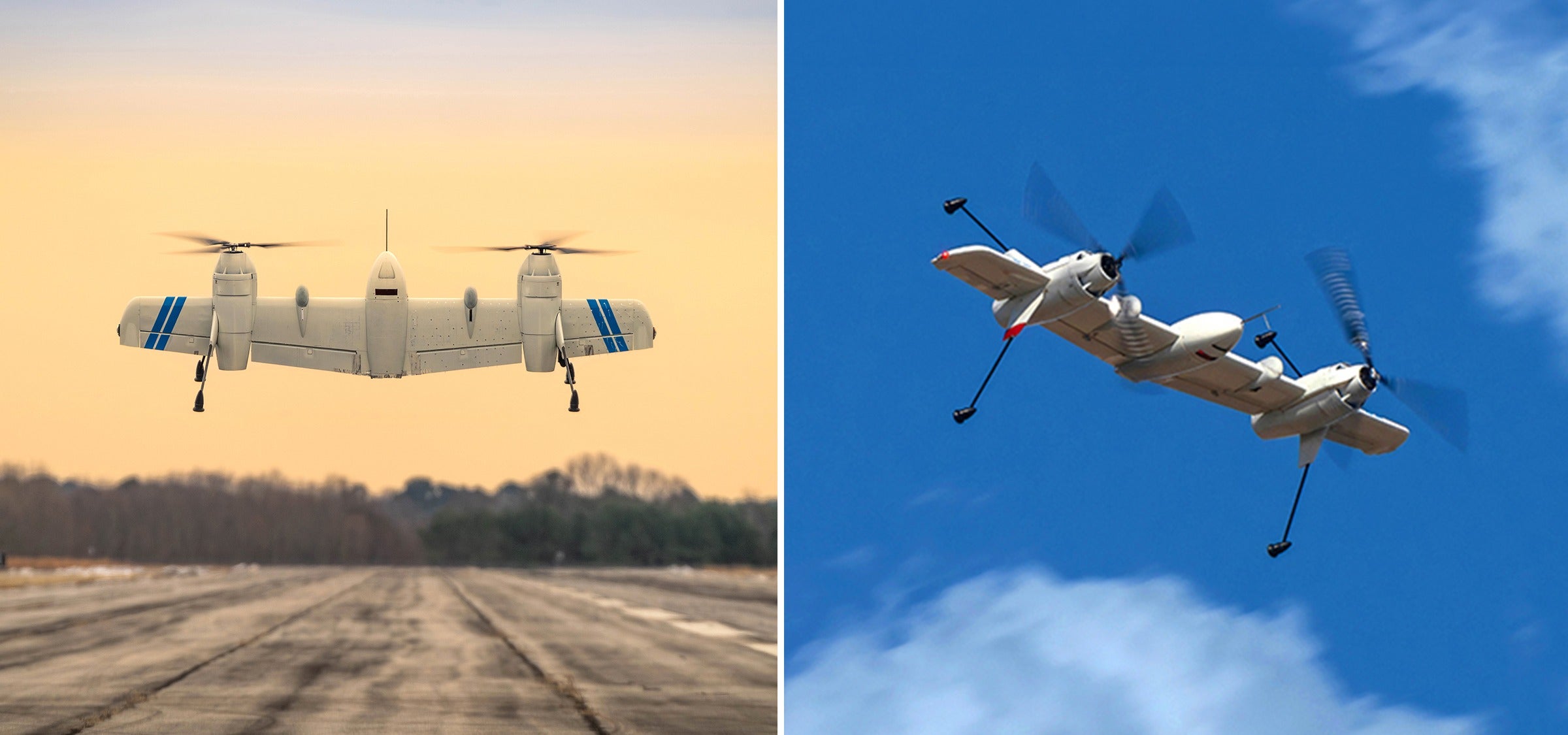


Lockheed Martin’s Sikorsky has successfully flown its “rotor blown wing” uncrewed aerial system in both helicopter and fixed-wing flight modes, it announced Monday.
The 115-pound twin-prop drone with a 10-foot wingspan takes off and lands like a helicopter from a tail-sitting configuration, transitioning and cruising in forward flight like an airplane. The “rotor blown wing” term stems from the constant airflow from the proprotor wash across the wing, according to the company.
The drop prototype “demonstrated operational stability and maneuverability across all flight regimes,” the company said. The aircraft also demonstrated that its vertical takeoff and landing (VTOL) design has potential to be scaled to a larger size, it said.
“Combining helicopter and airplane flight characteristics onto a flying wing reflects Sikorsky’s drive to innovate next-generation VTOL UAS aircraft that can fly faster and farther than traditional helicopters,” Rich Benton, Sikorsky vice president and general manager, said in a statement.
Around a year ago, Sikorsky Innovations—the company’s rapid prototyping arm—began design work on the drone and by January had achieved more than 40 takeoffs and landings.
“Notably, the aircraft performed 30 transitions between helicopter and airplane modes, the most complex maneuver demanded of the design,” Lockheed Martin said. “In horizontal flight mode, the aircraft reached a top cruise speed of 86 knots.”
Added Igor Cherepinsky, director of Sikorsky Innovations: “Our rotor blown wing has demonstrated the control power and unique handling qualities necessary to transition repeatedly and predictably from a hover to high-speed wing-borne cruise flight, and back again. New control laws were required for this transition maneuver to work seamlessly and efficiently. The data indicates we can operate from pitching ships decks and unprepared ground when scaled to much larger sizes.”
The design is simple, can be reproduced quickly and affordably, and has potential applications from naval ships, unprepared surfaces, search and rescue operations, firefighting monitoring, humanitarian relief responses and pipeline surveillance, the company said. Larger variants could be deployed for military intelligence, surveillance and reconnaissance flights, as well as piloted drone teaming.