Register

Search Results for: wright

Charts & Plates

BasicMed Checkup

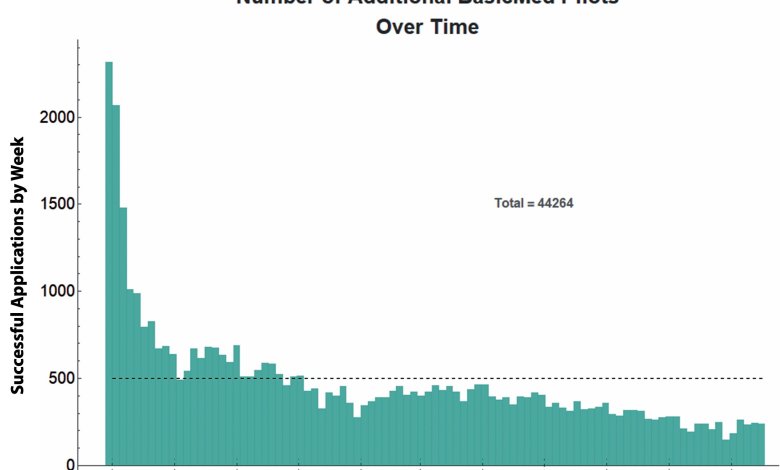
BasicMed is the result of a legislative initiative that produced Public Law 114-190, the FAA Extension, Safety, and Security Act of 2016, signed into law on July 15, 2016. BasicMed (a term that came later) is found in Section 2307 of the law: Medical Certification of Certain Small Aircraft Pilots. This law directed the Executive Branch, through the FAA, to issue regulations within 180 days to allow pilots to act as PIC under the law. The regulations (new Part 68 and changes to Part 61 & 91) and the term, BasicMed, came into existence when the rules were published in Federal Register on January 11, 2017 and became effective on May 1, 2017. Because the law only addressed pilots acting as PIC, we have the unintended consequence that a safety pilot, not simultaneously also acting as PIC, needs an FAA Medical as a required crewmember, as weve discussed previously.


Read More »
Careers

One Pilot’s Adventurous Life

One of the happy byproducts of a life largely spent flying, riding, sailing and exploring all over North America and beyond is that I have a great many friends scattered to every corner of the country and, indeed, the globe. Sometimes this means going years without seeing people, staying in contact by phone or social […]

Read More »
Pilot Proficiency

Sunday’s Aviation Characters

The first Sunday of this past May, Moraine Airpark celebrated the 60th ­anniversary of its annual “Sunday Funday”—the unofficial start of the flying season. Our Midwest spring has been monotonously wet, gray and cool, so Sunday morning’s less than-ideal-ceilings and visibilities were no surprise…or deterrent. It was VFR “enough” with better weather in Dayton, Ohio, and […]

Read More »
Aircraft Analysis

Managing Risk In Aircraft Certification

Most of my articles for this journal focus on managing the risk of flying piston-powered general aviation aircraft, with examples of good and poor risk management. But risk management is at least equally critical in the world of operating airliners and turbine-powered transport category aircraft. Recent air carrier accidents provide illustration and lessons relevant to operating small general aviation aircraft, especially when designing and certifying them. In fact, and just as during flight operations, the job of managing risk in the design and certification is to identify, assess and mitigate that risk. These procedures apply even more objectively when using rigid design criteria, especially when they involve transport category aircraft.

Read More »
Aircraft

A Novel Type of Engine Design

Despite the complaints we often hear about the “outdated” technology of opposed-piston engines, the industry has found nothing decisively better with which to propel smaller airplanes. Not for lack of trying: The history of small aircraft engines—in fact, of engines in general—is a freaks’ graveyard. There have been barrel-shaped engines, spherical engines, cubical engines and […]

Read More »
News

DARPA Announces Active Flow Control “Proposers Day”

When the Wright Brothers designed the original Flyer, a critical element to their success laid in the refinement of the flight controls they used—wing warping—to guide the craft through the air. The aerospace industry has evolved the way we physically control flight ever since. And much evolution has taken place under the guidance of DARPA, […]

Read More »
Pilot Proficiency

Lessons Learned From Birds

Every afternoon my partner Nancy and I walk around Echo Park Lake. Two miles from ­downtown Los Angeles, it is not Walden Pond. It is man-made, cement lined, ­shallow and ringed by a paved walk on which multicolored streams of ­people, old and young, some ­strolling, some rolling, flow in at least two directions, maybe more. On […]

Read More »
News

Delta Flight Museum Acquires Douglas DC-7B

Only one of her kind remains: The Douglas DC-7B was a workhorse for several airlines during its tenure in the 1950s and 60s, but none still fly save for N4887C. The airplane has had maintenance completed this summer at the Coolidge Municipal Airport in Arizona in advance of a ferry flight to its new owner—announced […]

Read More »
Avionics and Gear

High Too Tech

Step two: Set the clock that held no resemblance to the actual time of day. I fiddled with it for a few minutes and gave up after finding myself seemingly 50 layers deep in menus. I assigned the task to my wife, also an engineer and a pilot. She even got out the manual-a separate one for the man-machine interface but after a frustratingly long time, she was also defeated.

Read More »
Accident Probes

Nationwide Roaming

Pilots fly for a variety of reasons. If youre like me, transportation is the main reason to own an airplane. Flying a single-engine general aviation airplane can be an effective way to travel for business and personal reasons, especially in this era of degrading, inflexible and unpredictable airline service. However, to safely use small aircraft for this purpose and manage the risks, you need to expand the scope of your typical planning efforts and be ready to change schedules and even cancel some portions of a trip. This is especially true if, like me, your travel requirements include the entire United States.

Read More »
Pilot in aircraft
Sign-up for newsletters & special offers!

Get the latest stories & special offers delivered directly to your inbox.

SUBSCRIBE