Register

Search Results for: maintaining your airplane

Photos

Embraer Phenom 100

The entire normal operating checklist for the new Embraer Phenom 100 light business jet fits on both sides of a laminated card that you can slide into a shirt pocket. While other business jets need giant spiral-bound pages upon pages to go through before liftoff, the Phenom is designed to cut pilot workload to a […]

Read More »
General

What Makes an Expert?

Most pilots like to think they do pretty well at the whole flying thing. In fact, surveys show that overall most people rate themselves as above average in performance. This is obviously impossible, as half of all pilots would have their performance rated as less than average. In his new book Outliers, Malcolm Gladwell looks […]

Read More »
Features

Instrument Rating: The First 100 Hours

Congratulations! Youve just passed your instrument practical test. A significant achievement, requiring much more discipline and learning than even the private pilot exam. Or maybe youve held your instrument rating for a while, but youve never developed a plan to improve your skills. You may have even let your skills erode in some areas, to the extent you couldnt pass every task if you had to retake the practical test today. Unfortunately, most pilots get handed the proverbial “license to learn” by a pilot examiner, then dont really know what to do next except “go out and fly.” To avoid aimlessness or atrophy of your instrument skills and the life-threatening danger aimlessness breeds, first ask yourself what type of flying-personal transportation, time-sensitive business flying, etc.-you plan to do. Commit to a goal, whether its simply maintaining your skills at basic IFR levels, advancing beyond your current capabilities, or aiming for airline transport pilot standards. Then map out a program for the next 100 flight hours to develop and hone the necessary skills. Emphasis should be on safety, aimed toward what you want to do with airplanes. Be serious, but keep it interesting, challenging and fun.

Read More »
Airmanship

Slow For Slows Sake

If youve heard this once, youve heard it a hundred times: “Im really behind the power curve today.” Youve heard it, but do you really know precisely what it means? Can you sketch the relevant graphs, fill in the data points, then relate it to the real, practical world of flying an airplane? Theres good reason to be able to do this, for a fundamental understanding of the basic lift/drag curves that remorselessly govern aircraft performance relate to directly to refined stick and rudder skills. It may be enough to have a good seat-of-the-pants feel for what the airplane is doing, but its far better to have both that and a lucid grasp of the physics. Where this applies most directly is in that great undersung skill we all had to learn to muddle through a private pilot checkride but havent used since: precise control in slow flight. Slow flight is undersung because its so rarely used where its of most practical advantage: high performance short field landings and adjusting the interval in a crowded pattern. Next time you fly, try this experiment: Set up your best shot at a short field landing and see if you can match the POH numbers for touchdown and rollout. Or set yourself the goal of always making the first turnoff on every runway and see if you make it. Chances are, you wont. Top performance in short-field work requires absolutely precise control of speed just above the stall. Most of us dont do this very well because it takes a lot of work and no small amount of nerve. With no compelling need to stuff the airplane into short runways, why bother? Who cares if you float 600 feet and make the third turnoff because you flew the approach 10 knots fast? Probably no one. On the other hand, that sort of laziness leads to skill atrophy and before you know it, youve smoked off the end of a runway that wasnt really very short.

Read More »
Accident Probes

Gusty Go Around

One of the first things student pilots learn-right about the time theyre learning to land-is how to go around. If theyre like me, they got a lot of practice adding full power and reconfiguring the airplane in those first few frantic hours. Early in my flying career, I learned the airplanes configuration mattered. I was flying a Cessna 150, with wing flaps that were fully deployed at 40 degrees. Some other Cessnas Ive flown could only muster 30 degrees, a design change the company presumably made because it didnt affect landing distance all that much while making go-arounds easier. That well-worn 150 also didnt have pre-select detents in its flap switch as later Cessnas do. When asking for all 100 of those ponies to carry me and my instructor over the threshold and up for another trip around the pattern, I was holding full throttle, re-trimming and “milking” up the flaps while maintaining heading and airspeed, listening to the instructors critique of my aborted approach. It could be a busy time, especially if the instructor felt like introducing a system failure. Those were the days. A go-around in each airplane Ive flown since is always some variation on that same basic theme. But the workload varies. For example, there often is landing gear or a prop control to add into the mix, along with manual “Johnson” bar wing flaps that can be immediately retracted or the slower-than-Christmas electric variety. Dont forget carb heat or cowl flaps.

Read More »
Photos

Yingling Aviation, Conquest Experts

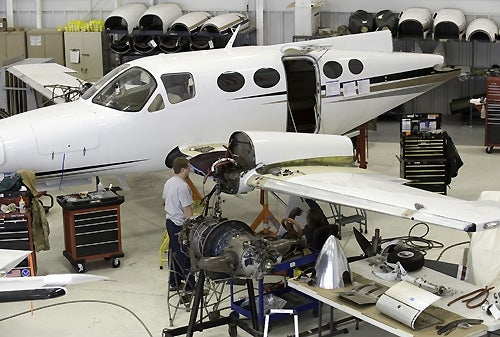
The Cessna 441 and 425 Conquest turboprops have been among the hottest turbine airplanes on the used market for several years. Both the higher flying, bigger and faster 441 Conquest II and the smaller PT6-powered 425 Conquest I have been selling for near their new prices, even though they are 23 or more years old. […]

Read More »
Features

ELT Alternatives

Emergency locator transmitters (ELTs) are one piece of equipment airplane owners love to hate. They dont work very well and they always seem to need replacement batteries. And, beginning this month, satellite monitoring of 121.5 MHz ELTs will cease, instantly making what didnt work all that well to begin with next to useless. This turn of events should not come as a surprise, since the U.S. Department of Commerce first publicized the Cospas-Sarsat decision to stop monitoring 121.5 MHz in November 2000. Cospas-Sarsat, of course, is the international organization charged with maintaining and monitoring the satellites listening for distress signals from ELTs and other devices. For pilots and aircraft owners, one question is whether 121.5 MHZ equipment will continue to be adequate. Another is whether alternatives exist to upgrading to a new-technology ELT transmitting on 406 MHz, the frequency on which Cospas-Sarsat satellites will continue to listen. The answers arent that complicated. Lets first take a look at the two technologies, and then something in the way of an interim solution to have a 406 ELT on a 121.5 budget.

Read More »
Pilot Proficiency

The Air Traffic Control Team

When I put out a request several months ago for responses from pilots on what they would like controllers to know, along with the responses I received from pilots I also received messages from several controllers. Dan Mason said when he saw the title of the previous article (“Working With Controllers,” August 2008), he thought, […]

Read More »
News

The Wayward Wind

When a Beech Sierra flown by a 4,000-hour commercial pilot, accompanied by his wife and daughter, arrived at the Fulton County Airport at Wauseon, Ohio, the wind was from the west-southwest at 26 to 35 knots, with gusts as high as 43 knots. The VFR flight from Troy, Michigan, a distance of only 76 nm, […]

Read More »
Features

Takeoff Aborts

Takeoff and initial climb accidents are 10 times more deadly than landing accidents, according to the AOPA Air Safety Foundation (ASF) presentation “Mastering Takeoffs and Landings.” And, when you think about it, the ASFs numbers make sense. After all, during a takeoff, the airplane is as heavy as it will be for that flight, youre accelerating, not slowing as when landing, and you arent accustomed to the wind or the airplanes loading, among other factors. If in fact takeoffs are so potentially fatal, its worthwhile to discover how to detect when a takeoff or “first-stage” climbout is going bad and, if needed, how to safely abort it before joining the NTSB tally. What clues do we have to a takeoff anomaly, and how can we safely abort a takeoff when things arent going right? Im in favor of letting the student do everything possible on the first lesson, but the relative ease at which we launch into the air-at least compared to what it takes to learn to land-might make us complacent about critically observing our takeoffs. After all, when turned into the wind and the powers brought up, were thinking about the flight ahead, or perhaps focused on an initial heading or altitude restriction. It takes a lot of discipline to be thinking about the takeoff itself.


Read More »
Pilot in aircraft
Sign-up for newsletters & special offers!

Get the latest stories & special offers delivered directly to your inbox.

SUBSCRIBE