Register

Search Results for: maintaining your airplane

Aircraft

How To Lower The Cost of Airplane Ownership

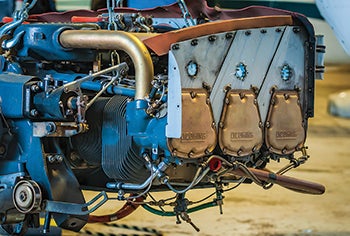
A new private pilot, who had big dreams but not big money, was contemplating purchasing an older Mooney. He had limited mechanical skills and no concept of the potential cost of maintaining a complex airplane. He just liked the looks of the plane and its performance. Roger that. Many people buy their first aircraft for […]
Read More »
Features

Your Other Wings

Unless you’re someone we’d really like to get to know better, it’s likely you’re not flying around in your own personal jet. Which means you probably are flying behind, between, below or in front of at least one propeller. They’re marvelous devices, often subjected to substantial forces as they unceasingly (we hope) spin thousands of times per minute. They also can be a bit mysterious, even the fixed-pitch variety.

Read More »
Aircraft

Piston Engines: Keeping Your Cylinders Happy

Photo by Bo Ryan| There is a magic number associated with every airplane — a number referred to as time between overhauls, or TBO for short. TBO is the number of hours the engine manufacturer expects you can operate the engine before it needs to be taken apart and have components replaced or repaired. The […]

Read More »
Features

Prepping For Your IPC

Maintaining your IFR currency isn’t that hard. Just fly and log in actual or simulated conditions six instrument approaches, “holding procedures and tasks” and “intercepting and tracking” electronic courses within the preceding six months, and you’re golden. Even if you find yourself slightly out of currency in the 11th month, you can go out with a safety pilot and fly the requisite approaches/holds/intercepts, regaining your ability to legally file and fly IFR. But after 12 full months of being out of IFR currency, you’ll need an instrument proficiency check, or IPC. There was a time, before the most recent revisions to FAR 61, when an IPC—previously known as an instrument competency check—wasn’t structured. That’s no longer the case.

Read More »
Pilot Proficiency

Maintaining Proficiency for Free

When the weather’s truly awful the decision to stay on the ground rather than fly is easy. But you’ve budgeted this time for flying anyway so why not get some use out of it? You might instead decide to “chair fly,” where you sit down and mentally go through various checklist items. If you have […]

Read More »
Features

Fixing Your Flare

No matter how smooth and enjoyable the flight, your passengers always will remember the landing. Anything other than a single, bounce-free touchdown is ripe for comment and, if your passengers also are pilots, ridicule. While a good landing is a combination of many factors, the last chance you have to affect its outcome is in the flare. Whether you’re flaring too high above the runway or too low, at too high an airspeed or too enthusiastically, there’s usually a fix for what ails your landings. A lot of it can come down to how you transition from approaching the runway with the nose down to the ideal nose-up, power-off attitude, inches above the runway. It’s not that hard.

Read More »
Training and Proficiency

Keeping Track of Your Altitude

Few things are more important than being at the right altitude on an instrument approach. In the abstract that sounds easy, but in practice I often see pilots make mistakes in this most unforgiving aspect of instrument flight. Most of my flying is in aircraft with moving maps, as part of either a GPS or […]

Read More »
Pilot Proficiency

Flight School: Maintaining Proficiency

What kinds of things should pilots practice regularly once they obtain their pilot certificate? Max Trescott is the 2008 National Certificated Flight Instructor of the Year. Based in Palo Alto, California, he teaches in glass cockpit aircraft and in Lake amphibians. He also publishes aviation books and software available through g1000book.com. He says: Celebrate your […]

Read More »
Features

Five Reasons Your Landings Suck

Landings are typically the pilot’s biggest challenge, presenting great frustration when we screw them up even as recognition of doing it right is as rare as $2.00/gallon avgas. Apparently, the act of returning to terra firma is one we simply can’t seem to master consistently. One of the reasons is each day’s conditions are different from the previous flights, and applying what we remember from them—if anything—won’t always work. Another reason is the pilot may not have enough experience to know how to gauge conditions and modify the pattern and approach to compensate for today’s conditions.

Read More »
Accident Probes

Keep Your Speed Up

No matter what and where we fly, our speed usually is of interest. Sometimes, were just out loafing, watching the clouds above us and the cars below us. Other times, were trying to get somewhere and for any number of reasons want to do it as quickly as possible. In fact, a personal airplane often is an ideal traveling tool, one ensuring the fastest door-to-door travel times this side of a Star Trek transporter beam. Speed usually is a good thing.

Read More »
Pilot in aircraft
Sign-up for newsletters & special offers!

Get the latest stories & special offers delivered directly to your inbox.

SUBSCRIBE