Register

Search Results for: general aviation inc

Features

New Certification Standards

The FAA and industry have spent the last three years preparing to replace the existing practical test standards (PTS). As a result, the new airman certification standards (ACS) will go into effect in 2016 for all airman certificates and ratings. This new system can potentially improve the general aviation safety record, but only if flight instructors, designated pilot examiners and FAA inspectors are prepared to teach, test and administer the new system.

Read More »
Accident Probes

Acro Tyro

Just as there are different airplanes optimized for different purposes, pilots fly for different reasons. For some, its just a job, akin to driving a bus. For others, its a means of personal and business transportation. Still more fly for recreation, like sightseeing or aerobatics. Droning along in the stormy clag and hand-flying an ILS to minimums is the epitome of flying skill for some pilots. Others perhaps couldnt fly an ILS if they had to but can fly, say, a loop or an Immelman to perfection, or safely get in and out of a back-country runway. Different strokes for different folks. Fortunate pilots may combine all of these activities, and others, into their flying career.

Read More »
Another Look

Fatals Higher In 2014

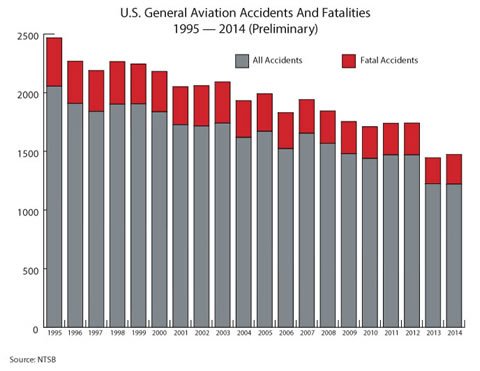
The NTSB in early August released preliminary general aviation accident statistics for 2014. Sadly, and despite major efforts at the FAA and within industry to enhance safety, the NTSBs preliminary 2014 data show an increase in fatal general aviation accidents, from 222 in 2013 to 253 in 2014. Our calculator says thats a 13.9 percent increase in fatal accidents between 2013 and 2014.

Read More »
Aircraft

Icon A5 Light-Sport Aircraft Review

I’m generally biased in favor of anything that flies, but truth be told there have been a few light-sport aircraft that I haven’t enjoyed flying. I felt that those airplanes were so light on the controls that it was rather unsettling. While the Icon A5 looks cool, I was prepared for the worst when I […]

Read More »
Unicom

Negative G?

Dr. Banners article in Julys issue, In-Flight Fires, mentions to bank 45 degrees during an emergency descent to create positive g loading and help offset negative g forces.Question: Generally speaking, why can airplanes withstand (or be certified for) greater positive g load limits than negative? Stated another way: Why are negative g loads more restrictive?Thanks for a great publication!

Read More »
News

GA Fatal Crashes Up Slightly in 2014

The National Transportation Safety Board released aviation accident statistics for 2014 showing a slight increase in fatal general aviation accidents, which rose from 222 in 2013 to 253 in 2014. The overall number of GA accidents dropped slightly from 1,224 in 2013 to 1,221 in 2014, but the accident rate increased from 6.26 per 100,000 […]

Read More »
Briefing

Briefing: September 2015

EAA hosted one of its busiest Oshkosh shows ever in July, with record numbers for aircraft arrivals and campers. Near-perfect weather for the entire week kept the airplanes flying. The show hosted for the first time a B-52, and an Airbus A350 XWB from the test fleet was open for tours. All the usual daily airshows, forums, and events kept visitors busy nonstop. Aircraft designer Burt Rutan returned after an absence of several years to talk about his new SkiGull amphibian design, and Icon delivered their first A5 amphib LSA to EAAs Young Eagles. Yingling Aviation, based in Wichita, debuted a new remanufactured 172, and Vulcanair, from Italy, introduced a newly FAA-certified twin turboprop.

Read More »
System

ICAO Flight Plan Update

It only takes a cursory look at an ICAO flight plan form to get cranial blood-vessel spasms and the resultant migraine. Who starts a form at item seven? Yes, you really have to look up aircraft type codes in ICAO DOC 8643. Can equipment codes really use the whole alphabet, indecipherable by humans? Do they really have only one remarks box that serves as an explanation for nearly every other box on the whole form?Despite the forms flaws and seemingly unfathomable complexities, the FAA is committed to drag U.S. pilots to the ICAO flight plan. Since the ICAO form is already required for flights utilizing performance based navigation (PBN), flying in RVSM airspace, utilizing ADS-B services, and flights outside the U.S., everybody else might as well share the pain.

Read More »
Training and Proficiency

Taking Wing: Experience Matters

We were bumping through the clouds at Flight Level 300, unable to escape the clutches of a low, winter jet stream thanks to 167 burly souls on board and 26,000 pounds of jet-A sloshing in the tanks. Under such conditions this McDonnell Douglas finds itself just a little short of wing, and the prudent pilot […]

Read More »
I.L.A.F.F.T

I Learned About Flying From That: Command Authority

It was a Cessna 340A model and I was the PIC. A sleek, powerful and very cool looking twin-engine airplane, the 340A is powered by two Continental 310-­horsepower engines. Regarded as a “pilot’s airplane,” it has good performance characteristics (airspeed and rate of climb) as reflected by a power loading of 10.48 pounds per horsepower, […]

Read More »
Pilot in aircraft
Sign-up for newsletters & special offers!

Get the latest stories & special offers delivered directly to your inbox.

SUBSCRIBE