Register

Weather

Readback May 2018

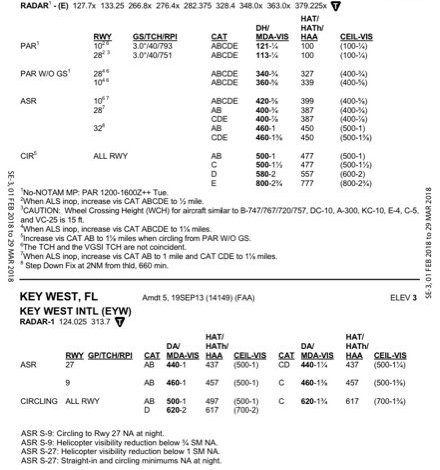
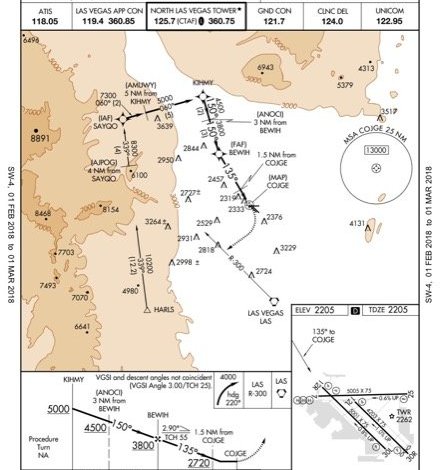
I was able to pull the ODP data but not the SID data, but I can give a fairly good guess as to whats going on. On the ODP, the controlling obstacle is a 2729-foot tower a few miles to the east of the runway. The initial climb is extended a bit more than usual in order to allow for a standard climb gradient when turning right (note that for turns other than to the right, a normal 400-foot turn is allowed). The WENDY and TRUPR are examples of Open SIDs, which have a route off the runway followed by radar vectors to a route. In these cases, the route off the runway is evaluated, but then the radar vector area gets no additional evaluation (other than MVA, etc.). SID evaluation begins again at the defined route. Because theres no SID evaluation required after the initial climb, the controlling obstacle for the ODP isnt considered. The minimum turning altitude for an RNAV SID is 500 feet above the runway, which would give you a turn at 1800 vs. the turn at 1900 on the ODP to keep a standard climb gradient and clear the tower. -LS
Read More »

ASR Approaches

Before the advent of GPS approaches, most civilian approach control facilities provided Airport Surveillance Radar (ASR) approaches, usually as a back-up to pilot-nav approaches. Many are now gone but some airports still have them. In Florida, only two civilian airports have ASR approaches: Key West and Tallahassee, at opposite ends of the state. However, there are seven military airports with ASR approaches.

Read More »

Wheres that Runway?

Its the end of a long day filled of uncooperative weather, ground stops, and a diversion tossed in to make it interesting. Youre shooting the non-precision (of course) GPS approach, and upon reaching minimums, you look up and see … nothing. Wait a minute! Isnt that a PAPI glowing out of the left side of your window? Is that your runway? If so, whats it doing all the way over there?

Read More »

Morning Commute

For some, the shoulder seasons mean ideal flying weather – crisp spring and fall mornings with great visibility, often under a stable ceiling. These conditions offer fantastic climb performance, and the lack of bugs splattered all over the windshield is a plus. Morning fog, too, is pretty to look at, although it sure puts a damper on early-bird departures.

Read More »

April Accidents

From time to time we look at weather accidents, reviewing the factors that might have led to poor decision making or perhaps even weather that could not be anticipated. In this edition well take a look at the crash of a Pitts biplane in IMC conditions in California, and a Beechcraft Baron that went down in bad weather in Kentucky. Both of these incidents took place in April, so they should give you some food for thought this time of year.

Read More »

On The Air: April 2018

On the way out of Florida for Hurricane Irma, it was very, very busy on frequency with everyone trying to get out of the state. ATC was doing a great job of handling very heavy traffic loads, and still managing to provide flight following to the greatest extent possible, when I happened to overhear the following exchange:

Read More »

Briefing: April 2018

For the 14th year, the U.S. Sport Aviation Expo welcomed visitors to Sebring, Florida, in January, providing respite from the cold for northerners and a chance for prospective buyers to take a demo flight in a Light Sport Aircraft. The show hosted about 100 exhibitors, more than last year, and organizers told AVweb ticket sales also were up. About 60 forums were held, and more than 1,000 youngsters took part in the shows youth education programs. The date for next years event is January 23 to 26.

Read More »

Climbing the Mountain

When asking air traffic controllers about their jobs, you might occasionally get the answer, Best job in the world. Its a demanding, technical career thats both very rewarding and-while not glamorous-carries a certain mystique with the general public.

Read More »

A Bad Idea that Just Wont Die

With each new budget impasse, it seems theres a concerted effort to pass a law divesting ATC from the FAA to turn it over to a private Congressionally-chartered nonprofit corporation. Congressman Bill Shuster (D-PA), the powerful chairman of the House Transportation and Infrastructure Committee offered two bills, HR 4441 in 2016 and HR 2997 in 2017. Fortunately, neither bill came to a vote because there was insufficient support.

Read More »

Planning versus Flying

You are planning an IFR flight. Its a route you have flown many times before. You always file direct and most of the time the cooperative controllers give it to you. So you again file direct, toss in a nearby Class B or C as an alternate, and calculate your fuel requirements for a flight to the alternate. Youve met your obligations under 14 CFR 91.167 and 91.169. Or have you?

Read More »
Pilot in aircraft
Sign-up for newsletters & special offers!

Get the latest stories & special offers delivered directly to your inbox.

SUBSCRIBE