














NASA, Lockheed’s Supersonic X-59 ‘Returned Prematurely’ on Second Flight

Supersonic test aircraft aimed to reach 260 mph at altitude of 20,000 feet.

NASA X-59 supersonic test aircraft
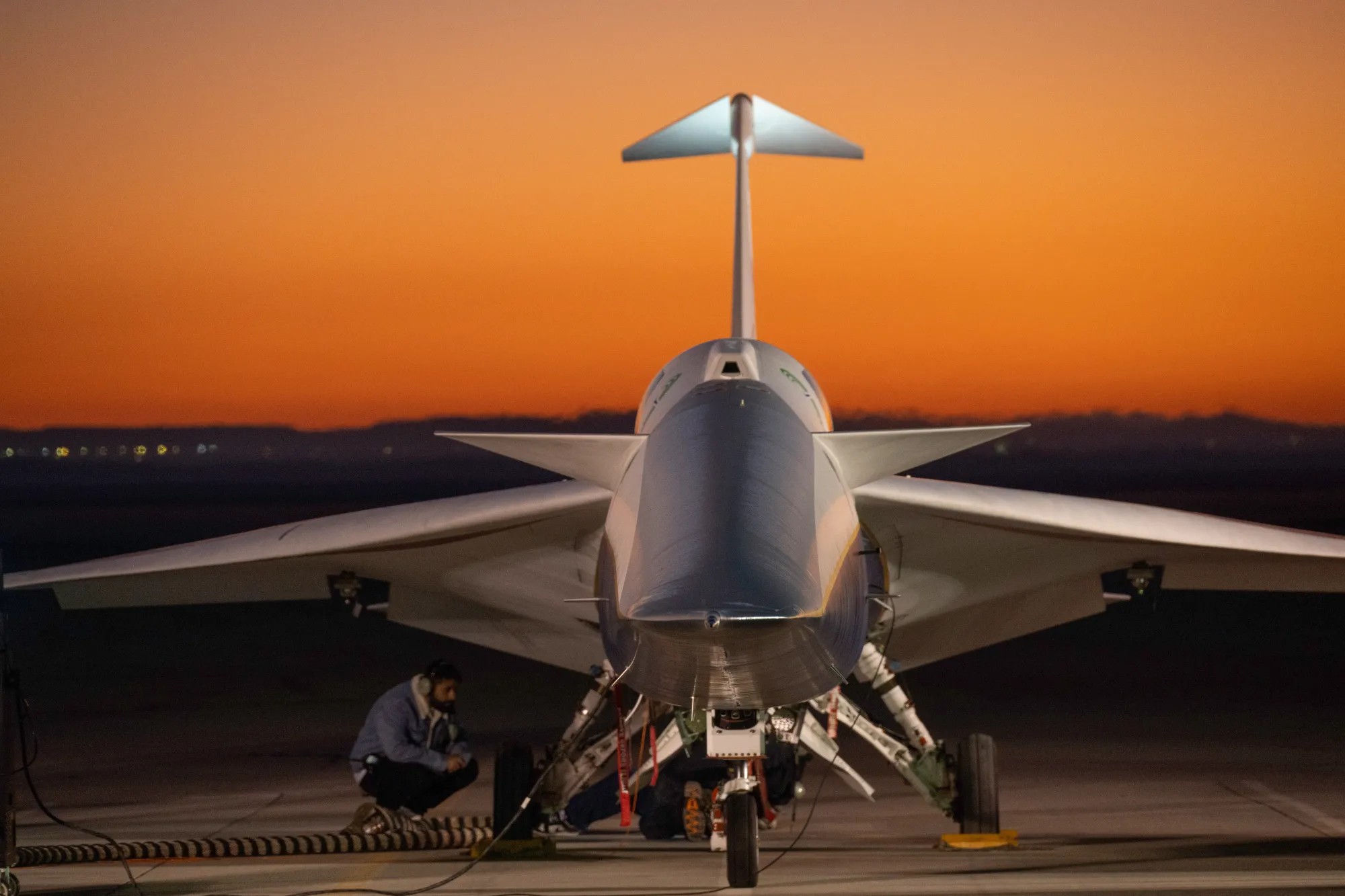
NASA engineers conducted engine run testing on Thursday, March 12, at NASA’s Armstrong Flight Research Center in Edwards, California, ahead of the X-59’s second flight. [Credit: NASA/Jim Ross]
Gemini Sparkle

Key Takeaways:

  • NASA and Lockheed Martin's X-59, a prototype for a quiet supersonic commercial airliner, made an unscheduled early return during its second flight, safely landing before achieving planned speed and altitude goals.
  • The X-59 is designed to produce significantly quieter "sonic thumps" instead of traditional sonic booms, aiming to gather data to help revise regulations on supersonic flight over land, which has been banned since 1973.
  • Future testing plans include further envelope expansion to higher speeds and altitudes, followed by acoustic validation and community surveys to assess public response to its reduced noise signature.
See a mistake? Contact us.

NASA and Lockheed Martin’s X-59—a prototype design for a quiet, supersonic commercial airliner—“returned prematurely” to Edwards Air Force Base (KEDW) in California during its second flight Friday, the space agency said.

NASA in a social media post said the experimental plane took off from Edwards at 1:54 p.m. EDT, but a “return-to-base call” prompted it to land before achieving its envelope expansion objectives—reaching 260 mph and 20,000 feet.


“The pilot and aircraft landed safely and successfully,” it said. “More information is forthcoming.”

The X-59’s first flight in October took off from Lockheed’s Skunk Works facility at U.S. Air Force Plant 42 in Palmdale, California. It flew for about 67 minutes before landing 30 miles away at NASA’s Armstrong Flight Research Center in California.

On March 12, engineers fired up the X-59’s modified, top-mounted F-18 Super Hornet F414-GE-100 engine, one of the final steps before taking to the skies. On Friday, they taxied it from Armstrong to nearby Edwards Air Force Base (KEDW), where NASA test pilot Jim “Clue” Less took off.

After completing checkouts at lower speed and altitude, Less was supposed to accelerate to 260 mph and ascend to 20,000 feet. But it appears that won’t happen until a future flight.

What Is the X-59?

NASA will gather feedback on responses to the X-59’s sonic booms—intended to be about as quiet as a car door shutting in the distance—to help regulators create new rules for supersonic flight over land. The FAA has banned overland commercial operations faster than Mach 1 since 1973. The White House last year ordered the agency to lift the restriction.

“This will be the first time I’ve flown an X-plane,” Less said ahead of the flight. “I think I’ll mostly be focused on getting the test cards done and getting them done correctly. It’ll probably sink in later that I was in the X-59.”

NASA in the coming months plans to take the X-59 faster and higher in order to validate its safety and performance. The goal is Mach 1.4 at about 55,000 feet, the parameters for its community survey mission.

“From here on out, once we’re airborne, we can increase speed and increase altitude in small, measured chunks, looking at things as we go and not getting ahead of ourselves,” said Less.

After envelope expansion will come acoustic testing at Edwards, gauging the aircraft’s sonic boom-canceling capability. It won’t eliminate noise, but NASA aims to reduce booms to quieter “sonic thumps.”

The X-59’s thin, Pinocchio-like nose extends about one-third of its nearly 100-foot length, breaking up shockwaves in front of the aircraft. Due to its length, there is no forward facing window in the cockpit. Instead, an external vision system feeds imagery from high-resolution cameras to a monitor.

The top-mounted Super Hornet engine gives the X-59 a smooth underside, intended to prevent shockwaves from merging in its wake. Other flight-proven components include life support systems from the F-15, landing gear from the F-16 Fighting Falcon, control stick from the F-117 Nighthawk, and cockpit canopy from the T-38 Talon.

Once NASA is satisfied with the X-59’s quietness, the aircraft’s final assignment will be the community response survey. The space agency is planning five one-month surveys in locations across the country, during which people below the flight path could hear the aircraft—or not—close to 80 times.

If regulators and lawmakers determine that Americans are sufficiently unbothered by the sonic thumps, it could lead to the development of clearer domestic and international standards for supersonic flight over land. NASA is coordinating with both the FAA and International Civil Aviation Organization (ICAO).

Jack Daleo

Jack is a staff writer covering advanced air mobility, including everything from drones to unmanned aircraft systems to space travel—and a whole lot more. He spent close to two years reporting on drone delivery for FreightWaves, covering the biggest news and developments in the space and connecting with industry executives and experts. Jack is also a basketball aficionado, a frequent traveler and a lover of all things logistics.

Ready to Sell Your Aircraft?

List your airplane on AircraftForSale.com and reach qualified buyers.

List Your Aircraft
AircraftForSale Logo | FLYING Logo
Pilot in aircraft
Sign-up for newsletters & special offers!

Get the latest stories & special offers delivered directly to your inbox.

SUBSCRIBE
