NASA Drops Air Taxi Mockup to Study Materials

Thirty-five-foot drop tests gauge how air taxi structures and batteries would withstand the impact of a crash.

NASA electric eVTOL air taxi drop test
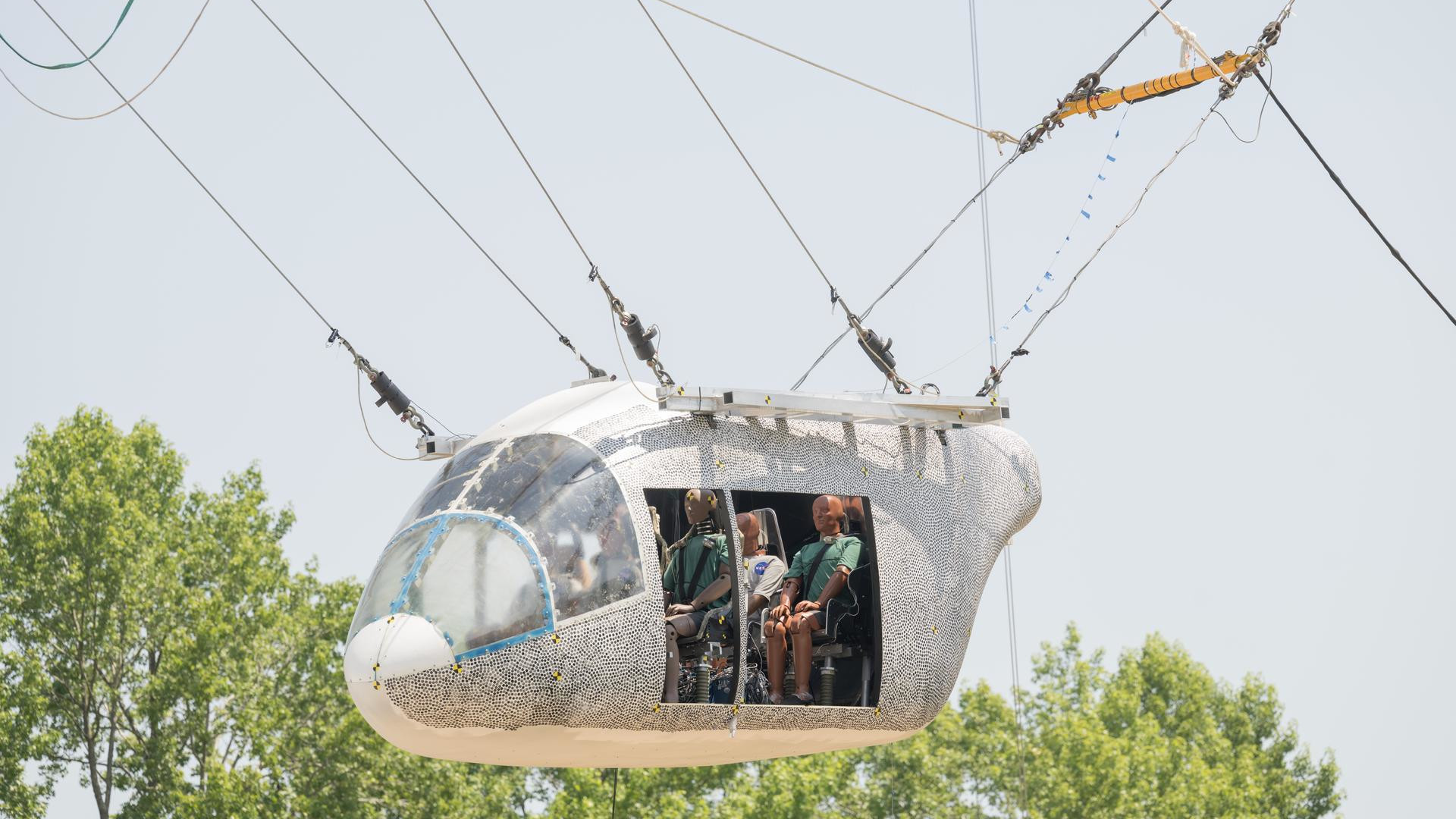
Researchers at NASA’s Langley Research Center in Virginia conduct a drop test of a full-scale aircraft body modeled after an electric air taxi. [Courtesy: NASA/Mark Knopp]
Gemini Sparkle

Key Takeaways:

  • NASA is conducting crash simulations, such as 35-foot drop tests of eVTOL air taxi mockups, to study optimal materials and enhance the safety of future air taxi designs.
  • The tests evaluate how materials behave and generate data on impact absorption, which NASA will share publicly to help eVTOL developers improve designs and inform safety regulations.
  • Beyond crash tests, NASA extensively collaborates with eVTOL manufacturers on various aspects, including battery testing, noise reduction, air traffic integration, and passenger comfort, through programs like Revolutionary Vertical Lift Technology (RVLT).
See a mistake? Contact us.

NASA researchers are simulating crashes to study the optimal materials for a new generation of electric vertical takeoff and landing (eVTOL) air taxis.

Per a recent media release, the space agency in June dropped a full-scale aircraft body—modeled after an eVTOL air taxi—from a 35-foot gantry at its Langley Research Center in Virginia. 

According to NASA, the materials behaved as expected by computer simulation predictions. It will share the data publicly once analysis is complete to help eVTOL developers enhance the safety of their designs.

“By showcasing elements of a crash alongside how added energy-absorbing technology could help make the aircraft more robust, these tests will help the development of safety regulations for advanced air mobility aircraft, leading to safer designs,” said Justin Littell, who led the tests at Langley.

There are a handful of U.S. companies developing passenger-carrying eVTOL air taxis, which the FAA categorizes as powered-lift aircraft in the special category. So far, none have achieved type certification.

The novel aircraft are built to carry four or five passengers, cruising anywhere between 100 and 200 knots depending on the design. They are geared primarily toward short-hop trips—such as between airports and city centers—in urban hubs such as New York, Chicago, and Los Angeles.

NASA researchers used cables to hoist an air taxi mockup atop the steel gantry, swinging it forward before letting it crash to the ground. The swing created a 10-degree yaw in order to replicate conditions required by the FAA for crashworthiness testing of powered-lift models.

Researchers prepare the eVTOL air taxi stand-in ahead of a 35-foot drop test. [Courtesy: NASA/Mark Knopp]

The aircraft’s “passengers” were a group of weighted test dummies. Protecting them were “energy absorbing subfloors” akin to the crumple zones in a car, which NASA said crushed as intended. Mass was added to the aircraft to mimic heavy electric batteries and predict how the added weight would affect acceleration. Impact absorption data will be shared with air taxi manufacturers to improve the safety of flights over people.

The four most prominent American air taxi developers, Archer Aviation, Joby Aviation, Beta Technologies, and Boeing’s Wisk Aero, all use carbon-fiber composites in their designs due to the material’s high durability and low weight.

Archer deploys a composite and toughened resin system called prepreg, supplied by Hexcel, for its airframe. Joby and Wisk similarly use composites from Toray and Sonaca, respectively. Beta, which is developing both an eVTOL and conventional takeoff and landing (CTOL) variant, primarily uses composites from Solvay and Albany Engineered Composites but incorporates aluminum and other materials into its structures.

The NASA testing, conducted under the Revolutionary Vertical Lift Technology (RVLT) program, could help these developers identify any weaknesses in their designs. It’s just one way that the space agency is charting a path for a new generation of aircraft.

RVLT and other NASA projects such as Air Traffic Management-Exploration (ATM-X), System Wide Safety (SWS), and Air Mobility Pathfinders (AMP) are studying everything from air taxi safety to ride quality.

A 2022 RVLT crash test, for example, produced the data needed to refine the computer simulations used in June’s drop test. NASA also drop tests eVTOL batteries and has a partnership with Archer to study battery cell health.

The space agency further works extensively with Joby and Wisk.

It began flying Joby’s aircraft in 2021 and has an agreement with the U.S. Air Force to use a model the company delivered to Edwards Air Force Base (KEDW) in California in 2023. Since then, the partners have collaborated to study air taxi noise, wind effects, and simulated operations at major airports such as Dallas-Fort Worth International (KDFW) and Los Angeles International (KLAX).

Archer and Wisk later joined the noise study. The latter has helped NASA evaluate automated precision approach and landing, as well as how air traffic control communicates with its autonomous air taxi. Wisk in May extended its collaboration to study the integration of self-flying aircraft in the National Airspace System under IFR.

Other NASA projects have focused on air taxi infrastructure, passenger comfort, pilot interactions, and much more.

“It’s like building or remodeling a house,” Supreet “Sue” Kaur, systems engineering and integration lead for the ATM-X program, told FLYING in July. “You need an architect, someone to lay the foundation, a framer, a roofer, an electrician, a plumber, and so on. All of these folks have their areas of expertise, but they work together in unison…Similarly, we are looking at different parts of a bigger challenge.”

Like this story? We think you’ll also like the Future of FLYING newsletter sent every Thursday afternoon. Sign up now.

Jack Daleo

Jack is a staff writer covering advanced air mobility, including everything from drones to unmanned aircraft systems to space travel—and a whole lot more. He spent close to two years reporting on drone delivery for FreightWaves, covering the biggest news and developments in the space and connecting with industry executives and experts. Jack is also a basketball aficionado, a frequent traveler and a lover of all things logistics.


Ready to Sell Your Aircraft?

List your airplane on AircraftForSale.com and reach qualified buyers.

List Your Aircraft
AircraftForSale Logo | FLYING Logo
Pilot in aircraft
Sign-up for newsletters & special offers!

Get the latest stories & special offers delivered directly to your inbox.

SUBSCRIBE