














NASA’s first lunar landing since the Apollo era and debut mission to the moon’s south pole will begin in the Rocky Mountains of Colorado.
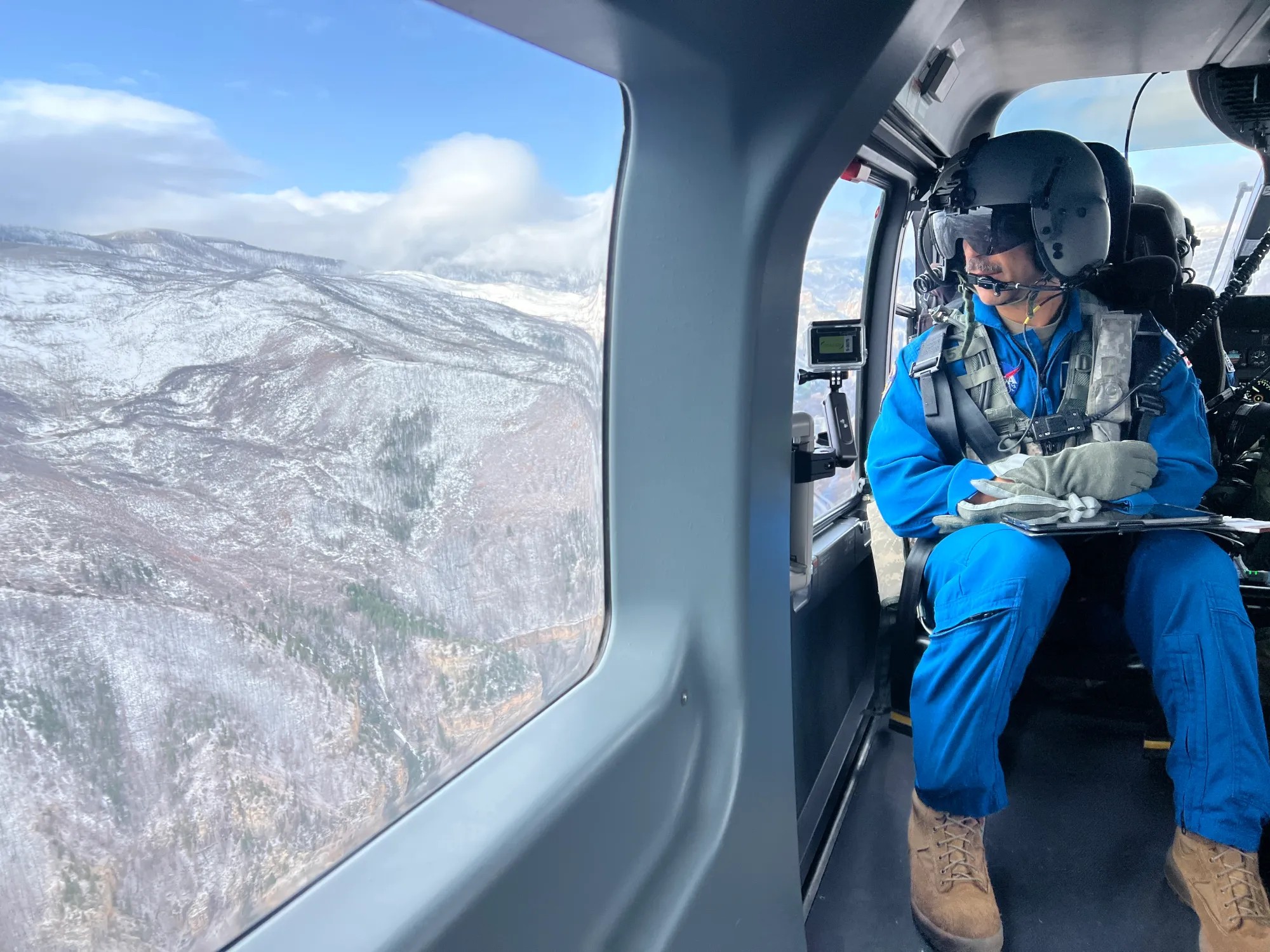
The space agency on Monday said it is close to finalizing a training course for the Artemis III lunar landing, scheduled for mid-2027, with the U.S. Army National Guard. Astronauts will fly military helicopters over the mountaintops and valleys of the Rockies to simulate the conditions they may face when approaching the moon’s surface.

According to NASA, the training regimen could be settled as early as this month.
“Our Colorado Army National Guard pilots may not fly around the moon, but we wear our motto, de monitbus ad astra—from the mountains to the stars—with pride,” said first sergeant Joshua Smith of the High-Altitude Army National Guard Aviation Training Site (HAATS) in Colorado.
Artemis and the Army
The Artemis III astronauts will land on the moon more than half a century after the final Apollo astronauts, who were consulted to develop the National Guard training course. But they will be the first to explore the treacherous lunar south pole.
At that latitude, the sun’s rays cast long shadows that can make it difficult to measure distances and heights. That adds complexity to an uneven landing surface dotted with active volcanoes, deep craters, steep ridges, and hulking boulders.
The moon’s exosphere is so thin that it “glows” in the sunlight, a phenomenon the Apollo crews reported. Plumes of lunar dust can further obscure vision and clog up altitude and velocity sensors.
Anticipating these challenges, NASA in 2021 began working with the National Guard to develop the training program at HAATS. About two dozen astronauts including Raja Chari—astronaut development and testing lead for the Artemis III lander, SpaceX’s Starship human landing system (HLS)—have evaluated the course.
Per NASA, SpaceX will be responsible for training personnel on the Starship HLS, and Blue Origin will do the same for its Blue Moon lander, which is set to debut on Artemis V. But the National Guard course will provide “foundational” training for both vehicles.
“During training flights at HAATS, astronauts can experience the visual illusions, cross-cockpit communication, and degraded visibility they may experience navigating to their landing zone near the lunar south pole,” said NASA astronaut Doug Wheelock. “Flight training opportunities like this are vital to mission success and crew safety.”
Snowy and dusty mountain conditions, for example, can obstruct a pilot’s vision, similar to the anticipated effect of lunar dust.
The “three-pronged” program will comprise motion-based simulation, in-flight analog training, and in-flight lunar simulations. After mastering the simulator, astronauts will be paired with National Guard pilots in a range of helicopters, including the UH-72A Lakota, CH-47 Chinook, and UH-60 Black Hawk.
Per Smith, HAATS airmen have racked up thousands of flight hours in the Rockies between 6,500 and 14,200 feet in altitude.
“Helicopters at or above 10,000 feet are not really efficient in the thin air, forcing us into operating with very thin power margins similar to the Apollo astronauts having to manage energy and momentum to land safely,” said Wheelock.
One astronaut will pilot the helicopter, and a second will chart the landing area by marking key landmarks and potential hazards. As the course progresses, landing zones and scenarios will grow increasingly complex, forcing astronauts to practice communication and teamwork.
Preparing for Liftoff
NASA has twice pushed back its 2025 target for the Artemis III landing, first to late 2026 and later to mid-2027. But mission preparations are underway.
On Monday, for example, NASA said it began assembling the Space Launch System (SLS) core stage for Artemis III at Kennedy Space Center in Florida. SLS rockets are scheduled to launch the next several Artemis missions, including Artemis II—a crewed flight around the moon that will set the stage for the lunar landing. The White House, though, is pushing to phase out SLS after Artemis III.
Contractor Axiom Space, meanwhile, continues to develop the next-generation spacesuits that will protect the astronauts. NASA officials in 2024 said Axiom was “struggling” to develop the suits’ life support system, but the company began initial crew testing in July.
Officials also worried that “there are going to be risks” to SpaceX’s delivery of the HLS. The company is gearing up for Starship’s tenth test flight as soon as Sunday but has been plagued by setbacks, including in-flight anomalies and an explosion on the test stand in June. It will need to hit a few critical test milestones before the HLS is ready to fly with humans.
Like this story? We think you’ll also like the Future of FLYING newsletter sent every Thursday afternoon. Sign up now.

