












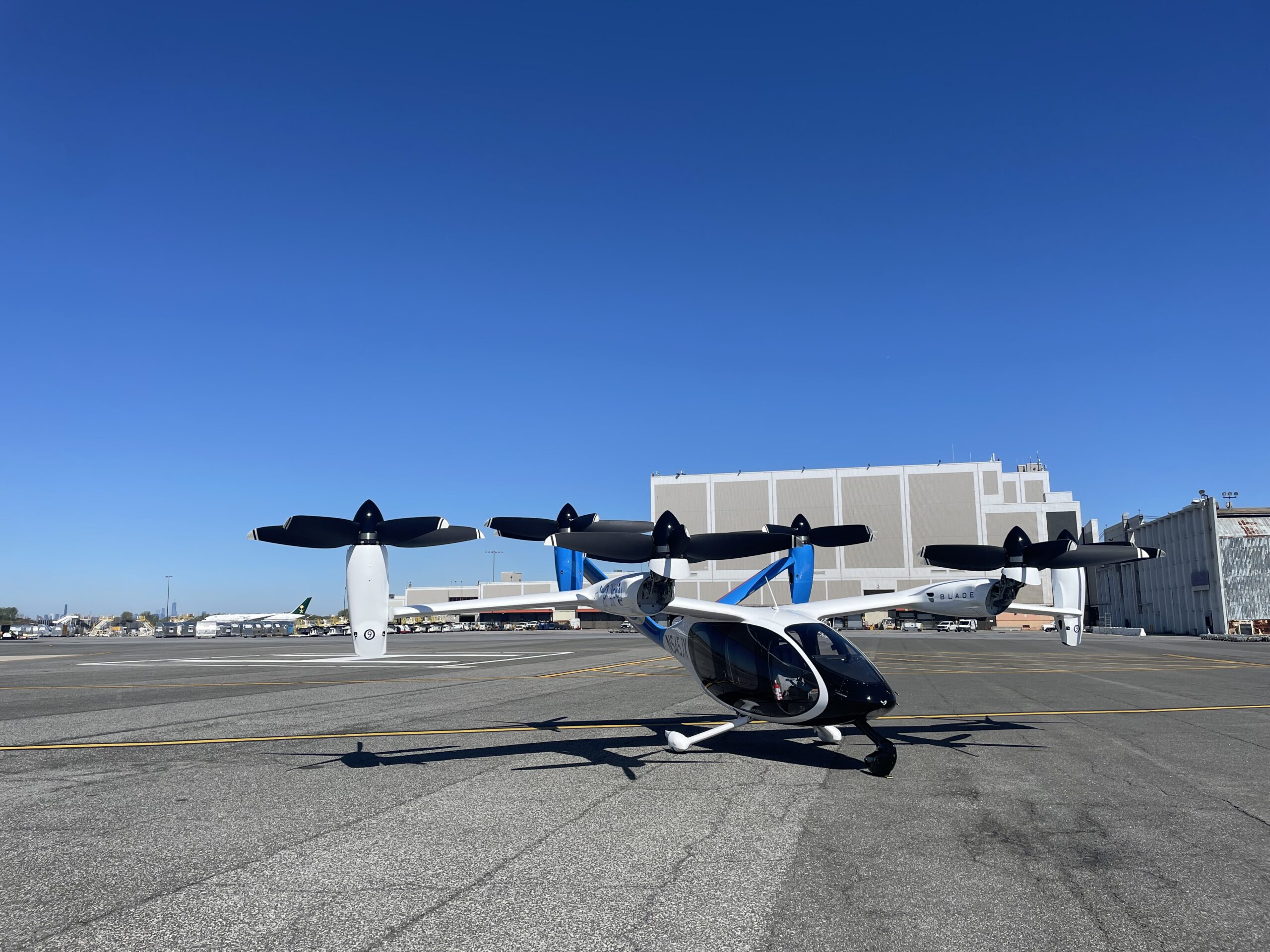


New Yorkers this week are getting a glimpse of the future of aviation, as electric air taxis soar across the city’s network of airports and heliports for the first time.
After conducting a handful of test flights over the weekend, a Joby Aviation production prototype eVTOL (electric vertical takeoff and landing) aircraft lifted off Monday from John F. Kennedy International (KJFK), marking the first time an electric air taxi has departed one of New York City’s three major airports.

It touched down at the West 30th Street heliport in Manhattan about 15 minutes later, completing the first point-to-point flight by an eVTOL in New York City. Didier Papadopoulos, president of aircraft OEM at Joby, told FLYING the demonstration was “in some ways a real life simulation of what we expect to deliver as an end-to-end service.”
It was just a taste of what is to come.
Joby will conduct further demonstrations over the next 10 days, flying from JFK into West 30th Street, the East 34th Street heliport, and Downtown Skyport—all of which are being electrified for future air taxi services. The manufacturer has partnerships with Delta Air Lines and Uber to handle airport transfers, cargo logistics, medical deliveries, and more in major cities across the U.S.
Papadopoulos said the company plans more point-to-point flights throughout the week as it looks to ramp up the cadence.
“A lot of it is about being able to exercise the muscles, so the ability to be able to do this multiple days, multiple times a day,” Papadopoulos said.
The Port Authority of New York and New Jersey (PANYNJ), which hosted Monday’s flight, also plans air taxi demonstrations with Joby competitor Archer Aviation this spring.
In a few months, test flights will expand to include electric aircraft from Joby, Archer, Beta Technologies, Boeing’s Wisk Aero, and Electra. The PANYNJ is leading one of eight projects selected by the FAA for the eVTOL Integration Pilot Program (eIPP), a planned three-year campaign of real-world operations with precertified aircraft in 26 states. Those could eventually include passenger flights into airports, potentially for revenue.
Kathryn Garcia, executive director of PANYNJ, said Monday that the agency is seeking partners to design, build, and operate a vertiport—an electrified heliport—at LaGuardia Airport (KLGA). Joby believes its air taxi could turn one- or two-hour commutes from Manhattan or Midtown to JFK into seven-minute flights.
Bonny Simi, president of operations for Joby, said the company is exploring other boroughs beyond Manhattan and Queens. Monday’s demonstration flight used a 20-mile route, but it is seeking FAA approval for a 9-mile route.
New York City, Los Angeles, and Miami are candidates to be the first U.S. cities to launch routine electric air taxi flights. Flight tests such as Monday’s and those planned under the eIPP are helping manufacturers and regulators such as the FAA integrate these new entrants alongside conventional aircraft.
Incidents like the recent collision at LaGuardia highlight the need for extensive testing before they are granted access to the National Airspace System (NAS). Fortunately, plenty more is planned.
Preparing the Flight Plan
Joby is among a handful of manufacturers building eVTOL air taxis, which combine the vertical takeoff ability and runway independence of helicopters with the efficiency of fixed-wing aircraft.
Many eVTOL models feature tilting propellers. Joby’s has six that provide vertical lift during takeoff and hover, swiveling forward to augment the wing during cruise. The five-bladed propellers have a low tip speed, with twisted blades designed to reduce the “whop, whop, whop” of a helicopter to the volume of leaves rustling in the wind.
The air taxi can continue flying with up to two motors out. The pilot uses fly-by-wire controls, inputting commands so that a flight computer adjusts the pitch and position of the propellers. The model is designed for a pilot to fly up to four passengers and four carry-on bags on short trips, cruising at 200 mph.
Monday’s test flight was a long time coming.
Joby in 2023 conducted New York City’s first electric air taxi flight, lifting off from the Downtown Skyport. Formerly the Downtown Manhattan Heliport, the site was acquired by Groupe ADP and Joby partner Skyports Infrastructure to be electrified for air taxis. Joby is working with Vertiports by Atlantic—the vertiport unit of FBO Atlantic Aviation—to prepare other sites in the region.
After the success of the 2023 flight, the PANYNJ requested more demonstrations at its facilities to better understand the aircraft. The agency is committed to net-zero emissions from its operations by 2050 and has undertaken a range of projects to expand electric vehicle chargers and solar panel installations atop airports.
In April 2023, it signed a five-year Space Act Agreement with NASA to study urban air mobility (UAM) services in congested airspace. The partners are initially exploring eVTOL flights under 200 miles. Earlier this month, the agency announced a yearlong cargo drone flight test campaign with Skyports Drone Services.
Joby simultaneously has been laying the groundwork for the historic flight. Its test aircraft have flown more than 50,000 miles across about 2,600 flights, including 9,000 miles across about 850 flights in 2025 alone. It has conducted piloted transitions from hover to forward flight—the capability that defines eVTOL models—since last April.
The test aircraft last year flew at Japan’s Fuji Speedway as well as the World Expo 2025 in Osaka, Dubai Airshow, and California International Airshow, traveling between airports.
Earlier this year, Joby began flying its first aircraft intended for the FAA’s type inspection authorization (TIA) process, during which agency pilots will take the controls. In March, it kicked off its “Grand Skies” tour with a flight over the San Francisco Bay. New York is the second stop.
Air Taxis in the Big Apple
Beta in June completed the first passenger-carrying electric aircraft flight into one of New York City’s three major airports with its conventional takeoff and landing (CTOL) Alia. But Joby’s prototype S4 is the first eVTOL model to enter the flight pattern.
Air traffic controllers at JFK first spotted the aircraft, N545JX, on Wednesday.
“What is that thing?” asked a controller in the tower.
“The future,” replied the aircraft’s pilot, eliciting a laugh.
The air taxi lifted off from Modern Aviation’s FBO site, accelerating from hover to wingborne flight as its propellers spooled up and tilted forward. A chase helicopter obtained clearance from ATC before takeoff.
The aircraft flew along the coastline, with the chase helicopter following and maintaining ATC communications. It soared over the Brooklyn coast past Coney Island and the Verrazano-Narrows Bridge into the special flight rules area around New York Harbor and the Hudson River, descending from about 1,500 to 1,000 feet.
Simi described descent and deceleration as the most demanding phase of the flight, as the air taxi slowed from about 100 mph for touchdown at West 34th Street. It landed about 15 minutes after departing JFK and will make a few more stops before heading back to the airport.
Residents of New York and 25 other states will see more of these demonstrations in the coming months.
In partnership with manufacturers, FBOs, data providers, and others, the PANYNJ plans to conduct tests out of JFK, LaGuardia, Newark Liberty International (KEWR) in New Jersey, and heliports and vertiports across Manhattan. Vaughn College will help prepare a workforce for the eIPP and beyond.
Electric aircraft will conduct airport transfers, cargo flights, medical deliveries, and more in urban, suburban, rural, and coastal settings. Manufacturers will gauge the noise, efficiency, and economics of their operations with real airports and ATCs.
“It’s an extraordinary opportunity to do things people had thought about before, like taking an airplane from the parking lot next door to an Atlantic City casino and flying it directly into one of the major airports in the neighborhood,” Marc Allen, CEO of Electra, told FLYING in March. “Or flying it into the vertiport at the south end of Manhattan, down by Wall Street.”
Joby in 2025 acquired the passenger division of Blade Air Mobility and its lounges at JFK, Newark, West 30th Street, East 34th Street, and the Downtown Skyport. The network served 90,000 people last year, giving Joby infrastructure for its future operations. The New York City Economic Development Corporation (NYCEDC), which manages the West 30th Street and East 34th Street heliports, is electrifying both sites.
Archer and the U.K.’s Vertical Aerospace have shared prospective New York City routes, cementing the city as one of the top markets for air taxis.
Still, Americans nationwide will get a chance to see the electric aircraft in action. Joby was selected for five eIPP projects spanning 12 states and is also planning medical demonstrations in Florida.. In all, the eight selected projects will comprise operations in 26 states, including Texas, California, and North Carolina.
Beta CEO Kyle Clark earlier this month predicted the eIPP would begin in September. Papadopoulos agreed that the timeline is realistic.

