Is Stability All That Important For Instrument Work?
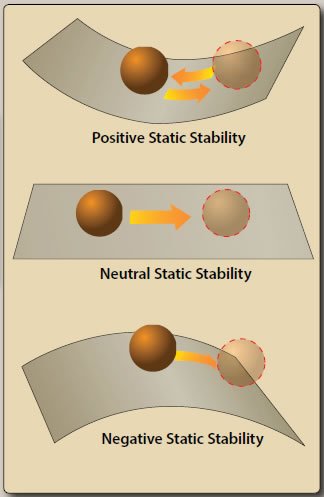
When considering an airplanes stability, we need to distinguish between static and dynamic stability. The FAAs Pilots Handbook of Aeronautical Knowledge, FAA-H-8083-25A, says the static version relates to the aircrafts initial response when disturbed from a given AoA, slip, or bank. It comes in three flavors, each of which are depicted at right:
Aircraft stability is categorized into static stability (initial response to disturbance) and dynamic stability (damping oscillations).
Static stability, which is crucial for instrument flight, comes in three forms: positive (tends to return to equilibrium), neutral (remains in new state), and negative (tends to move further away).
Positive static stability is highly desirable for an instrument platform, as it prioritizes stability and a predictable flight path over extreme maneuverability.
When considering an airplanes stability, we need to distinguish between static and dynamic stability. The FAAs Pilots Handbook of Aeronautical Knowledge, FAA-H-8083-25A, says the static version relates to the aircrafts initial response when disturbed from a given AoA, slip, or bank. It comes in three flavors, each of which are depicted at right:
CREATE A FREE ACCOUNT
Sign up to keep reading
Create a free account to continue. Already a member? Sign in below.