













Register

Instability

Stability and instability are responsible for much of the weather we encounter. But what exactly does all that mean?

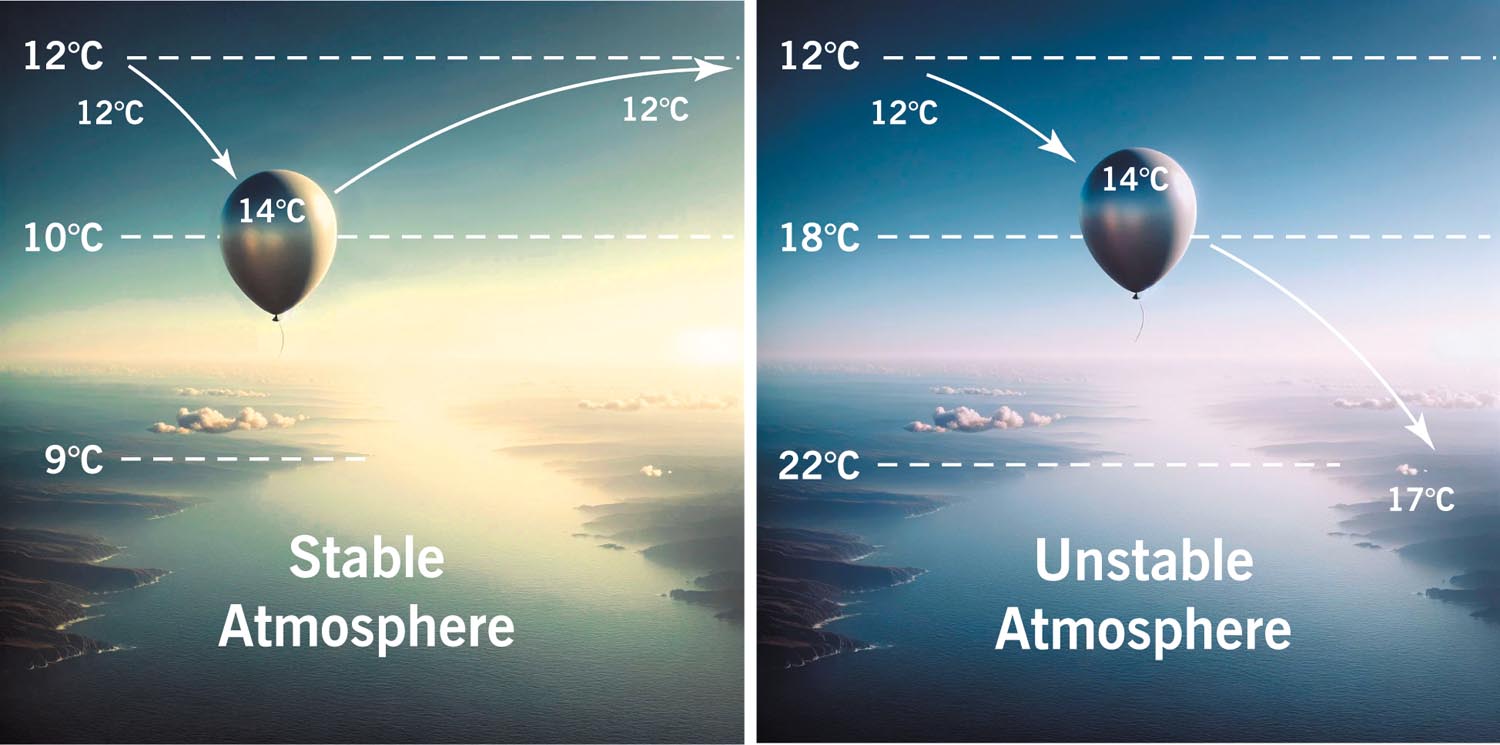
A balloon helps demonstrate the principles of static stability and instability. (Tim Vasquez)
Gemini Sparkle

Key Takeaways:

  • Atmospheric stability, critical for aviation safety, is defined by the lapse rate (how temperature changes with height). A steep lapse rate (rapid cooling with height or "cold over warm") indicates instability, while an inversion (warming with height or "warm over cold") signifies stability.
  • Stability dictates vertical air movement and related phenomena: unstable air promotes vertical motion, leading to turbulence, mixing, and often good visibility, whereas stable air resists vertical movement, resulting in smoother flight but can trap pollutants.
  • Adiabatic processes, described by the Dry Adiabatic Lapse Rate and Moist Adiabatic Lapse Rate, explain how ascending or descending air parcels cool or warm, influencing whether they become warmer or cooler than the surrounding air and thus their continued vertical motion.
  • Forecasters use thermodynamic diagrams like the Skew-T to analyze atmospheric layers and predict stability-related weather impacts, including mechanical turbulence, clear air turbulence (influenced by steep lapse rates and wind shear), and mountain wave turbulence.
See a mistake? Contact us.

Stability and instability are topics that come up a lot in aviation meteorology. Perhaps it’s been a little too long since ground school and you need a refresher. You’ve come to the right place. Physics concepts like humidity, pressure, density, and stability can sometimes be difficult to remember, and the topics are about as dry as it gets. But these things do play into the safety of your flight, and understanding them will make you a sharper pilot. So let’s begin.

Some Basic Concepts

When we consider a column of air through the troposphere, the layer of air about 20,000 to 50,000 feet deep, we find that the temperature always decreases within this layer as a whole. Smaller layers embedded within this column, including those in contact with the surface, often show different characteristics. These layers may be isothermal, showing no temperature change with height, or may increase in temperature with height, creating an inversion. The layer above the troposphere, the stratosphere, always shows an isothermal layer or an inversion, and we use this to help find the top of the troposphere.


Ready to Sell Your Aircraft?

List your airplane on AircraftForSale.com and reach qualified buyers.

List Your Aircraft
AircraftForSale Logo | FLYING Logo
Pilot in aircraft
Sign-up for newsletters & special offers!

Get the latest stories & special offers delivered directly to your inbox.

SUBSCRIBE