














And the Thunder Rolls: Convective Weather Season Is Upon Us

Flying high gives pilots the best opportunity for unlimited visibility and safe conditions.

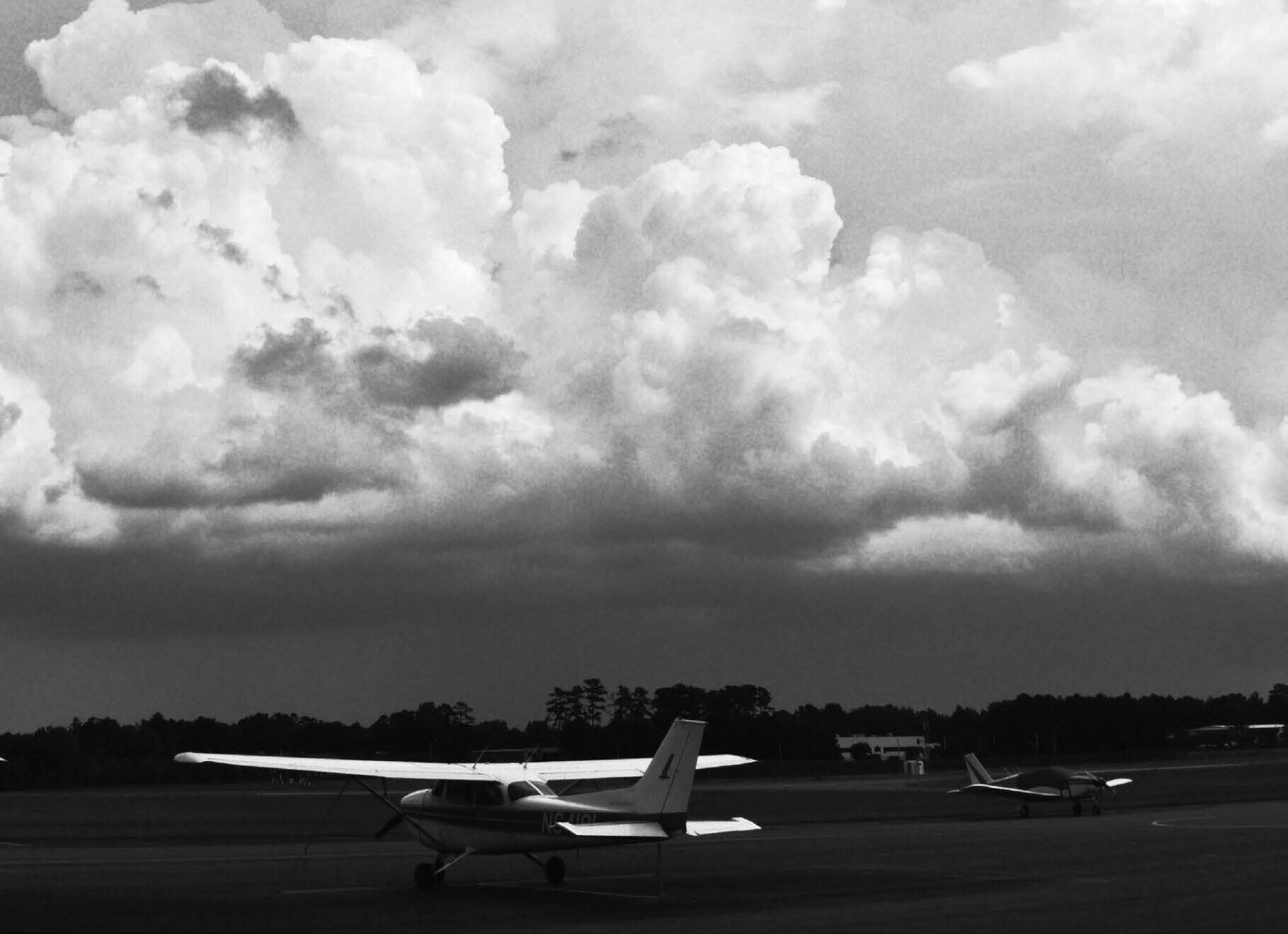
Pulse-type convection can develop quickly during the afternoon hours and be very scattered or isolated. It is usually easy to see and avoid. [Courtesy: Scott Dennstaedt]
Gemini Sparkle

Key Takeaways:

  • Pilots require a more in-depth understanding of "deep, moist convection" (thunderstorms) than basic FAA knowledge, particularly focusing on critical vertical atmospheric motion, which is difficult to measure and forecast precisely.
  • Thunderstorm development hinges on three primary ingredients: atmospheric instability (often initiated by solar heating), sufficient moisture, and an external lifting source such as frontal systems or orographic features.
  • Convective weather organizes in distinct ways—including linear formations, mesoscale convective systems (MCS), and banding—each presenting specific hazards that demand diverse in-cockpit strategies like flying high for visibility and utilizing advanced radar/datalink weather systems.
See a mistake? Contact us.

Most people like to swallow the bad news first and then wash it down with the good news. The bad news is that most of what you might have learned about thunderstorms is probably worthless—not to mention all the useless banter you hear from your local TV weather personality or read on internet aviation forums. So, in my best British accent, it is often littered with bloody misconceptions, and in some cases, outright poppycock.

The good news is that I got your attention. It is very obvious that the FAA requires a pilot to have a rudimentary knowledge when thunderstorms are a flight risk. However, being able to regurgitate the three stages of the thunderstorm lifecycle, for example, is as useful as the Washington, D.C., Air Defense Identification Zone (ADIZ) is to a general aviation pilot. 

This Article First Appeared in FLYING Magazine

If you're not already a subscriber, what are you waiting for? Subscribe today to get the issue as soon as it is released in either Print or Digital formats.

Subscribe Now

Sure, the FAA has good intentions and wants you to know that bad things can happen in and around thunderstorms. However, any pilot that has taken a long cross-country flight knows that a cursory understanding of the convective process isn’t enough to plan a safe flight during the spring, summer, and fall. For most of the following discussion, I will rely on the more generic term of convection (or deep, moist convection) rather than strictly using the term thunderstorm.   

Atmospheric Motion

When asked about atmospheric motion, the first thing that typically pops out of a pilot’s weather bag of knowledge is the wind. If we reach into that bag a little deeper, the general west-to-east movement of upper-level air, better known as the jet stream, might also emerge.  

We can easily measure or approximate this horizontal motion or air at the surface and aloft using anemometers and weather balloons, respectively. More importantly, meteorologists have been able to model this kind of horizontal large-scale motion to generate a fairly accurate forecast of wind speed and direction.

On the other hand, we rarely concern ourselves with atmospheric motion that occurs vertically. While large-scale ascent of the atmosphere can be associated with a feature such as an area of low pressure, most of the adverse weather we face in the form of deep, moist convection is due to a much smaller scale (mesoscale) enabled by buoyancy and sustained through instability and the convective process.  

Clouds, precipitation, and thunderstorms are all important manifestations of ascending air in the atmosphere. The trouble is, we cannot easily measure it. Instead, the vertical motion of air must be inferred by using the science of numerical weather prediction with the help of supercomputers. Even with all the computing power in the world, modeling individual updrafts to forecast the exact time and location that convection will form is at the moment fundamentally impossible. The best we can do right now is largely based on a probabilistic approach to forecast convection. 

Couple of Definitions

Convection is a term that meteorologists tend to throw around a lot in reference to thunderstorms.

Convection alone does not equate to a thunderstorm. It describes the transport of heat in the vertical and is largely responsible for the continued growth of deep, moist convection. Those rain showers that generate lightning are termed thunderstorms.    

Closely associated with convection, buoyancy can be thought of as the inherent force that enables the vertical displacement of air. Updrafts in convective clouds are due to positive buoyancy. More buoyant air equates to stronger updrafts. Downdrafts in a thunderstorm are characterized by negative buoyancy and contribute to most of the convective wind shear experienced at the surface including microbursts.  

Three Golden Rules

Meteorologically speaking, there are three golden rules to remember: (1) The atmosphere is always attempting to become and remain stable; (2) Insolation (solar heating) creates an imbalance over the earth; (3) Vertical motion is one process that attempts to alleviate the imbalance produced by the sun.

Keeping in mind these rules, there are also three basic ingredients before convection can develop—namely, instability, moisture, and outside energy contribution (lift). If any one of these three ingredients is missing in sufficient quantity, the probability of convective activity developing is low.    

Instability

When you worked on getting that private pilot certificate, it was etched into your brain that the standard atmospheric lapse rate is 2 degrees Celsius for every 1,000 feet gain in altitude. That is, on a standard day, the atmosphere cools at this rate from the surface up to the top of the troposphere.  

Relatively speaking, since warm air rises and cold air sinks, it would appear that the atmosphere is always in a naturally unstable state with warm air existing under cold air. Even given this seemingly unstable situation, the standard atmosphere is normally in a state that meteorologists call hydrostatic balance due to the weight (pressure) of the air above. Therefore, the first goal in convective forecasting is to predict when there is enough force in the atmosphere to overcome this basic hydrostatic balancing act. The second and more difficult feat is to determine when and where this will likely happen and how long it will last.   

As isolation takes place at the surface, this warmer air may gain enough positive buoyancy to begin to ascend. As warm air rises it will always expand and cool at a constant rate of 3 C per 1,000 feet. This is known as the dry adiabatic lapse rate and only applies only to unsaturated air. Note that the dry adiabatic lapse rate is greater than the standard lapse rate. Consequently, rising unsaturated air cooling off at 3 C finds itself in a warmer and more stable environment that only cools at 2 C and can’t rise on its own. That’s why it takes some outside energy contribution such as a cold front for air to rise and develop into deep, moist convection or thunderstorm.

The greater the environmental lapse rate is above the standard, the more buoyant the rising air. During times of strong insolation, a super-adiabatic environmental lapse rate is very common near the surface where it can exceed 6 or 7 C. This enables air to freely convect upward with little or no inhibition. 

A mesoscale convective system (MCS) has extremely cold cloud top 
temperatures and has a cloud signature that is roughly oval or circular in shape, making it easy to spot on the infrared satellite imagery. [Courtesy: Scott Dennstaedt]

Moisture and Saturation

Moisture is another key element for thunderstorm initiation and persistence. This starts with the dew point temperature at the surface. The higher the dew point, the more fuel for convection.

Assuming this unsaturated air continues to ascend by buoyancy or through lifting, it will eventually reach saturation. At this point the air is saturated and ascends at a lapse rate known as the moist adiabatic lapse rate. Although the moist adiabatic lapse rate varies with temperature, it is usually less than the standard lapse rate. A rate of 1.5 C per 1,000 feet is commonly used.  

Now the lapse rate of rising saturated air is less than the standard atmospheric rate, this makes for an unstable scenario. In other words, rising saturated air will likely find itself in a cooler, and therefore, unstable environment. This is referred to as moist convection, and when it grows vertically well into the flight levels, it is called deep, moist convection.

Even several days prior to your flight, you can assess just how unstable the atmosphere is by looking at various model-forecasted instability indices such as the lifted index and convective available potential energy (CAPE). They will give you an indication of the magnitude of the instability that may exist along your planned route of flight.

Lifting Source

Frontal systems are typically the most notable lifting source. Any frontal system to include cold, occluded, warm, and stationary can provide the necessary vertical forcing. Additionally, orographic lifting due to air rising up and over mountains can also provide the necessary lift to enable convection. 

Outflow boundaries, sea breeze fronts and upper-air dynamics can also provide enough lifting to initiate convective development in an unstable atmosphere.      

Thunderstorm Organization

Thunderstorms in the midlatitudes can be organized in one of three basic ways, namely, linear, complexes, or banding.

There is also a fourth case where thunderstorm initiation may be contained entirely within an air mass and therefore organization may or may not be as apparent. More on this later. 

Linear

The most common form of thunderstorms we experience consists of a line of cells. Normally, a line of convection occurs along a strong thermal and moisture gradient between two air masses.

When one air mass moves into another, a line of convection may develop, grow, and persist. Lines of convection are most closely tied to cold or occluded fronts and dry lines but may exist along a warm or stationary front as well. The terms “squall line” and “instability line” have also been associated with a line of intense convection ahead of a cold front.

Squall lines can also develop along outflow boundaries typically a hundred miles or more ahead of an intense cold front. These boundaries are a very effective surface-based lifting mechanism for initiation. 

Convective Complexes

The next organization of thunderstorms has been given the name mesoscale convective system (MCS). Researchers only recently described this category of thunderstorm organization in the early 1980s, so don’t feel bad if you haven’t heard of it.

An MCS normally begins as a number of isolated thunderstorm cells forms in the late afternoon or early evening. By late evening, the thunderstorms’ anvil cloud tops merge, creating the signature circular- or oval-shaped cloud shield you see on the color-enhanced infrared satellite imagery that can grow to be the size of Wyoming. This cloud shield masks what can be seen typically as a bow-shaped line of returns on ground-based radar mosaics. 

MCSs are nocturnal beasts and normally persist into the early morning hours and sometimes can persist for 24 hours or more. Complexes are typically not fast moving and can become nearly stationary. They can produce torrential rains, flash flooding, and hail. While they can spawn tornadoes, mature MCSs can produce severe windstorms called “derechos.” Bow-shaped radar echoes are often observed with a derecho, which is a classic sign of damaging, low-level, straight-line winds.    

These MCSs tend to form most frequently east of the Rocky Mountains. In May, you will start to see these develop and move through the southern Plains and lower Mississippi Valley. As spring morphs into summer, they tend to form in the central Plains and move east into the middle Mississippi Valley. Then by the middle to end of summer, they are more common in the northern Plains and Great Lakes region.   

Banding

Thunderstorms that occur with tropical storms and hurricanes are not associated with a separation of air masses. Instead, these thunderstorms are organized in bands around the tropical system’s eye wall and move outward from there.

Besides heavy rains, these storms also can produce small tornadoes and may contain little or no lightning.  

Unorganized

You may have heard the terms “air-mass,” “popcorn,” or “pop-up” thunderstorm. As the terms suggest, do these thunderstorms develop in some random fashion? Not exactly.

According to research meteorologist Dr. Charles Doswell, “thunderstorms develop at a particular time and place for a reason, even though it is often difficult to the point of being impossible to diagnose those reasons with enough accuracy to be able to forecast thunderstorm initiation time and location.” 

There is a tendency to label a thunderstorm as falling into either an “air-mass” or “frontal” category. Fronts provide an adequate lifting mechanism to develop convection, whereas other thunderstorms develop within broad areas of more or less homogeneous characteristics (air masses). The latter meteorologists call “pulse-type” convection. It is often taken to imply that the thunderstorms develop more or less randomly in the “air mass,” as opposed to the organization provided by the front. Doswell believes many thunderstorms develop outside of surface frontal zones.

“The development of thunderstorms is never random,” Doswell said. “They develop in particular places at particular times for reasons that we may not be able to observe and/or understand, but it is absurd to think that thunderstorms develop, in effect, for no reason.”

Back in the Cockpit

Navigating through a line or area of convection is not a wise choice without some kind of weather-avoidance equipment in the cockpit. While some aircraft are equipped to fly over some of these beasts, many are stuck with flying around or between them.

If you do have onboard radar, Stormscope, or datalink weather, the best strategy is to fly high and stay visual. The latter is especially difficult to do after the sun sets.    

The reason to fly high is to be able to remain above the haze layer that frequently exists prior to a developing convective event. If you are flying below this layer, you may not be able to see the full extent of the cumulus field that may be starting to blossom in front of you.  

What altitude is high enough? The higher the better. It’s always an advantage to be looking down at the cumulus field rather than trying to fight your way through it or under it where moderate turbulence will likely ensue as morning turns into afternoon. Moreover, you’ll usually have unlimited visibility and smooth conditions the higher you fly.

The start of the haze layer varies, but typically occurs below 10,000 feet agl and may intermingle with the cumuliform clouds. If you become familiar with forecast temperature soundings, you can usually estimate where this haze layer might be lurking. Of course, you’ll establish its exact location once you become airborne.      

As you compare what you see visually with the datalink weather graphical products that are literally at your fingertips, you can plot to remain separated from these boomers. A solid line on the other hand either means a huge diversion or a “land-and-wait-it-out” situation. And remember, diversions suck fuel out of the tank, so plan accordingly.     

Don’t become complacent. An active Stormscope will certainly keep you out of the truly ugly parts of a thunderstorm. Keep in mind that it doesn’t take lightning to represent a metal-bending threat. You can have a huge and dangerous growing cell without one strike on your trusty Stormscope. That’s why onboard radar or datalink ground-based radar provided by SiriusXM or FIS-B can help. Stay out of the reds and yellows (and God forbid magenta), and you’ll stay clear of most of the rough stuff although there are many exceptions.   

Unlike icing conditions that can shut down entire sections of the country for long periods of time for us noncertified ice protection folks, thunderstorms are a little more forgiving. Planning your flying activity in the early morning hours is still one of the absolute best practices. From a daily perspective, thunderstorms are more likely to be active between the hours of 2 p.m. and 9 p.m. local due to the daytime heating that supplies some of the fuel for convection. 

This is not to say that thunderstorms (even severe ones) won’t happen outside of this convective window. This is especially true unless you fly in the central Plains, where much of the convection occurs in the overnight and early morning hours. You still must be very cognizant of the synoptic picture and the forecast. A strong cold front can produce a nasty thunderstorm at 8 a.m. in the dead of winter.


This feature first appeared in the July Issue 960 of the FLYING print edition.

Scott Dennstaedt, Ph.D

Scott resides in Charlotte, North Carolina, and flies regularly throughout the Mid-Atlantic and Southeast U.S. He is a CFI and former NWS meteorologist. Scott is the author of "The Skew-T log (p) and Me: A Primer for Pilots" and the founder of EZWxBrief.
Pilot in aircraft
Sign-up for newsletters & special offers!

Get the latest stories & special offers delivered directly to your inbox.

SUBSCRIBE

