Full Issue PDF

Download the Full December 2016 Issue PDF

Most modern comm radios can tune frequencies with 8.33 kHz channel spacing, which currently is required only in high altitude airspace in Europe (Code Y). It would not be necessary to indicate that in the U.S. Further, Im not sure we can file a performance-based navigation (PBN) code as they require FAA approval. The closet reference is AC 90-100A-maybe someone can interpret this for Part 91 (non 91K) operations.

Read More »

Download the Full December 2016 Issue PDF

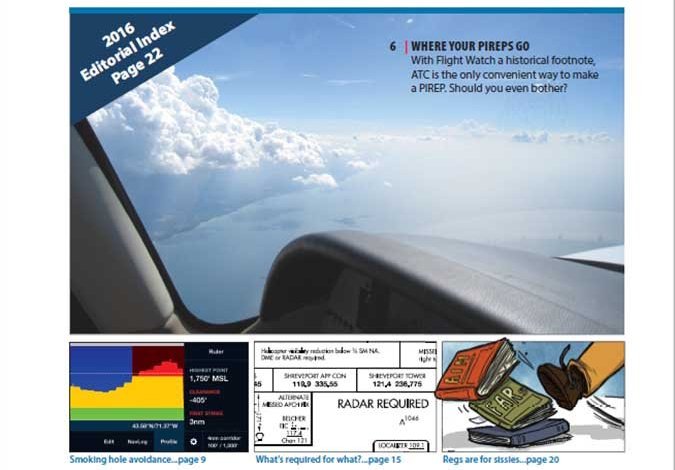
The multiple steps involved in filing NOTAMs and PIREPs can steal time from a controllers main purpose of separating aircraft. From their first transmission as a trainee, controllers have the term priority of duty bashed into their head. Allowing two aircraft to get too close because you were distracted by a PIREP or a NOTAM is not an option.

Read More »

Download the Full November 2016 Issue PDF

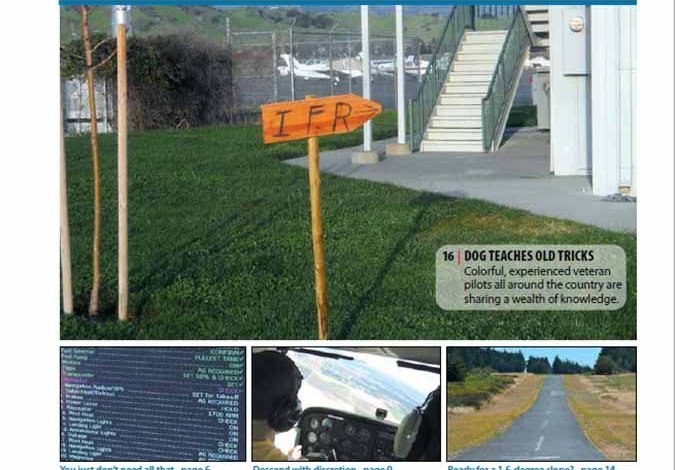
If your aircraft model has a type club or owners organization, you may want to join and participate in their training programs and related activities. Many of the name-brand types are well-served by these programs, and their graduates often come away with new and safer insights on how to operate their aircraft. If your aircraft has unusual handling characteristics-or if you just want to be able to take full advantage of its performance-obtaining specialized instruction from an instructor or training center with experience in that model should be a no-brainer.

Read More »

Download the Full November 2016 Issue PDF

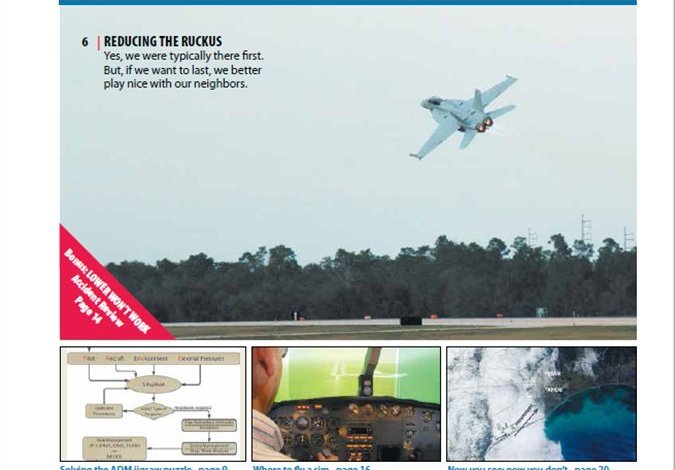
For jets over 75,000 pounds, many airports urge pilots to use Noise Abatement Departure Profiles (NADPs). There are two detailed in FAA AC 91-53. A Close-in Community NADP is intended to provide noise reduction for noise sensitive areas located in close proximity to the departure end of an airport runway. A Distant Community NADP has less stringent requirements since the noise-sensitive areas are further away. Each specifies thrust settings, speeds, lift device settings, and altitude goals, all designed to maximize climb rate and minimize disturbances.

Read More »

Download the Full October 2016 Issue PDF

That was when I realized that my system had stopped charging. Not only was the weather collapsing, but the location I had just departed had limited maintenance options and expected severe thunderstorms with hail the following day. From my previous loss of electron flow, I knew I could do a great deal in this different airplanes cockpit to manage power consumption, plus I was flying steam gauges that didnt need electrons. Plus it was Mothers Day weekend, so continuing to a destination with known good weather required less decision making than finding an alternate airport with services.

Read More »

Download the Full October 2016 Issue PDF

In fact, since many pilots learned to do things with canned checklists from the very beginning, they go about things following rote instructions rather than practicing a higher level of understanding and cockpit resource management. Later on, this can make training for advanced aircraft more challenging, since pilots must then adapt to the other methods well discuss below. Note that were not talking about eliminating checklists insofar as written guidance to structure your operations.

Read More »

Download the Full September 2016 Issue PDF

As I progressively increased my use of the Mooney and Bonanzas, the process of safely using the airplanes for virtually all of my domestic transportation followed a more organized safety management process. Cutting to the chase, in the 52 years I have been flying I have not had an accident, incident or serious occurrence where the outcome of the flight was in doubt. I also accomplished my transportation objectives more than 95 percent of the time. Im no superman and only an average stick, so what are my secrets? Pilots will all approach this differently, but I believe the factors highlighted in the sidebar on page 5 were most responsible for this record.

Read More »

Download the Full September 2016 Issue PDF

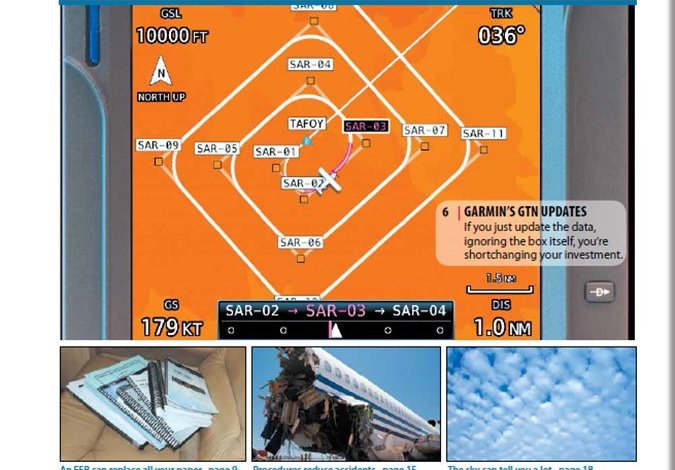
From a flight plan perspective, waypoint sequencing is suspended at the hold waypoint. Thus, the CDI is always showing an error relative to the inbound course. But, as you near the hold and for each turn in the hold, you get an annunciation telling you what to do. In addition, if you have GPS steering to your autopilot, the autopilot will fly the hold, even though the CDI shows a large error on the outbound leg. While creating the hold is straight forward, there are some nuances to exiting the hold. If you select the hold from the flight plan, you have an option to simply, Exit Hold. Selecting this will have you complete the present circuit and then proceed to the next leg.

Read More »

Download the Full August Issue PDF

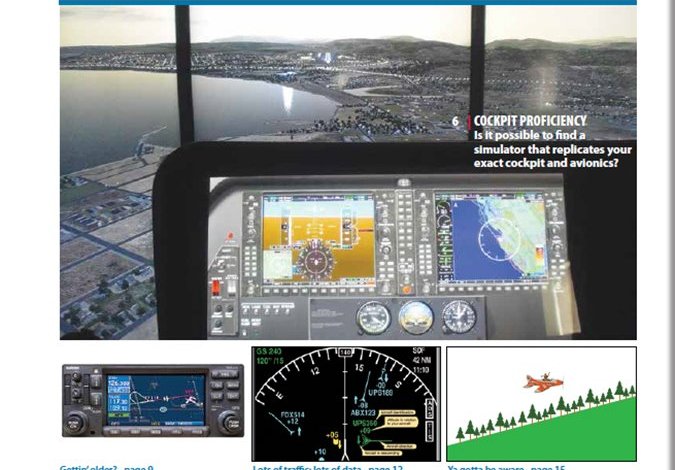
If you need realistic switches and levers in realistic locations, youll need a bigger budget. Much bigger. Flight Training Devices (FTDs) put actual avionics, or near-exact replicas thereof, in realistic cockpits. If one of these sims offers a G1000, thats a real G1000 display. The Level simulators at the sim centers and airlines are of this type. These can cost as much as many airplanes (like $250,000 and up). In partnership with a flight school that might work, but its not what most of us put in our basement.

Read More »

Download the Full July 2016 Issue PDF

While an FBO might have policies, published hours and options galore for the wayfaring airman, at many airports, the lowly line man or woman is your first and last line of defense when you are up against any of the scenarios he mentioned, and a host more. They can make or break your trip, and they know it. How much he or she cares may very well be tied to how you treated them the last time your presence graced their ramp.

Read More »
Pilot in aircraft
Sign-up for newsletters & special offers!

Get the latest stories & special offers delivered directly to your inbox.

SUBSCRIBE