Full Issue PDF

Download the Full June 2017 Issue PDF

Many mainstream aviation publications include a recitation of facts about selected accidents. The idea, Im sure, is a there-but-for-the-grace-of-God-go-I kind of warning. Clearly theres value in that information, but when I read those sections Im often left with a so-what or too-bad-for-them reaction because discovering the applicability of those mishaps is left to the reader. IFR has never published many articles about accidents. However, weve recently begun to occasionally include that article genre in the lineup of the mag.

Read More »

Download the Full May 2017 Issue PDF

For almost as long as Ive been flying, the general aviation industry has been in upheaval. By the mid-1980s, product liability concerns and tax law changes helped remove what was propping up things, and the bottom fell out. Among other outcomes, Cessna stopped making piston-powered airplanes altogether while other manufacturers discontinued numerous models, preferring to concentrate on one or two.

Read More »

Download the Full May 2017 Issue PDF

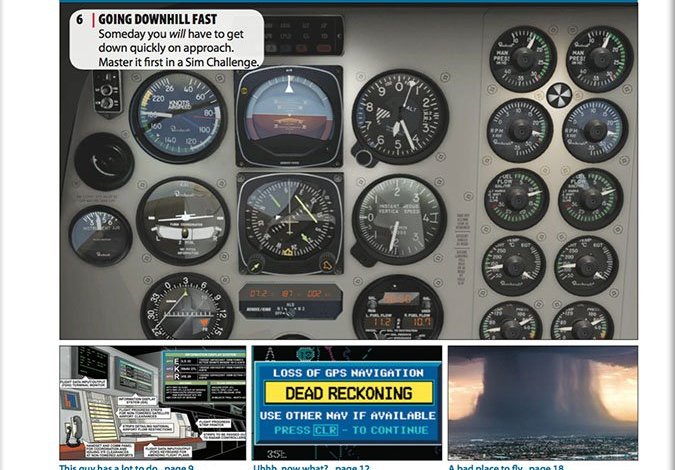
Anything that can go wrong, will, and at the worst possible moment-so states Finagles corollary to Murphys Law. This notion is drilled into pilots from the beginning, so that it becomes second nature to have a plan to handle all sorts of potential failures that could be experienced in flight. Engine failure: check. Instrument and system malfunction: got it covered. Communication failure: no problem. GPS failure… Uhhh, what? Hang on a minute.

Read More »

Download the Full April 2017 Issue PDF

There is a fundamental reason we perform preflight run-ups and engine checks before takeoff: It is a whole lot better to find problems at 1G, 0 feet agl and 0 knots airspeed than it is while airborne. Making sure a power- plant will work as we intend before taking off is just good airmanship. A good run-up doesnt mean every- thing is perfect, however, and we train for airborne engine problems, including full use of its controls and instruments. Sometimes, though, the problems were looking for dont reveal themselves when it is convenient for us, and we have to diagnose engine issues in the air. Urgently. And fly the airplane at the same time. It is not a comfortable experience.

Read More »

Download the Full April 2017 Issue PDF

Aviation widely relies on the transfer of institutional knowledge. The flight instructor teaching you to fly didnt acquire all his/her skills alone. Someone taught them the basics, who in turn was taught by another individual, and so on. Lessons from past experience (a.k.a. mistakes) enlighten future generations. ATC is no different. Regardless of background, when a controller walks in the door of an ATC facility, they need to learn how to work that particular facilitys airspace. Achieving certification depends on the experience and guidance of the other controllers and staffers.

Read More »

Download the Full March 2017 Issue PDF

The FAA is focusing on increasing the use of PBN procedures, particularly RNAV STARs. Increased use of PBN procedures will reduce ATC complexity and simplify traffic sequencing. PBN begins to really shine as new, more efficient traffic management and avionics capabilities enter the NAS. Pilots will find ATC more predictable and discover more opportunities to fly efficiently. At about 3300 smaller airports, safer PBN approaches with LPV and LNAV/VNAV minimums will be commissioned to every qualified runway. Most, but not all, airports will have an IAP to at least one runway end.

Read More »

Download the Full February 2017 Issue PDF

At this writing, its impossible to know what ongoing investigations will determine, and whether either the flight crew or the controller will face consequences. This and other incidents, however, highlight a longstanding problem: air traffic control is designed by and comprised of humans, and its therefore imperfect. Controllers make mistakes just like the rest of us, pilots included. The challenge is to recognize those mistakes when they happen and take action appropriate to resolve the issue. A recent encounter I had at a towered airport reinforces the old, bad joke that the controller likely will feel really bad after an accident. The pilot likely wont feel a thing.

Read More »

Download the Full February 2017 Issue PDF

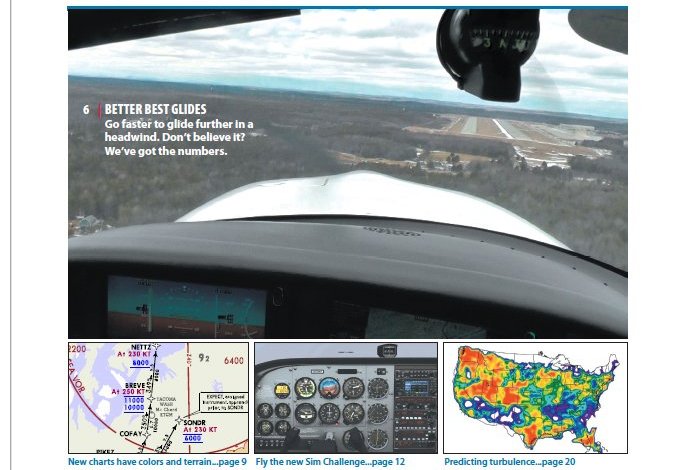
A 20-knot headwind or tailwind for a gliding 747 makes for a rounding error, but for an engine-out single it can mean the difference between an on-airport landing and an off-airport tragedy. Glider pilots have charts and techniques for speed and loading to maximize their performance, including adjustments for wind. They call it Speed to Fly; for X headwind increase the indicated glide speed to Y for a new rate of descent of Z.

Read More »

Download the Full January 2017 Issue PDF

Until recently, the constituency comprising LBA operations was paid little attention by the major aviation organizations. Most general aviation pilots affiliated themselves with either the Aircraft Owners and Pilots Association (AOPA) or the Experimental Aircraft Association (EAA). Most of those organizations members, especially in EAA, often do not fly for personal or business transportation purposes. The heavy-iron two-pilot corporate jets already were well represented by the NBAA.

Read More »

Download the Full January 2017 Issue PDF

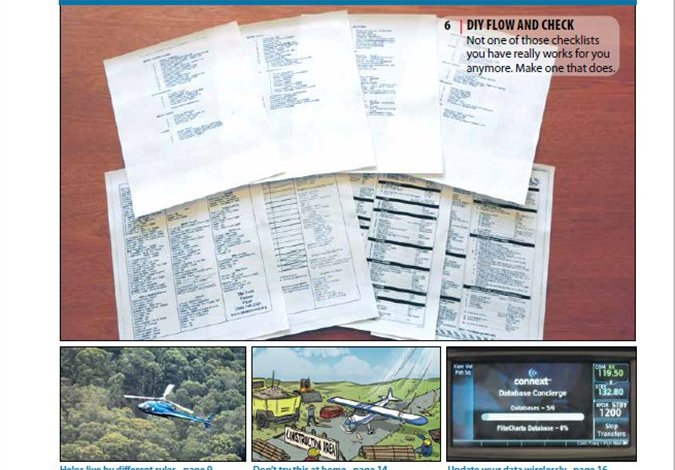
Unless youve already made your own checklist(s), chances are youll want to add a few items to what youve got so far. Say you mostly fly IFR. Youll want IFR-specific items in your checklists. So, consider adding items for flight plan (checked), departure briefing, approach briefing, etc. Or, perhaps youve found that turning off your fuel pump during the After Takeoff check is something you often forget. Consider making a redundant entry in the Cruise check.

Read More »
Pilot in aircraft
Sign-up for newsletters & special offers!

Get the latest stories & special offers delivered directly to your inbox.

SUBSCRIBE