












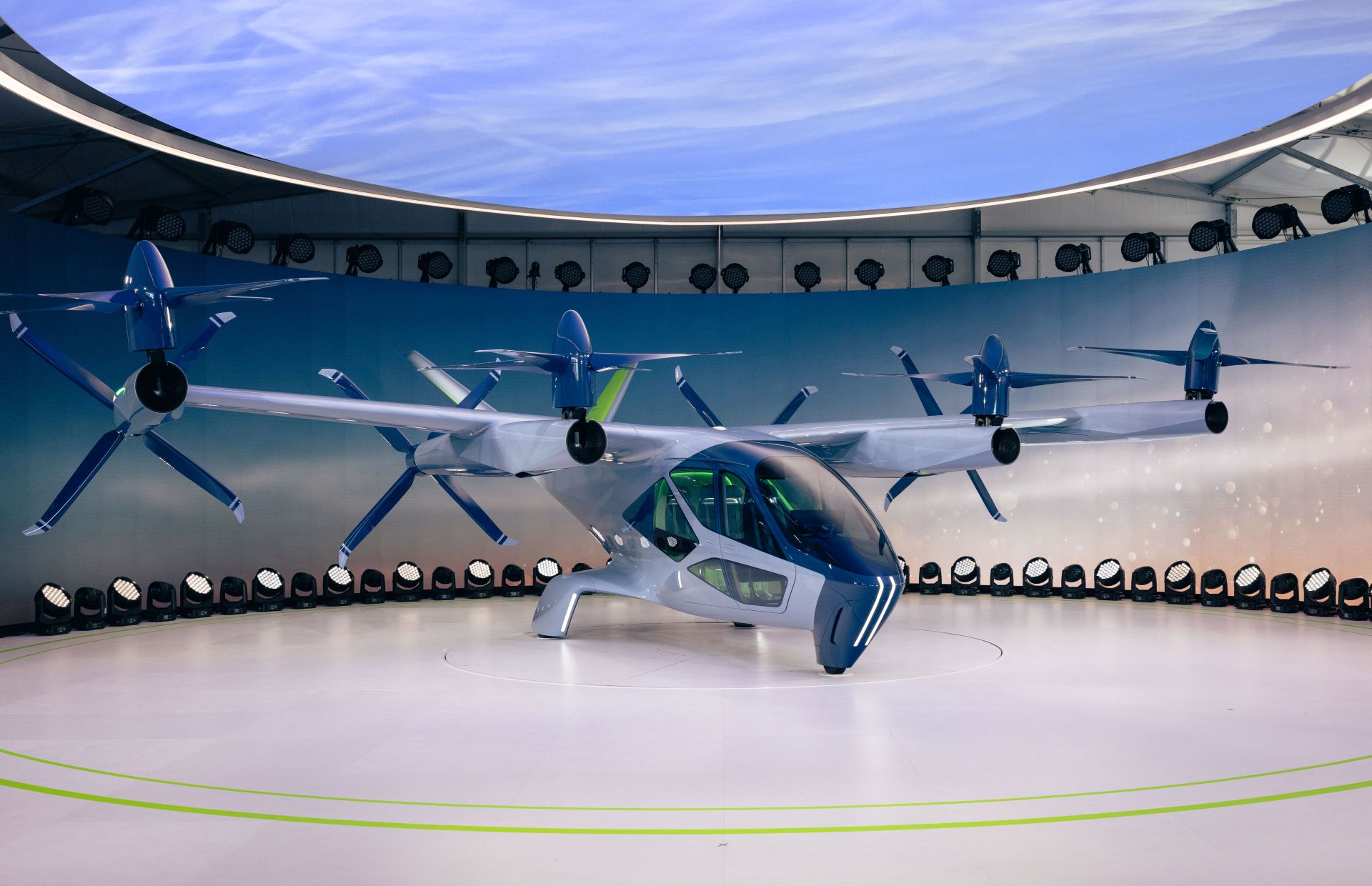


Supernal, the electric vertical takeoff and landing (eVTOL) air taxi unit of South Korean automaker Hyundai, is reportedly pumping the brakes on its flagship aircraft.
The Orange County Register was first to report that Supernal is “pausing” its aircraft program, which began tethered flight testing with a demonstrator in March but for years has struggled to get off the ground. The company is targeting a commercial launch by 2028 in cities such as Los Angeles, where it has acquired facilities in nearby Irvine and Fremont.
The Register was also first to report the departure of Supernal chief technology officer David McBride, who was previously the longest standing director of NASA’s Armstrong Flight Research Center in Edwards, California. McBride’s exodus follows that of Supernal CEO Jaiwon Shin, who headed Hyundai’s advanced air mobility (AAM) division, amid what the company in August described as a “strategic leadership transition.”
“As we transition to new leadership, we have taken the opportunity to strategically review our program’s progress and next steps to ensure alignment with our long-term goals,” a Supernal spokesperson said in a statement shared with FLYING. “Hyundai Motor Group remains strongly committed to its AAM business.”
Shin—also a NASA veteran—transitioned to an advisory role, and interim chief operating officer David Rottblatt will assume his responsibilities. Veronica Grigoriou, who leads external communications for Supernal, said the company “remains confident in the long-term potential of AAM and will continue investing in building a sustainable business.”
“While the AAM industry continues to face external challenges—including regulatory frameworks, infrastructure development, and ecosystem maturity—Hyundai Motor Group views these as part of the natural evolution of a pioneering sector,” Grigoriou wrote.
Supernal Struggles
Though AAM regulations and infrastructure are still being developed, Supernal has yet to prove it has an aircraft that can take advantage of them.
The company earlier this year began initial testing at a facility at Edwards Air Force Base (KEDW) in California but has yet to achieve flight with a production-intent model or without a tether. That program has been “placed on hold,” the Register reported.
Supernal over the summer cut more than 50 employees across its facilities in Fremont, Orange County, and Mojave, California, part of broader cost-cutting measures at Hyundai. According to her LinkedIn, Tracy Lamb also stepped down from her role as the company’s chief safety and quality officer in August. Those moves have left Supernal with about 500 employees.
Sergio Cecutta, who leads SMG Consulting’s AAM Reality Index, described the pause as “more of a re-invent as opposed to a shut-down.”
“I think Supernal is re-establishing the framework of their entire company: who they are, what markets they are going after, what aircraft to offer, and the timeline,“ Cecutta told FLYING.
“I would not be surprised if it takes some time and a new Supernal emerges. I think that the mothership Hyundai still believes in urban air mobility as an extension of their car business.”
Like other eVTOL air taxi developers, Supernal has ambitions to change the way people fly by combining the vertical lift capability of rotorcraft with the efficiency of fixed-wing aircraft. But bringing the concept to fruition is not without challenges.
The Hyundai subsidiary unveiled its flagship S-A2 concept in January 2024 at the Consumer Electronics Show (CES) in Las Vegas. The model is designed initially for a pilot to fly up to four passengers on zero-emission, 25 to 40 sm urban routes, cruising at about 120 mph (104 knots) at 1,500 feet agl.
Like many of its competitors, the S-A2 uses a distributed electric propulsion system to power an array of tilting propellers, which aid in all phases of flight. Per Supernal, the aircraft will operate as “quietly as a dishwasher.” It also features an unusual V tail design that combines the functions of a rudder and elevator, similar to the Cirrus Vision SF50 or previous versions of the Beechcraft Bonanza.
Supernal, with the backing of Hyundai, is unlikely to go the way of German competitors Lilium and Volocopter, which ran out of cash last year. Lilium has since shut down operations, while Volocopter’s assets were acquired by the parent company of Diamond Aircraft.
Still, a prolonged hiatus could put it behind competitors such as Joby Aviation, Archer Aviation, Beta Technologies, and Boeing’s Wisk Aero. Joby and Archer have obtained certification bases from the FAA, while Beta in July told FLYING it intends to use the agency’s recently published certification guidance to secure its airworthiness criteria. Wisk, which is designing an autonomous model, is targeting a commercial launch toward the end of the decade.
But according to Cecutta, Joby, Archer, and Beta’s eVTOL designs are unlikely to enter service before 2027. SMG’s AAM Reality Index—which assigns a rating to developers based on their progress toward delivering a mass-produced aircraft—ranks Supernal well below its rivals, meaning any delay to its timeline could jeopardize the firm’s 2028 target.
Like this story? We think you’ll also like the Future of FLYING newsletter sent every Thursday afternoon. Sign up now.

