












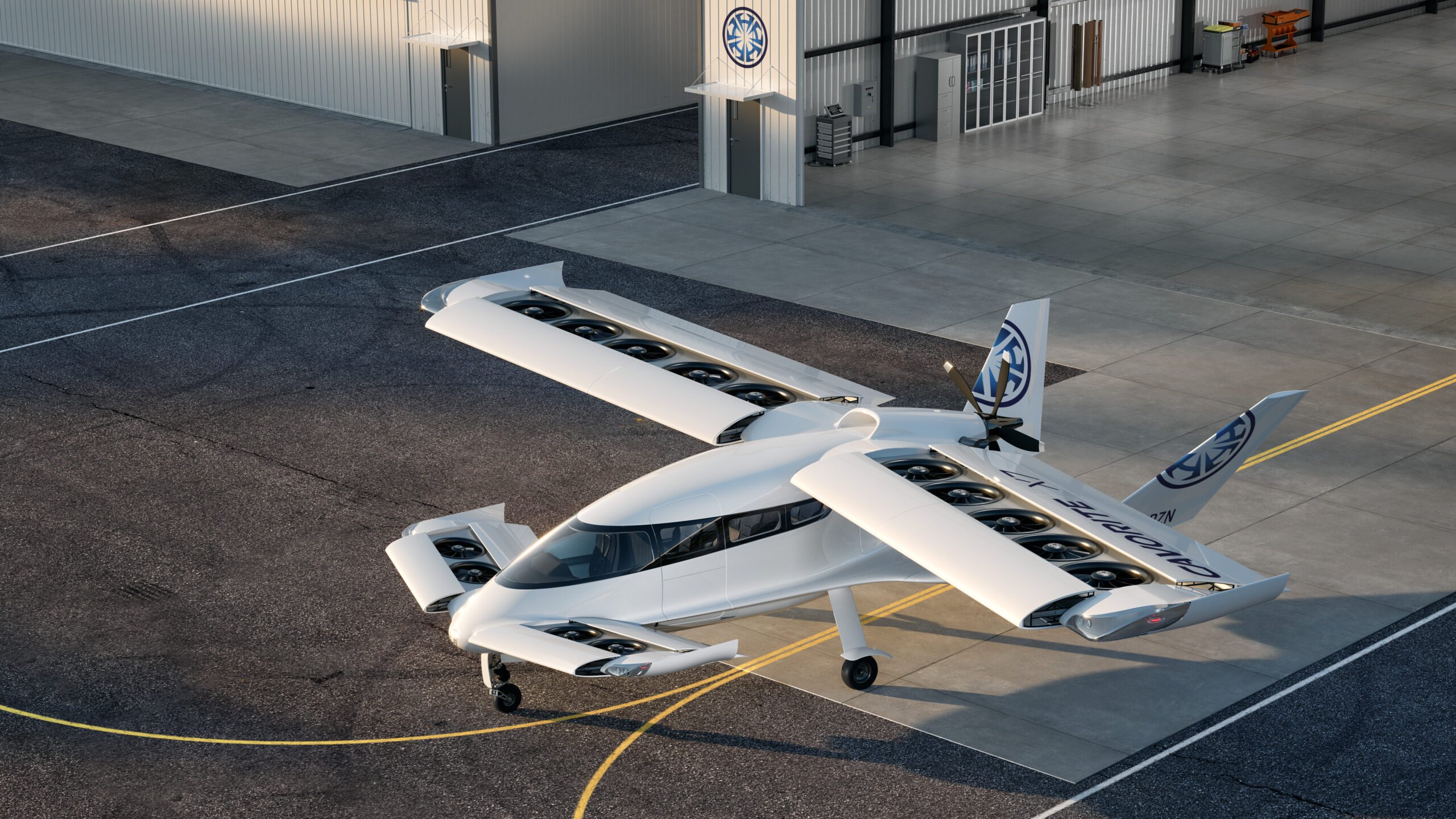

Canada’s Horizon Aircraft, a developer of a hybrid-electric vertical takeoff and landing (VTOL) aircraft, believes its Cavorite X7 will avoid the cold-weather pitfalls faced by most helicopters.
The company on Friday said it will aim to certify the X7 for not only IFR operation but also flight into known icing conditions (FIKI). That would give it a level of operational flexibility typically reserved for large, expensive rotorcraft, whose exposed blades are vulnerable to ice formation.

The X7 also includes blades on its 14 wing-embedded vertical lift fans. That hardware enables its VTOL capability, though the aircraft can also take off conventionally from the runway. In the air, the fans are covered by sliding panels, enabling conventional, fixed-wing, low-drag flight. But on the ground, they are susceptible to icing.
Horizon envisions the aircraft taking on a variety of roles, from medical evacuation and search and rescue to high-urgency logistics and military missions. Crucially, it said Friday, those operations will be conducted “reliably and year-round, with enhanced safety, speed, and lower operating costs” compared to existing aircraft. For example, the company said, icing conditions can cause cancellations or interruptions to the Canadian Coast Guard’s support helicopters.
Earlier this month, the Royal Canadian Air Force visited Horizon’s Ontario facility and received a tour of the X7. Recently, the company began a series of all-weather vertical propulsion trials under a grant from Canada’s Initiative for Sustainable Aviation Technology program. It plans to use that effort to test ice-phobic and electrothermal coating solutions, as well as other ice detection and protection technologies.
“The Cavorite X7 is one of the only modern VTOL aircraft designed to fly in clouds,” said Brandon Robinson, co-founder and CEO of Horizon, in a statement. “This significant differentiator will provide all-weather operations with improved performance for all real-world operations.”
Like Horizon, Vermont-based Beta Technologies plans for its Alia VTOL to have FIKI permissions. Competitors Joby Aviation and Archer Aviation, though, are not seeking FIKI certification for their designs.
Beta’s Alia will also be IFR-capable and has extensive IFR experience through demonstration flights. Joby and Archer plan to certify their S4 and Midnight aircraft, respectively, as VFR-only, though Joby in a February SEC filing said it intends to add IFR permissions down the road.
Not Your Average VTOL
Though Beta too is pursuing FIKI certification, Horizon claims its X7 has a greater range, speed, and payload than the Alia, Midnight, S4, or EHang’s EH216-S.
The aircraft’s unusual fan-in-wing configuration resembles that of the Lilium Jet, which was in development by Germany’s Lilium until it filed for insolvency this year. Unlike the Lilium Jet, however, the X7’s hybrid-electric power system can run on 100 percent electricity or a combination of electric and gas. Since the fans aren’t needed for cruise flight, Horizon claims the model will spend about 98 percent of its mission time in a conventional configuration.
The X7’s other calling card is its flexible takeoff and landing capability. It can use a normal runway or take off and land vertically from an area about the size of a tennis court.
The hybrid-electric VTOL model is designed for a pilot to fly up to seven passengers or about 1,500 pounds of cargo, or up to 1,800 pounds with a conventional takeoff. It has a projected cruise speed of 150 knots and range of 500 miles with reserves, or 900 miles without cargo. The X7’s batteries can be recharged between missions or in the air using a range extender motor.

