














Europe’s Space Agency Signs Commercial Launch Agreements

Contracts with Isar Aerospace and Avio are the first between privately funded launch providers and European institutions.

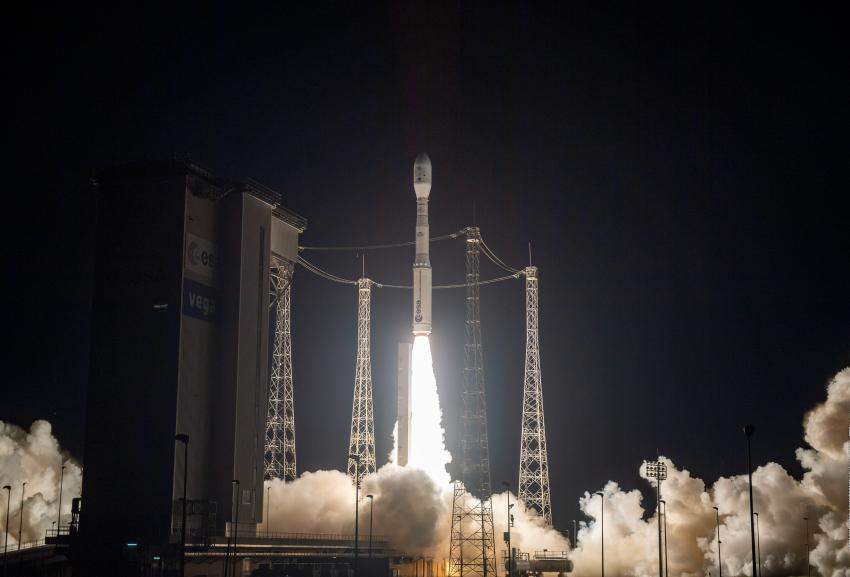
Avio Vega-C launch vehicle
Avio’s medium-lift Vega-C lifts off on its fifth mission from the European Spaceport in French Guiana. [Courtesy: Avio]
Gemini Sparkle

Key Takeaways:

  • The European Space Agency (ESA) is accelerating efforts to achieve space independence and compete with the U.S. commercial launch industry through its new Flight Ticket Initiative.
  • Under this initiative, ESA awarded its first commercial launch service contracts to Italy's Avio and Germany's Isar Aerospace for a total of five missions.
  • These missions will utilize Avio's Vega-C and Isar Aerospace's Spectrum rockets to test critical technologies, including space debris cleanup, advanced satellite propulsion, and Earth observation.
See a mistake? Contact us.

The European Space Agency (ESA) is stepping up its efforts to compete with the likes of SpaceX and the American commercial launch industry.

The agency on Thursday awarded contracts to Italy’s Avio and Germany’s Isar Aerospace to provide launch services for five missions. The commercial agreements represent the first between privately funded European launch providers and Europe-level institutions.


Avio and Isar’s contracts are the inaugural awards under the Flight Ticket Initiative: a collaboration between ESA and the European Commission that funds European launch vehicles and missions with “ready to fly” experiments.

The project began in 2023 with a call for expression of interest, which remains open to satellite operators through mid-March. In May 2024, ESA selected a first batch of Flight Ticket Initiative companies that it will retain for launch services: Isar, ArianeSpace, PLD Space, Orbex, and Rocket Factory Augsburg. The companies will compete for work orders with a ceiling of 5 million Euros as payloads are selected.

Though not part of that initial pool, Avio received a contract for launch services with its Vega-C after splitting from its launch agreement with ArianeSpace in July. Avio builds boosters and motors for Ariane’s family of ESA-owned, heavy-lift rockets.

The mission awards come amid a push for European independence in space exploration. Outside of the Ariane vehicles and Avio’s Vega, ESA largely relies on foreign spacecraft such as SpaceX’s Falcon 9—which handled more than half of all orbital launches in 2024—to fly payloads to orbit.

New Era of Launch

Avio and Isar took very different paths to reach this point.

Between February 2012 and its retirement in September, Avio’s Vega flew 22 missions for ESA and other European and commercial customers. Vega-C, which debuted in 2022, was developed as a more powerful successor to the small-lift launcher. ESA owns the program, with Avio as the prime contractor.

The medium-lift Vega-C introduced improvements across the design. The rocket’s larger first propulsion stage—which also powers the Ariane 6—significantly increases thrust at liftoff. Its Zefiro 40 second stage can hold about 25,000 pounds more propellant than Vega’s Zefiro 23.

Similar to its predecessor, Vega-C’s upper stage is designed for extended stays on orbit and can relight its engines in space to deliver multiple payloads to different orbits on a single mission. Sitting atop it, though, is a payload fairing that doubles the cargo volume of Vega.

All Vega-C launches lift off from the European Spaceport in French Guiana, which previously hosted Vega. Standing about 115 feet tall, the vehicle is designed to carry about 7,300 pounds to low-Earth orbit (LEO), accommodating payloads that are large, small, or unusually shaped. Avio can use it to offer satellite rideshare missions and flights with multiple customers.

Vega-C is also being developed to support missions of ESA’s Space Rider—an uncrewed robotic laboratory designed to host orbital experiments that can be returned to Earth. The first flight of the reusable spacecraft aboard Vega-C is scheduled for 2027.

Avio is developing an improved upper stage for Vega-C that combines the current upper stage and third propulsion stage, which respectively use solid and liquid propellant. It will be powered by the company’s M10 engine, which can carry 22,000 pounds of cryogenic liquid oxygen and methane. Reducing the number of stages from four to three simplifies the design, which according to ESA will lower launch costs and improve performance.

Isar, meanwhile, is a new player looking to put its stamp on the industry.

In March, the company’s two-stage, small-to-medium-lift Spectrum became the first commercially built rocket to lift off from continental Europe. The rocket exploded about 30 seconds into the test flight but did enough to attract the interest of ESA.

Spectrum is designed to compete directly with Falcon 9 and the Ariane family, launching small and medium satellites up to 2,200 pounds to LEO. It stands about 92 feet tall, burning 40 tons of liquid oxygen and propane across its nine first-stage engines and single second-stage engine. According to Isar, launch vehicles for the next two test flights are in production at the company’s factory near Munich, where it aims to build 40 rockets per year.

Daniel Metzler, CEO of Isar, said the development of Spectrum is a “key step in strengthening Europe’s sovereign space access.”

“Recent political events…have underscored the critical importance of space for Europe’s security, prosperity, and autonomy,” Metzler said in a LinkedIn post in March. “Gaining competitive, flexible and independent access is a major leap forward.”

The Missions

Isar said its two Flight Ticket Initiative missions will take place from 2026 onward, launching from Andøya Spaceport in Norway.

French company Infinite Orbits will fly its “Tom & Jerry” mission aboard Spectrum to simulate the cleanup of space debris. It will launch a pair of satellites, with one standing in for a piece of debris and another approaching to within a few meters of the dummy satellite. The company’s goal is to enable future missions to remove or service satellites that are no longer operational.

Dutch firm Isispace will deploy three more satellites, each hosting multiple experiments selected by the European Commission, as part of an ESA-led mission to test satellite propulsion, communications, and other technologies.

Avio did not offer a timeline for its trio of missions, which will launch from the European Spaceport.

Spain’s Persei plans to demonstrate a fuel-free deorbiting system. It will attach a one-kilometer long strip of aluminum tape to a satellite, passively generating an electric current as it passes through the plasma and geomagnetic field encircling the Earth. This creates drag, slowing the satellite down to be safely deorbited.

Another company, France’s Grasp, will use Vega-C to launch the second satellite in its Earth observation constellation. The craft will be equipped with a special instrument that is designed to detect greenhouse gases in the atmosphere and gauge air quality.

The lone organizational payload provider among the five missions, the German Aerospace Center, will aim to test technology that is normally associated with larger satellites. Its Pluto cubesat will demonstrate a compact avionics system and flexible solar array that can generate 100 Watts of power on orbit.

“Deploying advanced technologies into orbit is essential to sustaining the sector’s growth in an increasingly dynamic global landscape,” said Giulio Ranzo, CEO of Avio, in a statement.

The growing sentiment in Europe is that such experimental missions should be handled by European spacecraft.

Following Ariane 6’s debut commercial mission in March, Philippe Baptiste, France’s minister for higher education and research, said Europe must have autonomy in space to maintain its security.

Officials made similar statements following the White House’s release of its budget request for fiscal year 2026, which proposes the largest single-year cut to NASA’s funding since the Apollo era. Projects carried out with ESA and other European entities, such as the Mars Sample Return mission, are among those on the chopping block.

“There will be an assessment with our member states of potential actions and alternative scenarios for impacted ESA [programs] and related European industry,” Josef Aschbacher, director general of ESA, said in a statement in May. “Later in the year, ESA will hold its council at ministerial level and is determined to raise Europe’s potential in space—for the ultimate benefit of Europe, ESA’s member states, and their citizens.”

The space agency’s Boost program has already awarded tens of millions of Euros to European firms. New initiatives could further elevate the commercial industry’s role.

The European Launcher Challenge, for example, opens competition to provide launch services for ESA and other institutions. In October, ESA awarded funding to Isar, Ariane, Rocket Factory Augsburg, and The Exploration Company to develop reusable rocket technology. Both Spectrum and Vega-C are expendable.

Still, the move away from American launch providers is not total. In August, for instance, Italy’s space agency struck a deal with SpaceX to send Italian experiments to Mars on the company’s Starship. The gargantuan spacecraft is designed to carry up to 150 metric tons, more than any launch vehicle in history.

Like this story? We think you’ll also like the Future of FLYING newsletter sent every Thursday afternoon. Sign up now.

Jack Daleo

Jack is a staff writer covering advanced air mobility, including everything from drones to unmanned aircraft systems to space travel—and a whole lot more. He spent close to two years reporting on drone delivery for FreightWaves, covering the biggest news and developments in the space and connecting with industry executives and experts. Jack is also a basketball aficionado, a frequent traveler and a lover of all things logistics.

Ready to Sell Your Aircraft?

List your airplane on AircraftForSale.com and reach qualified buyers.

List Your Aircraft
AircraftForSale Logo | FLYING Logo
Pilot in aircraft
Sign-up for newsletters & special offers!

Get the latest stories & special offers delivered directly to your inbox.

SUBSCRIBE
