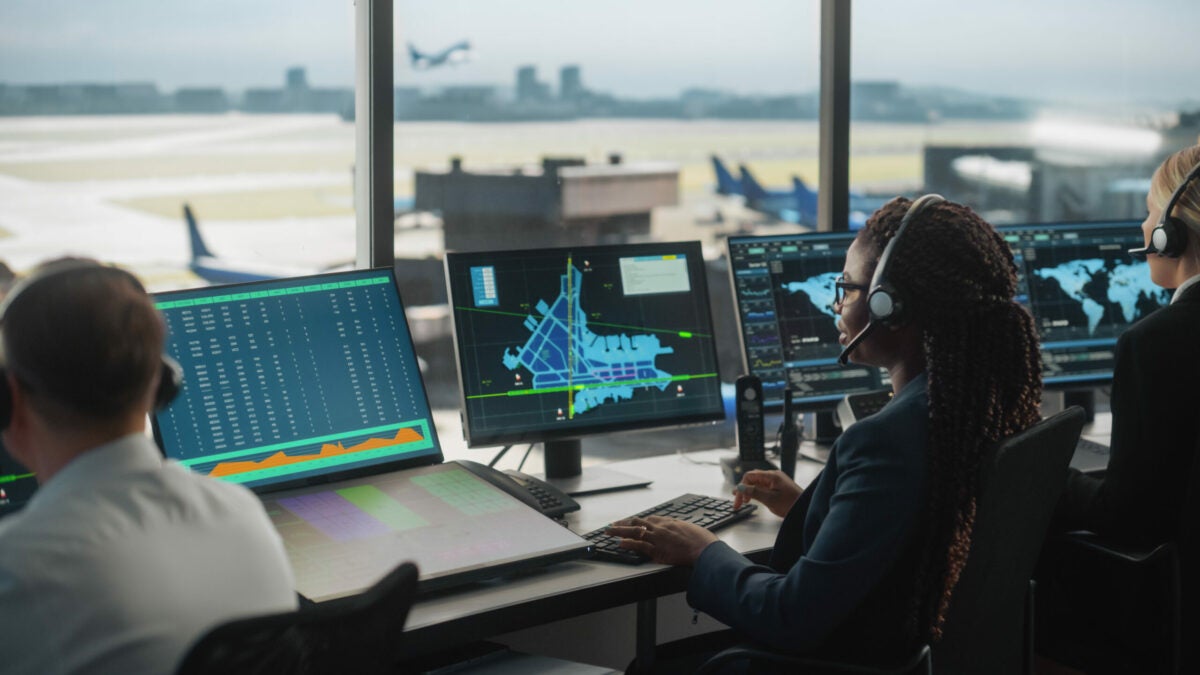


I retired from a 26-year career as an air traffic controller (ATC) in September 2023. I didn’t even take a day off before starting my new career as a Part 91 corporate pilot. I was so excited to get out of the dark control room and go enjoy the views. I was definitely going to miss the intensity of doing ATC every day, but I was ready for the change.
Since then, I have had countless people ask if I had always wanted to be a pilot and finally fulfilled my dream.
Truth be known, I was a pilot prior to starting my career as a controller. But, yes, I love flying. I started when I was 15 years old. I would work my paper route for three months, fly for four hours, and be out of money. I was in Air Force ROTC, and not unlike 90 percent of the college-age population back then, I thought I was destined to be a fighter pilot.
Unfortunately, I tore my ACL and was disqualified to fly for the Air Force. So I transferred to community college to pursue a professional pilot degree. During my training, I took a tour of the Salt Lake ARTCC (center) and asked how one becomes a controller. Since I was with a group they invited me back the next week for a personal tour so I could spend more time and plug in with a controller to see if it was something that I actually wanted to pursue as a career.
I completed my private pilot certificate at 23. I was accepted to an experimental program in Minnesota and went off to ATC school at 24. To be honest, I was dipping my toe into the ATC waters because I had heard what a difficult and stressful job it was. I was training at KZFW (Fort Worth Center) and working on my instrument rating. My ATC trainers and my IFR flight instructor all thought that I was insane to load myself up with two incredibly demanding training programs. Little did I know the unique perspective these simultaneous pursuits would offer.
By the time I became a certified professional controller (CPC, or FPL in those days) I was enjoying the daily challenge of being a controller. I liked being at home every night with my young family. So I bought a share of an airplane, flew when I wanted, and mentally locked in for a career in the FAA.
Enough of the introduction. There are some things that I think pilots, particularly the bored ones, need to understand.
At the Air Route Traffic Control Centers (ARTCC) there are shout lines,overhead speakers used to monitor the guard frequency and for controllers from other facilities to get you to pick up a line to coordinate. Usually when someone calls on the emergency frequency, or guard, it transmits out of every speaker in the area, sometimes in the entire building.
Back when I started working ATC, if you heard someone call on the emergency frequency (121.5), everyone listened because there was a possibility that lives were at stake.
About three years ago while I was still a supervisor at Salt Lake Center, I was working the boards to maintain currency. I heard an aircraft in distress calling to request help. I looked around to see if anyone else had heard it, since it seemed like it only came out of my speaker.
![Pilots in the cockpit. [Credit: Shutterstock]](https://flyingmag1.b-cdn.net/wp-content/uploads/sites/2/2025/03/shutterstock_1661552755-scaled1.jpg?width=1024&height=683)
I called across the room to the guy working the low altitude sector to see if he had better reception. The sector that I was working in was from FL 310 up. I heard the pilot say that he was about 40 miles north of KBOI, so I unplugged my headset, stood up, and plugged it into the emergency jack so that I could communicate with him. I selected the transmitter that I thought I had received the distress call on and asked the pilot his altitude and direction of flight.
As the pilot who was VFR in IMC and icing conditions tried to answer, I had three different non-emergency pilots key up to let me know that I was “transmitting on guard.” I did not have time to deal with these other pilots, so I asked again the emergency aircraft’s altitude and direction of flight and told him to identify.
To this I got a couple of “you’re still on guard!”
All of my controllers in the area were watching and listening to these interactions. Without hesitation I keyed up again and said, “This is the center, I am dealing with an aircraft in distress that needs my help. The rest of you need to shut the hell up!”
I was ticked off and stressed out and extremely worried about the emergency aircraft. It was a unique situation because he was not even showing up on my radar scope. I was coordinating with the low altitude sector who did not have access to the radio site that we were communicating on. We immediately started looking at METARs and steered the aircraft to an airport with VFR conditions.
The situation ended well, but to this day I am bothered by the what-ifs. The controllers that I supervised would not let me forget that one time when I said a swear word on guard.
I don’t think that I need to remind anyone who has been in aviation for any duration that almost every time there is always a perfect storm, a crazy chain of events, some unanticipated outside force, that caused or largely contributed to an accident, incident, or just a close call.
In my second career as a pilot I started out flying in the right seat in a Pilatus PC-24 and an Embraer Phenom 300. I flew with several different captains. Inevitably at some point they all want to talk ATC. They usually would ask things like, “What is your biggest pet peeve that pilots do?” or “What things made you cringe?”
They usually are expecting me to talk about all of the added unnecessary verbiage that some ATCs use. But to be honest, most controllers are way more laid back than pilots think.
Controllers are required to confirm altitudes, hear the call sign, and hold short instructions in the same transmission. But honestly, the circles I ran around in weren’t bothered by much. Based on my straw poll, the biggest frustration for most controllers is people messing around on guard.
When someone transmits, it comes out every sector within range of the aircraft transmitting or any sectors that have a frequency tied in when they combine sectors for the mid-shift. The speakers that guard comes through are the same ones that land line coordination from other facilities transmit through. So someone playing around on guard will almost always block a coordination transmission between facilities.

I have had some pilots tell me that it just doesn’t seem like a big deal. So why do I think it is? I called a couple of controller friends and asked what they do when pilots start meowing on guard. I was not surprised because I saw it happen daily. They stand up and turn the volume off on the guard frequency. I have seen on more than one occasion all of the controllers in my area stand up simultaneously and turn off the guard frequency. There is no automatic reset on those volumes. Your cutest little meow may cause someone’s distress call to go unanswered.
You might say that all of the other pilots are monitoring the guard, so it shouldn’t be a problem. In the example I gave the three pilots telling me I was on guard could not hear the pilot, in the mountains making a distress call. We had one transmitter/receiver that we used to save the pilot and passengers on that flight. I shudder to think that if someone had been playing around on guard that my receiver could have had the volume off and those poor people would have died due to some bored pilot thinking that a meow would be funny and entertaining.
Also, I have flown with several pilots who no longer monitor the guard frequency because they do not want to hear people playing around on it. It often blocks critical control instructions, especially when an aircraft is being vectored in mountainous terrain to an ILS or other low altitude intercepts.
The problem with this is twofold. One, they are no longer monitoring and therefore cannot assist other aircraft in distress. And two, if they are in a critical situation and are not on the correct frequency, ATC uses guard as a first option when it cannot raise an aircraft on the frequency that it should be on.
I heard that in the last year or so, United Airlines fired a first officer because he meowed on guard. I applaud the company for it. I hope other airlines follow suit to help reduce and remove this entirely unnecessary risk from the system.
The FAA through Flight Service Stations and the military has the ability to triangulate transmissions and could use this to pinpoint offenders. I wish that the agency would start taking punitive action against these guys.
In the last two years while I have been flying, I have been amazed at the number of pilots using guard as a toy to play with when they are bored. It is juvenile and unacceptable behavior. And this is coming from a guy whose wife says that my maturity level is that of a 12 year old. That’s right, she doesn’t even put me in the teenage category, so if I’m telling you it’s time to grow up, it means something.
As a side note, there have been rocket launches, Starlink flybys, and even a UFO sighting since I have been flying professionally. These events always light up the guard frequency. Pilots want to talk about it, even those who otherwise would never key up on guard and be “that guy,” will talk at length about an unusual situation.
Well, you are disrupting every ATC facility for miles and miles around. There is a great alternative where you can talk to your heart’s content.123.45 is the air-to-air frequency. If you are one of these fools that get some sort of satisfaction from transmitting animal noises, this is the place to do it without the potential of having blood on your hands.
Please, we are trending in a bad direction.
I still fly light aircraft for fun. Although I am pretty careful about where and when I fly, I still run the risk of needing some guard assistance. Sometimes I take off with four hours of fuel and just start exploring. It scares me to think that one of these days I am going to find myself in a situation where I need immediate assistance on a guard frequency and I am going to key up asking for help and nobody is going to be monitoring the frequency.
I may think that I am in luck when I hear a voice from the other end, but these days it will probably be one of the guys sitting there, not really listening, but super-excited to tell me “you’re on guard.” I will incessantly be meowed at by the three funny guys that somehow get a kick out of transmitting that nonsense.