












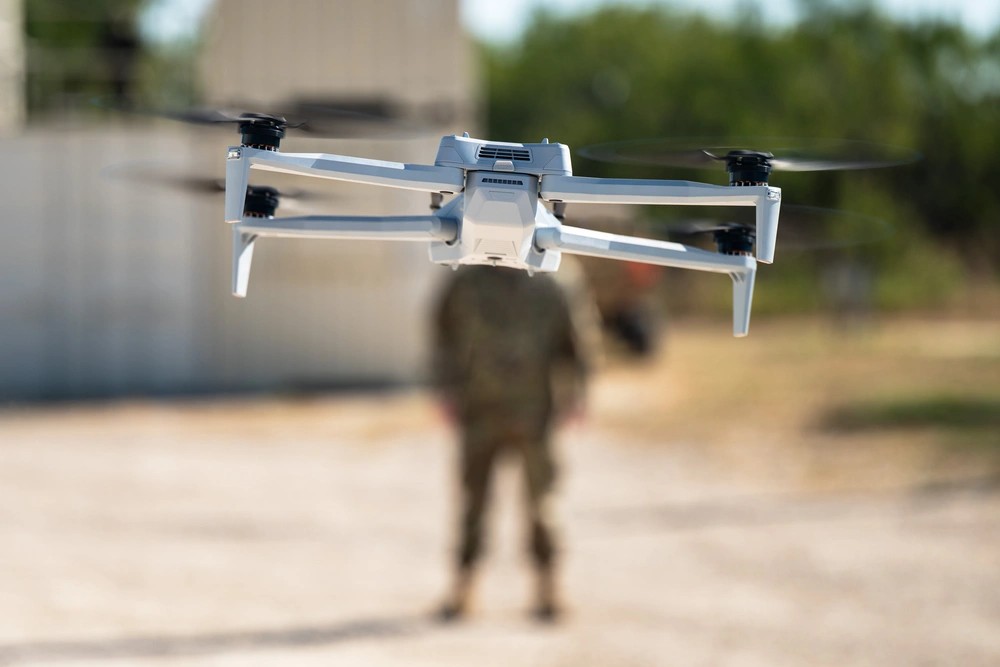


As U.S. President Donald Trump pursues a Golden Dome to shield the country from missile attacks, the government is quietly introducing a similar, smaller system in the National Capital Region (NCR) around Washington, D.C.
On Thursday, the military’s Air Forces Northern and Air Forces Space units—collectively known as CONR-1AF and responsible for protecting the U.S. from aerial threats—unveiled a system that is designed to create a “fused, actionable air picture” of all uncrewed aircraft system (UAS) activity in the region.

The counter-UAS (C-UAS) technology, called Athena, has been in development for about seven years. But it recently reached initial operating capability, which in military parlance means it is ready for its first operational action. The government-owned system will work behind the scenes to detect, identify, and respond to unauthorized drone activity.
“The Athena system represents a pivotal advancement in our ability to safeguard the skies,” said Lieutenant General Luke Ahmann, commander of CONR-1AF, in a statement. “It amplifies our counter-UAS capabilities by providing a single, integrated air picture, enabling us to detect, track, and neutralize threats with greater speed and precision.”
According to CONR-1AF, Athena will integrate C-UAS sensor data from the NCR that is provided by multiple government agencies. The system can distinguish between drones and other detected objects.
“Athena fuses information from multiple sensors to produce a more precise track than any individual sensor can provide,” said Lieutenant Colonel Nicholas Detloff, chief of CONR-1AF’s strategic requirements division.
The system then forwards that UAS data to various command-and-control systems, which can act on it. Typically, authorities will first attempt to contact the drone’s pilot and persuade them to land. If that fails, they can deploy an array of methods, from shooting the drone down to entrapping it with a net.
Why It Matters
Washington, D.C.’s airspace is more restricted than in any other part of the U.S. due to rules enacted after 9/11. Violators face strict fines and criminal penalties. But the region is not immune to rogue UAS. In 2022 officials briefly halted flights into and out of Ronald Reagan Washington National Airport (KDCA) after a drone was spotted in the vicinity.
A Special Flight Rules Area (SFRA) covers all flights within a 30-mile radius of KDCA. It is divided into inner and outer rings, with respective radii of 15 and 30 miles. UAS are prohibited from flying within the inner ring without specific FAA authorization. Between 15 and 30 miles, pilots can fly drones recreationally—so long as they are registered, marked, and fly below 400 feet in clear weather, within the visual line of sight, and far from crewed aircraft.
The FAA also permits some non-recreational drone operations if they are conducted under Part 107, an applicable exemption or waiver, or the requirements for public aircraft operations.
Efforts to oversee all of that activity have not been without controversy. In April, U.S. Representatives Rick Larsen and Bennie Thompson penned Homeland Security Secretary Kristi Noem, alleging that the Secret Service’s use of C-UAS technology resulted in false Traffic Alert and Collision Avoidance System (TCAS) alerts for aircraft flying near KDCA.
Drone disruptions have not been limited to Washington. The FAA says it receives about 100 reports of UAS near airports every month. There have been more than 2,000 such sightings since 2021, according to the Government Accountability Office.
In September, concerns about rising UAS activity prompted more than 30 U.S. state and territorial governments to request greater C-UAS capabilities from the federal government. There is potential for more drone activity near airports as the FAA develops Part 108—a proposed rule that would permit UAS operations in controlled Class B, C, and D airspace. A final Part 108 rule is expected as soon as February 1, per the timeline provided by a White House executive order.
Counter-Drone Push
The introduction of Athena is just one example of the U.S. government’s push for greater counter-UAS capabilities.
The Pentagon’s fiscal year 2026 budget requests $3.1 billion for C-UAS technology across the services. Recently, the Army demonstrated the capability on the Boeing AH-64 Apache. And in August, the Pentagon established Joint Interagency Task Force 401 to lead a whole-of-government C-UAS effort.
“Countering this threat requires every element of the U.S. government working together with shared purpose and unity of effort,” said Secretary of the Army Dan Driscoll during a November interagency meeting.
The Federal Emergency Management Agency (FEMA) in 2025 launched a $500 million C-UAS grant program. Half of that money will be made available this year for the 11 states hosting 2026 FIFA World Cup matches—in December, the Washington National Guard simulated a drone attack on Seattle’s Lumen Field. The rest will be available to all states and territories starting in fiscal year 2027.

