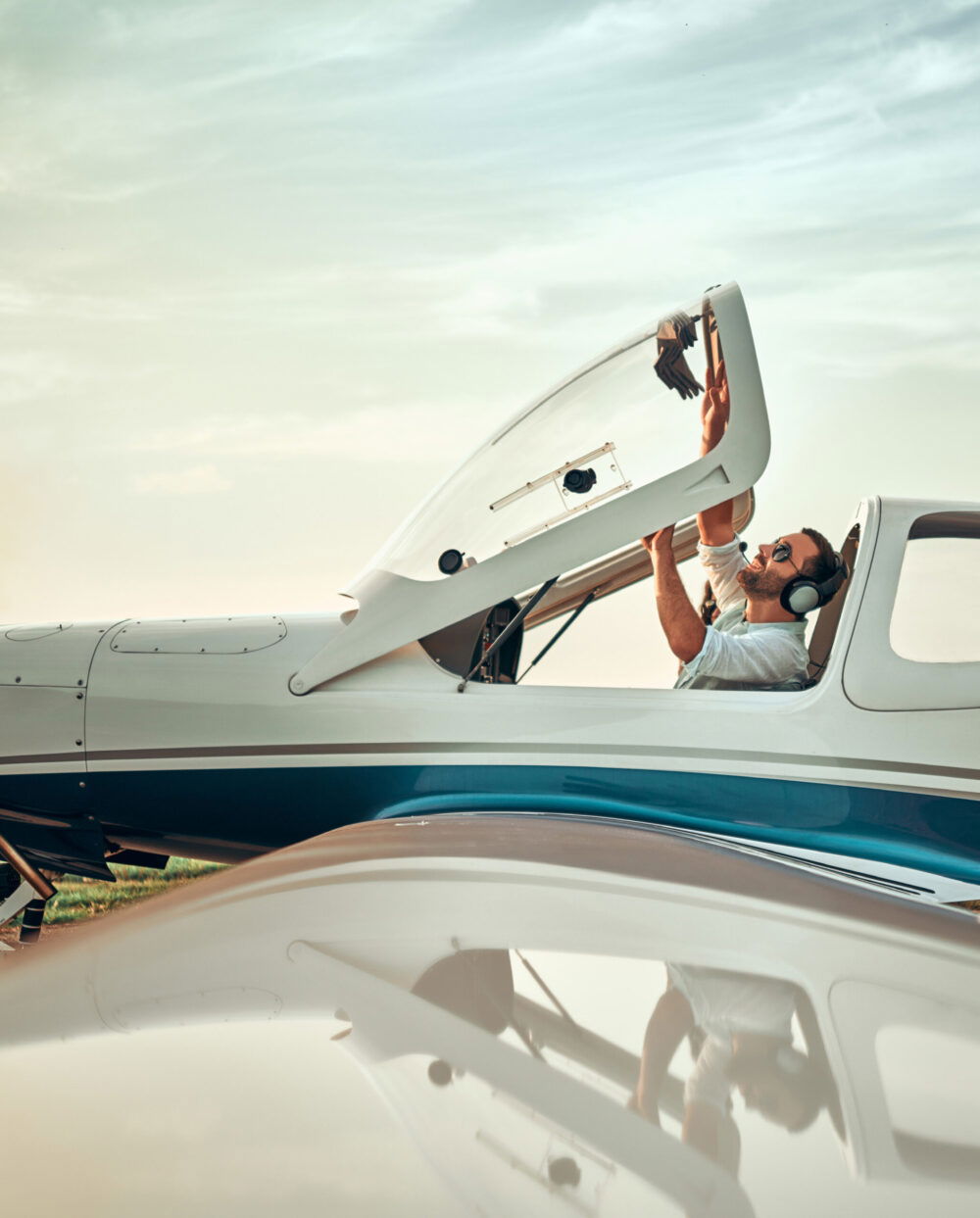
Have you ever mentally flown an airplane on the ground? This practice known as chair flying is as old as aviation itself.
But how effective is it as a learning tool? A team at the University of North Dakota aims to find out.
The college’s study, entitled “Mental Imagery Ability and the Use of Mental Practice in Aviation Training,” is investigating the relationships between pilots’ mental imagery ability and their chair flying practices.
Cynthia Johnston, a former instructor pilot in the U.S. Air Force, is conducting the study with the assistance of Nicholas Wilson.
The study came about when Johnston, a 2,500-hour pilot who taught in the T-38 and T-6 and flew as an F-15 flight lead, was pursuing a college degree.
“I originally was going to study virtual-reality simulators and the integration of technology into pilot training,” Johnston said. “I found a wealth of academic information about simulators in aviation and about the trade-offs between fidelity and cost. Virtual-reality simulators were no different. The current technology can provide higher fidelity in some cases [such as creating a sense of immersion] but also lower fidelity in other ways [no physical switches and buttons]. While exploring the fidelity/cost trade-offs, I realized that chair flying is really one of the cheapest, shall we even say free, forms of getting mental repetitions, just like in a simulator.”
She was surprised at how little academic research there was on the topic of chair flying in aviation. A casual survey revealed some pilots did not chair fly and others weren’t sure how to apply the practice.
“My goal is to inform the development and adoption of more formal mental practice interventions into pilot training,” Johnston said.
Johnston is familiar with chair flying.
“[I used it] all the time in training and to prep for flights,” she said. “While I am currently a simulator instructor, I still get to fly in the sim and will chair fly maneuvers I need to support my students as ‘Red Air’ [a designation used in military aviation training for aggressor aircraft and pilots that simulate enemy forces] Chair flying even helps me figure out how to explain things better to my students, as I must really think about what I am doing and the picture I am building in my mind.”
A script is essential, according to Johnston.
“I used to fill up notebooks with scripts about how to accomplish a checklist or a flight maneuver—sometimes even a whole flight,” she said. “I would then use that structure to guide my chair flying. I could check what I did against that script as well to understand what I had missed and needed to work on. Also, incorporate as many senses as possible. Don’t just think about what you will see but also what you will feel, hear, and smell. Add as many details as you can.”
Technique
Chair flying is often done with a checklist in hand. The pilot reads through it, and while doing so reaches out as if manipulating throttles or switches appropriate during that phase of aircraft operation. This enables the pilot to build muscle memory and learn the flow for the procedures.


A student pilot chair flying [Credit: Meg Godlewski]
To be successful at chair flying, the pilot needs to be able to form mental images in their mind. However, not everyone can do this, Johnston said. The technical term for this is aphantasia, defined as the “inability to form mental images of objects that are not present.”
“Part of my research is understanding how varying mental imagery abilities—or the ability to create vivid mental images in the mind’s eye—affect the use of chair flying,” she said. “My goal is to inform the development and adoption of more formal mental practice interventions into pilot training. “
How to Participate in the Study
Johnston hopes to have a good sampling of general aviation pilots by mid-February.
To participate you must be over the age of 18 and hold at least a student pilot certificate. Participants will be invited to include their email address at the end of the survey for a chance to win one of five $25 Amazon gift cards.