Boeing’s Wisk Self-Flying Air Taxi Makes First Flight

Generation 6 will complete additional hover testing before the company expands the envelope.

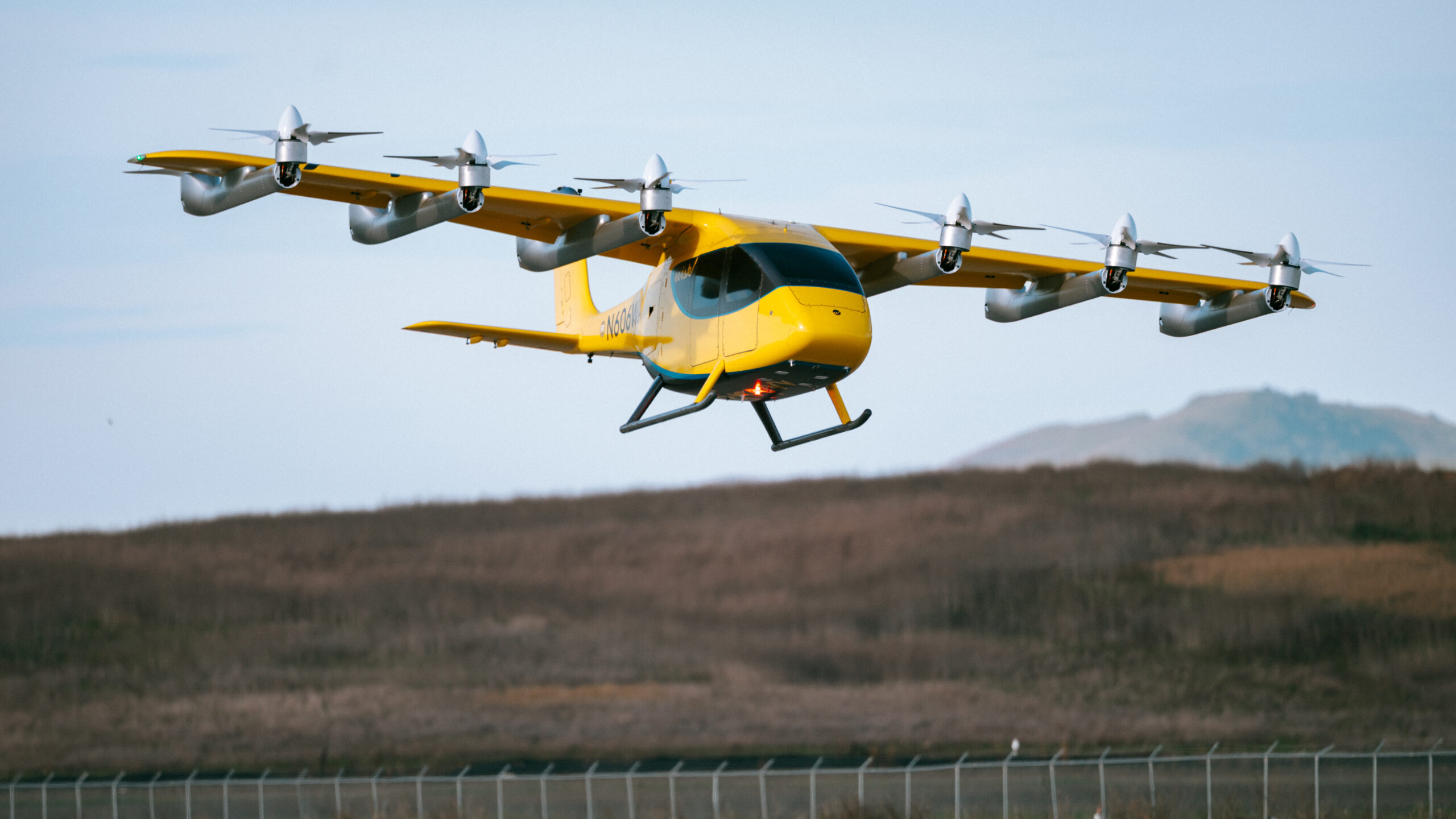
Wisk Aero autonomous Generation 6 eVTOL air taxi makes first flight
Wisk Aero’s autonomous Generation 6 aircraft completes its maiden sortie. [Credit: Wisk Aero]
Gemini Sparkle

Key Takeaways:

  • Wisk Aero's Generation 6, an autonomous electric vertical takeoff and landing (eVTOL) air taxi, successfully completed its first pilotless, preprogrammed vertical takeoff and hover flight.
  • The Gen 6 aims to be the first autonomous passenger-carrying aircraft certified in the U.S., with Wisk distinguishing itself by focusing on full autonomy from launch.
  • Wisk plans for commercial launch in cities like Houston, Miami, and Los Angeles before 2030, supported by an extensive testing campaign and collaborations with the FAA and NASA for certification and airspace integration.
See a mistake? Contact us.

It’s not every day that a new aircraft makes its first flight. Even rarer is a first flight without a pilot in the cockpit.

But that’s exactly how the inaugural sortie for the Generation 6—an autonomous, electric vertical takeoff and landing (eVTOL) air taxi being developed by Boeing’s Wisk Aero—played out.

Wisk on Wednesday said the Gen 6—which it described as a “test article” of the model for which it is seeking FAA type certification—completed a maiden vertical takeoff and hover flight at its test facility in Hollister, California. The untethered flight included limited forward movement, Wisk’s senior director of aircraft development, Guillaume Beauchamp, told Aviation Week.

Rather than being remotely piloted, the air taxi followed a preprogrammed flight plan. Wisk told FLYING the flight lasted about one minute.

“The team at Wisk has built advanced technologies across flight controls, sensing, navigation, mission management, electric power, systems integration, and many others for a product that is designed to meet a rigorous safety case for a focused concept of operations,” said Brian Yutko, vice president of product development for Boeing Commercial Airplanes and chairman of the Wisk board. “The engineering methods and technologies are all a valuable source of insight for Boeing as we work together and thoughtfully apply them to the future of flight.”

Beauchamp predicted that by 2026, Wisk will fly individual aircraft several times per day, multiple days per week. Transitions from hover to forward flight—the capability that sets eVTOL aircraft apart from others—could happen within the next six months, he said.

Beauchamp said the flight test plans align with Wisk’s timeline for a commercial launch in cities such as Houston, Miami, and Los Angeles before 2030. The company already has an active certification project for the Gen 6 and is working with the FAA to determine how it will prove the air taxi’s capabilities through testing.

According to Wisk, the model is a candidate to be the first autonomous passenger-carrying aircraft certified in the U.S.

Air Taxi Flight Plan

Unlike its eVTOL competitors, Wisk aims to introduce its air taxi with autonomy at launch.

The Gen 6 is designed for up to four passengers, with a projected range of 90 miles, cruise speed up to 120 knots, and service altitude between 2,500 and 4,000 feet. It will rely on a combination of computers, predictive hardware and software, radar, sensors, and ground links to fly predefined routes. Flights will be overseen by remote Multi-Vehicle Supervisors who can take control of the aircraft, but it will be capable of detecting and avoiding obstacles on its own.

According to Wisk, the vehicle will match the safety standards of commercial aircraft in service today. The company plans to certify it for instrument flight rules (IFR) and has a five-year agreement with NASA to study integration under IFR in the national airspace system. The campaign will comprise live flights in simulated airspace and aims to develop protocols for communicating with air traffic control (ATC), among other objectives.

Wisk said it has conducted more than 1,750 test flights using earlier eVTOL prototypes, including public demonstrations in Los Angeles with its Generation 5. Almost 200 of those, the company told FLYING, were with the Gen 5.

In 2024, Wisk obtained a G-1 Stage 2 issue paper for the Gen 6, which laid out the airworthiness standards and environmental rules required for type certification. Now, with first flight in the books, the company is ready to begin what it described as an “extensive” and “rigorous” Gen 6 test campaign.

Testing will initially focus on the hover phase, with additional takeoffs and landings to gauge how the aircraft’s behavior aligns with simulations and models. Wisk will also evaluate stability at low speeds.

Next will be envelope expansion, where the prototype advances to higher speeds and altitudes. During this phase, it will perform more complex maneuvers at low speeds, such as pedal turns and the transition from hover to forward flight.

“In parallel,” Wisk said, the company will continue testing detect and avoid, navigation, and other autonomous systems. It will conduct additional work with the FAA, NASA, and SkyGrid—a third-party traffic management platform for autonomous aircraft that it acquired in June.

Also on tap is the eVTOL and Advanced Air Mobility (AAM) Integration Pilot Program (eIPP)—a three-year initiative to study real-world operations of eVTOL and other aircraft, in which Wisk told FLYING it intends to participate. The company will work with state, local, tribal, and/or territorial government partners, who have until Friday to submit applications. eIPP operations are expected to begin next year.

Jack Daleo

Jack is a staff writer covering advanced air mobility, including everything from drones to unmanned aircraft systems to space travel—and a whole lot more. He spent close to two years reporting on drone delivery for FreightWaves, covering the biggest news and developments in the space and connecting with industry executives and experts. Jack is also a basketball aficionado, a frequent traveler and a lover of all things logistics.


Ready to Sell Your Aircraft?

List your airplane on AircraftForSale.com and reach qualified buyers.

List Your Aircraft
AircraftForSale Logo | FLYING Logo
Pilot in aircraft
Sign-up for newsletters & special offers!

Get the latest stories & special offers delivered directly to your inbox.

SUBSCRIBE