












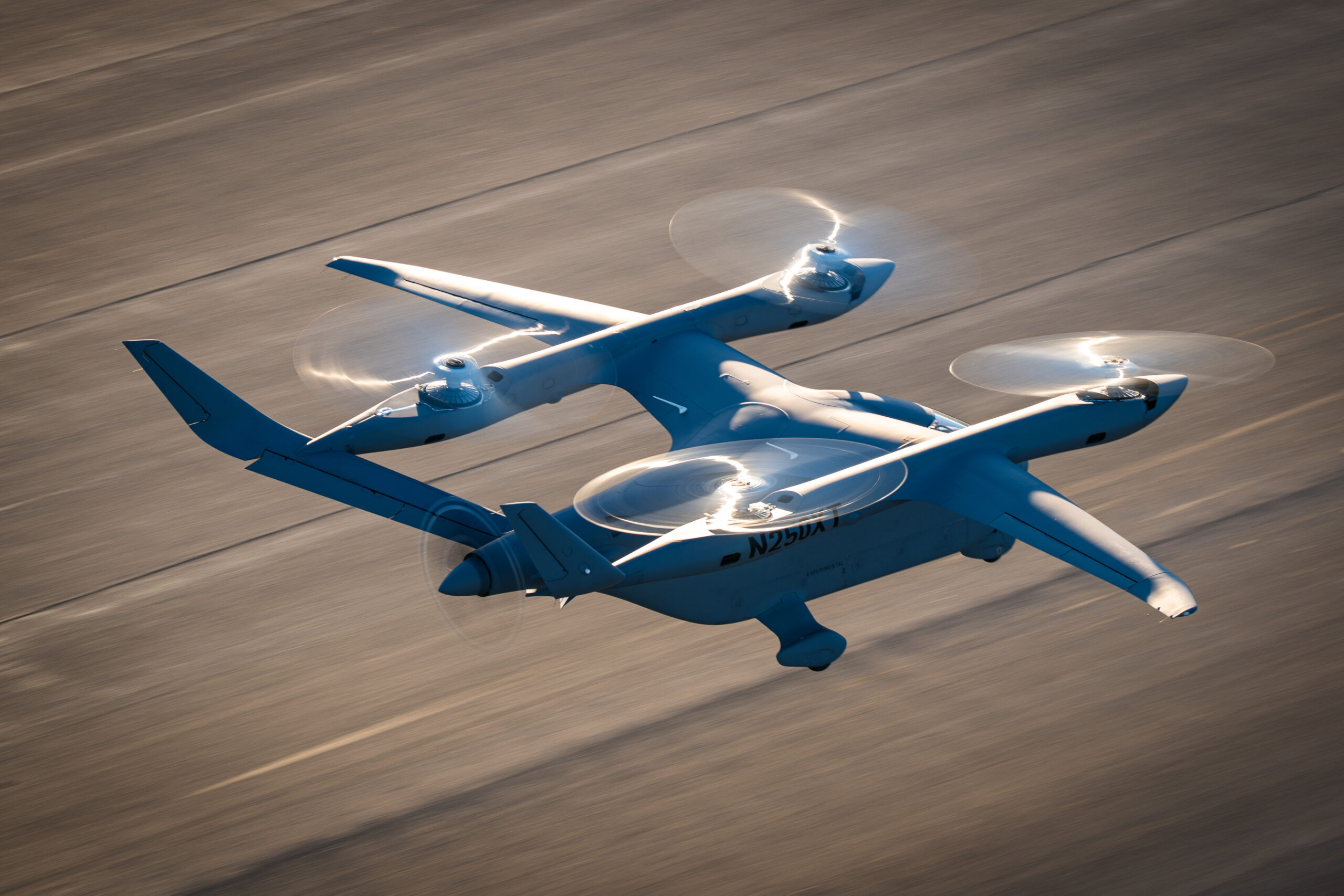


Beta Technologies’ Electric Aircraft Are Preparing to Fly Autonomously

Company integrates Near Earth Autonomy’s perception and guidance technology into its fly-by-wire system.

Beta Technologies Alia electric aircraft
Beta said it has been flying subscale aircraft equipped with its in-house autonomy system for years. [Courtesy: Beta Technologies]
Gemini Sparkle

Key Takeaways:

  • Electric aircraft developer Beta Technologies is integrating an in-house autonomy system into its Alia aircraft, having completed over 1,000 uncrewed flight hours on subscale models, aiming to enhance capabilities like payload and range for military and commercial clients.
  • Beta has partnered with Near Earth Autonomy for perception and guidance, targeting autonomous flight testing by the first half of 2026, leveraging Near Earth's extensive experience in the field.
  • This move aligns Beta with a broader industry trend in Advanced Air Mobility, where other companies like Wisk, Archer, and Joby are also actively developing autonomous or hybrid-electric variants, often with a focus on military applications.
See a mistake? Contact us.

As if one transformative technology wasn’t enough, electric aircraft developer Beta Technologies has integrated autonomy on its flagship Alia.

The company—which is developing both vertical takeoff and landing (VTOL) and conventional takeoff and landing (CTOL) Alia variants as well as a hybrid-electric powertrain—revealed Thursday that it has been flying subscale aircraft equipped with its in-house autonomy system “for the past several years.” Beta said it has racked up more than 1,000 uncrewed flight hours with its subscale aircraft, which have a demonstrated range of 158 nm on a single charge.


Per the company, autonomy could open new opportunities for its military as well as commercial customers, such as UPS and Bristow Group.

“Increasing our autonomy capabilities will deliver even greater optionality to operators, including faster speed, higher payload, longer range, and optional piloting,” said Shawn Hall, Beta’s chief revenue officer, in a statement. “In order to meet the demands of the defense and civil sectors today, mobility platforms must be smarter, more flexible, and ready to operate where traditional systems can’t.”

Autonomy for Electric Aircraft

Both of Beta’s electric aircraft are designed to accommodate a pilot plus five passengers or 1,240 pounds of cargo. Without a pilot, the company said, their payload will be “nearly double.”

The Alia CTOL has a projected cruise speed of 135 knots and demonstrated range of 336 nm. It has traversed the U.S., Europe, and New Zealand in VFR, IFR, day, and night conditions, including flights into controlled airspace at Hartsfield-Jackson Atlanta International (KATL) and John F. Kennedy International (KJFK) airports.

In September, Beta announced a partnership with GE Aerospace to develop a hybrid-electric powertrain for future Beta aircraft, VTOL aircraft, and other applications. It will combine its permanent magnet electric generator with GE’s turbine and certification expertise in a bid to deliver longer range, higher speed and payload, and lower operating costs than aircraft in the same segment. That could open new commercial and defense opportunities, particularly in the Indo-Pacific, where the military envisions autonomy as a force multiplier.

As part of the agreement, GE made a $300 million equity investment in Beta.

“We believe the industry is on the precipice of a real step change,” said Beta CEO Kyle Clark in September. “We look forward to partnering to codevelop products that will unlock the potential of hybrid-electric flight, and to do it with the rigor, reliability, and safety that aviation demands.”

Beta’s aircraft are designed with fly-by-wire flight controls, which the company said makes them an “ideal platform” for both crewed and uncrewed operations. On Thursday, it said it integrated Near Earth Autonomy’s perception and guidance suite into the fly-by-wire system, with autonomous flight testing targeted for the first half of 2026.

Near Earth claims its founders were behind the world’s first fully autonomous helicopter flight in 2010, using an uncrewed Boeing Little Bird. Today, it says its autonomy systems have powered more than 10,000 flights on over 140 airframes from Boeing, Airbus, Bell, Leonardo, and other major OEMs.

Alongside partner and investor Honeywell, Near Earth is coleading the U.S. Army’s $15 million effort to retrofit UH-60L Black Hawk helicopters. It’s also lending its systems to the Marine Corps Tactical Resupply Unmanned Aircraft System (TRUAS) program. Working with NASA and Boeing, the company is devising a method for inspecting commercial airliners using autonomous drones.

“Working with a pioneer in electric aviation allows us to combine high-assurance autonomy with cutting-edge electric propulsion to help unlock sustainable, scalable autonomous air mobility,” said Near Earth CEO Sanjiv Singh.

Join the Club

Beta’s autonomy play aligns with the activities of other players in the young advanced air mobility (AAM) sector.

Boeing air taxi unit Wisk Aero, for example, plans to fly autonomously at launch, planned toward the end of the decade. Archer Aviation and Joby Aviation, meanwhile, are developing autonomous, hybrid-electric variants of their eVTOL air taxis in partnership with Anduril and L3Harris, respectively.

Those designs will be pitched to the military, which envisions autonomous aircraft taking on urgent or high-risk tasks and freeing up larger, more expensive aircraft.

Joby, for example, in 2024 acquired Xwing’s Superpilot gate-to-gate autonomy system. Over the summer, a Superpilot-equipped Cessna 208B Grand Caravan took part in the military’s Resolute Force Pacific exercise, covering more than 7,000 nm across 40 hours of flight in VFR and IFR conditions as well as Class B, C, D, and uncontrolled airspace. That included a 5,000 nm roundtrip ferry flight over the Pacific that culminated in an airport landing.

The Caravan flew with an onboard safety pilot. But operations were managed primarily from Guam’s Andersen Air Force Base (PGUA) more than 3,000 miles away, hinting at the technology’s potential.

Archer, meanwhile, has yet to publicly disclose any autonomous flights. But in 2023, it agreed to make Wisk its sole provider of autonomy. Boeing will fund the technology’s integration on a future variant of the company’s flagship Midnight.

The military is also pursuing autonomy systems from Merlin Labs and Reliable Robotics that could be retrofitted onto existing aircraft, such as the KC-135 Stratotanker.

Merlin is working with GE to enable reduced-crew, single-pilot, and uncrewed operations, with the partners targeting the Air Force’s KC-135 Center Console Refresh effort for the first integration of their jointly developed “autonomy core.” In December, it was tapped to develop its Merlin Pilot for the branch’s entire tanker fleet.

The Air Force has already purchased Reliable’s system under a $17.4 million contract, with plans to equip it on the Caravan for real-world, overseas deployments in the Indo-Pacific. Both it and Merlin are part of the branch’s effort to refine its autonomy government reference architecture (A-GRA)—essentially, a blueprint for private companies to design autonomy systems that are compatible with any military platform.

Jack Daleo

Jack is a staff writer covering advanced air mobility, including everything from drones to unmanned aircraft systems to space travel—and a whole lot more. He spent close to two years reporting on drone delivery for FreightWaves, covering the biggest news and developments in the space and connecting with industry executives and experts. Jack is also a basketball aficionado, a frequent traveler and a lover of all things logistics.

Ready to Sell Your Aircraft?

List your airplane on AircraftForSale.com and reach qualified buyers.

List Your Aircraft
AircraftForSale Logo | FLYING Logo
Pilot in aircraft
Sign-up for newsletters & special offers!

Get the latest stories & special offers delivered directly to your inbox.

SUBSCRIBE
