












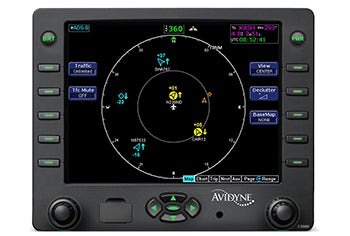


Avidyne, MIT Advance ADS-B with VeriTAS

Gemini Sparkle

Key Takeaways:

  • Avidyne and MIT developed "VeriTAS," an advanced ADS-B traffic alerting system designed to provide precise collision warnings while minimizing nuisance alerts.
  • VeriTAS correlates traffic data from multiple sources and utilizes dual protection zones, with one dynamically adjusting its size based on closure rates (e.g., larger for head-on, smaller for same-direction).
  • This technology aims to provide a 30-second collision warning and is part of an FAA program to establish new industry standards for ADS-B traffic alerting, with Avidyne integrating it into its current products.
See a mistake? Contact us.

Avidyne and MIT researchers have been working for the past three years on improved ADS-B traffic alerting algorithms that the FAA hopes to use as the baseline standard for the entire avionics industry. Now the collaboration has led to the development of an Avidyne traffic alert feature called VeriTAS that has the goal of providing more precise collision alerting while eliminating nuisance alerts.

At a Sun ‘n Fun press conference on Tuesday morning, Avidyne founder Dan Schwinn outlined the basics of the VeriTAS concept. The word veritas is latin for “truth,” and that’s exactly what the Avidyne and MIT software seeks to give pilots by creating two distinct zones of protection around aircraft, the larger of which can dynamically change depending on the severity of the traffic threat.


VeriTAS technology correlates traffic information from multiple sources, including 1090- and 978-MHz ADS-B, ground-based re-broadcast ADS-R and TIS-B signals and transponder interrogations to provide a more complete picture of traffic. The system includes dual protection zones, one of which changes in size depending on closure rates and the other of which is fixed in size. The outer protection ring is designed to provide a 30-second warning of an impending collision. The fixed inner ring has a 500-foot radius and vertical dimension of +/-200 feet.

During possible head-on collisions, the outer protection ring is very large. In scenarios where two aircraft are headed in essentially the same direction, the protection zone becomes much smaller as the closure rate reduces. This technique, said Schwinn, helps reduce nuisance alerts, especially in high traffic areas around airports.

The research is part of the Airborne Traffic Awareness and Alerts (TSAA) program launched by the FAA in 2011 to develop TSO standards for ADS-B traffic alerting. As part of a $4 million contract awarded to Avidyne and MIT, the program has progressed from studying midair collisions to millions of computer simulations to actual flight testing. Avidyne, meanwhile, is incorporating VeriTAS technology into the ADS-B In traffic advisory systems it sells today.

Ready to Sell Your Aircraft?

List your airplane on AircraftForSale.com and reach qualified buyers.

List Your Aircraft
AircraftForSale Logo | FLYING Logo
Pilot in aircraft
Sign-up for newsletters & special offers!

Get the latest stories & special offers delivered directly to your inbox.

SUBSCRIBE
