










Coming Up Short
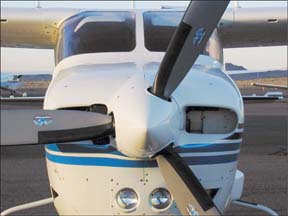
Ferrying a Cessna Pressurized Centurion to its new home should not have been a great challenge. So why did two pilots manage to run it out of gas?

Ferrying a Cessna Pressurized Centurion to its new home should not have been a great challenge. So why did two pilots manage to run it out of gas?
As most in the aviation community know by now, legendary test pilot Scott Crossfield died April 19 when his Cessna 210A rapidly descended into remote mountainous terrain near Ludville, Ga., after entering an area of thunderstorms, as the NTSB put it. According to the safety board, his airplane entered a Level 6 thunderstorm just prior […]
Questions And Answers
In Cross-Coordinated (April 2006), David St. George talks about the stall break being more subtle in a turning stall due to the offset of the elevator force.
Why is the elevator force offset? Ive done some research and cant find out why this is so. Id like to add this explanation in my stall instruction but want to make sure I fully understand the aerodynamics behind it.
Thanks for the great article.
Jeff Frye
Pensacola, Fla.
The author responds: I can refer pilots to some of the literature, but a detailed description is hard to come by. Basically, in the turn the elevator force we are creating is offset increasingly from…
The airplane sustained a loss of engine power at about 1240 Eastern time while climbing to cruise altitude. The Private pilot made a forced landing at the airport in Fort Pierce, Fla., from which he had just departed. Visual conditions prevailed. The Private pilot received minor injuries and the airplane incurred substantial damage. According to the pilot, about eight to 10 minutes after takeoff, while still climbing and at an altitude of about 5000 feet, the airplane lost engine power. The gauges showed about 1000 rpm and the manifold pressure remained at 25 inches. The pilot could not regain power or determine the reason for the power loss. As the airplane glided toward the airport, the pi…
At approximately 1109 Central time, the airplane was destroyed upon impact with terrain shortly after takeoff. The pilot and one passenger were fatally injured, and two other passengers were seriously injured. Visual conditions prevailed. An eyewitness located several hundred yards east of the runway stated that he heard a sputtering noise, and saw the airplane level off at about 100 feet above the ground shortly after taking off. At the departure end of the runway, the right wing and nose of the airplane dropped. The witness heard the sound of impact a few seconds later….
The Airline Transport pilot received serious injuries and the airplane was substantially damaged at about 1055 Eastern time when the Cessna crashed short of the runway. Visual conditions prevailed. A witness saw the accident airplane on the downwind leg, rocking its wings. While on final approach, he saw the propeller had stopped rotating. It appeared the pilot was trying to stretch the glide; the airplane stalled and impacted the ground a short distance from the runway….
At approximately 1415 Mountain time, the airplane was substantially damaged when it nosed over during a forced landing. The Commercial pilot and a passenger were not injured; visual conditions prevailed. According to the pilot, the engine began running rough, then lost all power. He made a forced landing in an open field. During the landing roll the airplane nosed over, crushing the vertical stabilizer and the top of the upper wing. He said that fuel leaking from the fuel tanks after the accident smelled like kerosene….
The airplane sustained substantial damage on impact with a roadway embankment following a reported loss of engine power while on approach to land. Night visual conditions prevailed. A rear-seat passenger sustained minor injuries. Both occupants of the front seats were seriously injured; they subsequently died as a result of their injuries. The rear-seat passenger subsequently stated that the pilot said that the airplane lost engine power. She stated that the airplane was in a turn while on approach during the reported engine power loss. The left and right tip tanks exhibited tears in their fiberglass construction. The left and right auxiliary fuel tanks contained a fluid that exhibited a sm…
As the pilot approached the runway, the visual approach slope indicator showed that the airplane was on a proper glidepath. During the landing, the airplane encountered ground effect and floated down the runway. The pilot contemplated aborting the landing, but subsequently elected to continue. After touchdown he applied full brakes, but the airplane overran the end of the runway, and was substantially damaged. The pilot reported no mechanical malfunctions associated with the airplane….
At 2130 Central time, the aircraft was substantially damaged during a forced landing in a field following loss of engine power. Visual conditions prevailed. The Commercial pilot and passenger reported no injuries. The pilot later stated that the engine began to lose power while en route. He contacted ATC and declared an emergency and then made an emergency landing in an open field. The airplane collided with a ditch on landing rollout, and nosed over inverted….

Get the latest stories & special offers delivered directly to your inbox.
SUBSCRIBE