Aviation Safety

April 9, 2006, Philadelphia, Penn. / Piper PA-28RT-201

At about 1030 Eastern time, the airplane was substantially damaged during a forced landing shortly after takeoff. The Private pilot was not injured; visual conditions prevailed. The pilot subsequently reported completing a preflight inspection and an engine run-up, both per the checklist, and noting no anomalies. After the takeoff, as the landing gear retracted, there was a loud noise and the engine began to vibrate severely. The pilot immediately checked the engine gauges and cycled the landing gear back to the down and locked position. The pilot elected to land straight ahead, and completed an emergency-landing checklist. The airplane came to rest approximately 500-700 feet beyond the de…

Read More »

April 10, 2006, Fort Wayne, Ind. / Cessna 182 RG

The single-engine retractable sustained substantial damage when it impacted the runway after a gear-up landing. The pilot reported that he had performed four practice instrument approaches. After the final approach, the pilot was cleared to circle to land on Runway 23. The pilot reported that he failed to lower the landing gear prior to landing, and the airplane touched down about 300 feet from the threshold in a gear-up configuration. The pilot reported that the landing gear warning horn did not sound prior to touchdown….

Read More »

April 10, 2006, Passadumkeag, Maine / Cessna 150M

At 1727 Eastern time, the airplane was substantially damaged during a forced landing following a loss of engine power. The Flight Instructor and the Student pilot sustained minor injuries. Visual conditions prevailed. The instructor later said that the airplane was in cruise flight at 1500 feet when the engine lost power. At that time, he noted that the fuel quantity indicator for the right tank showed one-quarter full, and the left tank indicator showed three-quarters full. The engine would not restart, but when the primer was pumped, the engine produced short bursts of power. The instructor gave control of the primer to the student, and used the short bursts of power to help the airplane r…

Read More »

Weathers Risk

The NTSB recently took a close look at weather-related accidents to see how different pilots manage risk. The results provide clues on avoiding weather-related mishaps.

Read More »

Bad Attitude

Is the attitude indicator itself to blame for loss-of-control accidents in IMC? Its all in the way pilots perceive information the instrument is presenting.

Read More »

Soft Touch

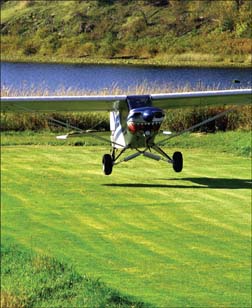
Operating off pavement requires a different, perhaps rusty technique to extract maximum performance. A little finesse on the grass goes a long way.

Read More »

After The Crash

You and your passengers are okay, but the airplane will need some work before it flies again. How will you secure it and handle what comes next?

Read More »

Learning Experiences: 06/06

It was an August afternoon in 1980 and I had my wife and two business associates in the back of our Cessna 182. We had just spent a successful yet exhausting week at Chicagos McCormick Place for an annual trade show.

We were on our way back to Eugene, Ore., and I had a raging head cold. My wonderful wife had been flying the leg from Iowa to Wyoming, but she elbowed me as we approached Billings, Mon. She said it was IFR ahead and that I needed to take over.

I was sound asleep but rallied to her call. I filed with Salt Lake Center and entered the clouds near Billings.

Understand that we had been in the air for five hours and had emptied our bladders into the onboard containers. In th…

Read More »

Squawk Box: 06/06

The following information is derived from the FAAs Service Difficulty Reports and Aviation Maintenance Alerts.

———-

Sonerai Model II LT Experimental
Failed Canopy Latch Mechanism

During the investigation into an accident involving a Sonerai II Experimental aircraft, it was discovered that the canopy latch had no positive or over-center latch mechanism to prevent the canopy from coming open during flight. According to a post-accident interview with the pilot/builder, the canopy inadvertently came open in flight, causing loss of control-one factor contributing to the accident. This aircraft was substantially damaged and the pilot was seriously injured.The FAA admon…

Read More »
Pilot in aircraft
Sign-up for newsletters & special offers!

Get the latest stories & special offers delivered directly to your inbox.

SUBSCRIBE