Aviation Safety

Forget The Checklist

Every Flight Manual, every Pilots Operating Handbook and every aftermarket pilots guide contains checklists. Normal and emergency, and in some airplanes, abnormal and alternate procedures checklists attempt to cover most situations youre likely to encounter. The FAA, instructors and authors (myself included) expend great effort trying to get pilots to use printed checklists. So it may seem odd to read there are times when a printed series of steps is too cumbersome to use. There are some times when you should forget the checklist. Most in-flight situations are not so time-critical that forgetting to move a switch or control spells immediate disaster. These conditions provide enough time for you to make inputs or move controls, then as time permits pull out a checklist and verify you have forgotten nothing. For instance, when leveling off from climb to cruise you may forget to close cowl flaps; the engine may cool rapidly as airflow accelerates, and cooling drag may prevent the airplane from reaching its maximum speed. But the engines not going to quit, and the airplane isnt going to fall from the sky. Level off, then as time permits reference a printed checklist to catch and correct your omission.

Read More »

Job One

One of a pilots most dreaded scenarios-beyond, perhaps, the mid-air collision-is an engine failure shortly after takeoff. Even multi-engine pilots arent immune, since the pilot of the typical light twin at gross weight and little altitude often has little from which to choose-except exactly where the NTSB investigation will begin. In a single, at least, when the engine fails shortly after takeoff-for whatever reason-we know whats going to happen. We also know to maintain control of the airplane, choose the most suitable off-field landing site and do everything we can to avoid obstacles. Of these maxims, maintaining control is always the most important and, depending on the terrain, sometimes the easiest to ensure. Over the years, much research and actual accidents have proven the likelihood of surviving such an event is much greater if the airplane touches down at minimum speed, in a slightly nose-high attitude and with its wings level. In other words, under control. Or, as legend R.A. “Bob” Hoover has been quoted, “If youre faced with a forced landing, fly the thing as far into the crash as possible.”

Read More »

End Of The Line

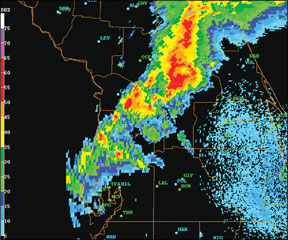
It had been a perfect day, so far. My early-teen kids and I had flown to Tampa, Fla., for a family reunion. Bidding fond farewells, it was time to motor back to the Washington, D.C., area and put the airplane, the kids and me to bed. Of course, it was summertime and, of course, a fast-moving cold front stretched from the Gulf of Mexico well into New York. A pre-launch glance at the FBOs Nexrad display showed a well-defined mass of yellow and red splotches, embedded in green, parallel and west of my course, but moving east. It was definitely time to go. Soon, we had climbed to 11,000 feet and cleared the Florida peninsula. Cruising a couple of miles offshore, we were in the clear, but eyed the dark clouds closing in from the west with trepidation.

Read More »

Diamond Door Departs

At rotation speed on the takeoff roll, the aft passenger door (p/n DA4-5221-00-00-2) departed the airframe, narrowly missing the tail plane and rudder. The door was later recovered. The aft hinge was broken off and the forward hinge damaged. Investigation revealed the hinge had cracked (then broke), due in part to the materials used in part fabrication and the high pressure placed upon it by the door opening strut (p/n DA4-9052-00-11). The door and hinge are one assembly made of composite material. The hinge is approximately -inch wide. The strut is attached near the rear hinge. It exerts approximately 90 pounds of force near the hinge attach point. Even though the door employs a safety latch handle, when the aft hinge fails the door flexes enough to slide past the stop.

Read More »

Deviant Behavior

Its been said that experience is what you get when you dont get what you wanted to get. Well, taking significant liberties, a pilot might then say that a deviation is where you go when you dont get to go where you planned to go. Got it? We pilots are typically a robust and determined bunch. We dont like to admit we cant travel our planned route. Once were on our way and it looks like Mother Nature doesnt want us on our planned route, the common technique is to simply go have a look before deciding on a different, longer route. To understand the fallacy in this, lets cover a little basic geometry to see that its better to deviate early for the shortest practical addition to your route while maintaining your sanity and keeping your blood pressure in check with a conservative deviation.

Read More »

Unfamiliar Territory

Theres little I find more exciting than launching for a new destination across unfamiliar territory. Exploring the great unknown makes adventurers out of pilots who use their planes for, you know, actually going places. But, getting there requires a little-sometimes a lot of-extra planning. My bride enjoys the adventure of personal airplane travel as much as any pilot; she also appreciates the added risks involved when tackling new terrain, new airspace, new weather systems and new destinations. Shes such a good sport, in fact, weve enjoyed the thrill many times. Our first “real” trip took us on a 2300-mile journey starting only five days after passing my private pilot checkride. Then, there was our first time to Sun n Fun; to coastal North Carolina and the sands of the Wright Brothers; our first flight to Oshkosh and-well, you get the picture. We also made a couple of international trips that still stand out years later: Key West to Grand Cayman for one, and Cancun, by hugging the Bay of Campeche to Vera Cruz, then the West Yucatan city of Campeche and across the Yucatan. The latter one took two days each way.

Read More »

Batteries Not Required

When was the last time you planned a flight? No, we dont mean hop in the aircraft and punch direct on the nearest GPS navigator; we mean really planned the flight the good old-fashioned way…with a pencil, a plotter, an E6-B, a sectional and a flight log. Its been a while, hasnt it? At this point, youre probably thinking, “Here comes another really boring article about navigation,” but thats not the case. Instead, this really is about safety and situational awareness; its about really understanding what is happening when you fly from point A to point B. Finally, its about remembering and utilizing the basic skills of a VFR pilot that may have some rust on them. Youll recall the three basic forms of navigation: Pilotage, ded reckoning and electronic. (Okay, there also is celestial, but were making the broad assumption that there are not a lot of flight navigators out there.) Each has its own tricks and tips. But the most important lesson is never, ever to rely on just one of them.

Read More »

KOSH

Another EAA AirVenture Oshkosh is in the can, and writing this is one of my first considered actions since returning home and putting the airplane away late last night. Many attendees are saying the 2008 edition was one of the best ever, if not number one. The weather was magnificent, with no rain at the site, there were just enough new aircraft and gadgets to keep things interesting and most people seemed to be in a good mood. Perhaps one of the reasons this years event was so good has to do with their (and my) expectations. Through no fault of their own, the Experimental Aircraft Association (EAA) spent the several weeks leading up to the event fending off gloom and doom predictions centered on the price of aviation fuel and general economic conditions. Theres no way, many observers said, for this years show to be as well-attended as previous ones. Notably, the associations staff took a “wait and see” attitude.

Read More »

Handling Heat

Excellent article by Tom Turner in Julys issue (“Hot And High How-To”) but a couple of things come to mind. First, in the sidebar Cruise Considerations, you infer that a high density altitude decreases the available amount of oxygen for breathing. This is technically true, but the difference is so small it is hardly worth considering. Obviously, if one feels the need for it oxygen should be taken regardless of altitude, density or otherwise. A pulse oximeter is a huge help here, and the basic guideline is to maintain a saturation level that is within 10 percent of sea level saturation to avoid judgment impairment. Dr. Jack Hastings, former author of the American Bonanza Societys Aeromedical column, and a past president of the group, was kind enough to research and answer my question concerning density altitude and human saturation. Briefly stated, he said that oxygen saturation in the human body is dependant upon the “partial pressure” of oxygen in the atmosphere to create the osmotic exchange in the lungs. That partial pressure is only slightly affected by density altitude, and therefore insignificant.

Read More »

June 1, 2008, Shafter, Calif. Piper PA-28-140

The pilot reported that the airplane landed hard. The nose gear collapsed and the propeller struck the runway. The airplane then swerved off the runway, stopping 50 feet later. The pilot stated that the airplane and engine had no mechanical failures or malfunctions during the flight.

Read More »
Pilot in aircraft
Sign-up for newsletters & special offers!

Get the latest stories & special offers delivered directly to your inbox.

SUBSCRIBE