Aviation Safety

August 16, 2008, St. Johns, Ariz., Cessna 177

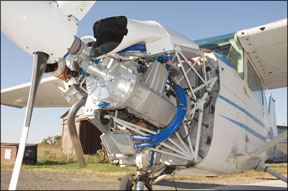
At 1545 Mountain time, the airplane collided with terrain during takeoff. The commercial pilot and two passengers sustained serious injuries; the airplane sustained substantial damage. Visual conditions prevailed. A witness reported the airplane landed at about 1520. During the landing, the airplane bounced on the runway and the engine lost power. The pilot could not restart the engine so the airplane was towed to the fueling area. The fuel tanks were filled to capacity; the engine started without difficulty and the pilot then departed at 1545. The witness saw the airplane go down the runway and noted there was no change in engine power.
Read More »

August 19, 2008, Jeannette, Penn., Piper PA-22-160 Tri-Pacer

At about 1852 Eastern time, the airplane went off the right side of the runway during the landing rollout. The airplane received substantial damage. Visual conditions prevailed. The private pilot and one passenger reported no injuries. The pilot later stated he made two visual approaches and go-arounds due to the airplane being too high. On the third approach, the airplane bounced and touched down on the runway 1300 feet past the landing threshold. He aligned the airplane with the centerline of the runway and applied upward pressure on the manual brake to slow the airplane. After reapplying brake pressure without response, the pilot observed the brake cable had separated and began S-turning the airplane in an attempt to stop.

Read More »

August 15, 2008, Georgia Pass, Colo., Cessna 182T Skylane

The airplane was destroyed when it impacted terrain at about 0915 Mountain time. The instrument-rated private pilot and the three passengers were fatally injured. Instrument conditions prevailed at the time of the accident. Air traffic control tapes showed the airplane on radar from 0840 to 0902. The last radar contact was approximately 30 miles north of the accident site, at 11,800 feet. There was no record of voice communications between the pilot and ATC. Examination of the airplane and accident site indicates the airplane was approximately 55 degrees nose low when it impacted terrain at a 12,300-foot elevation. Flight control continuity was confirmed to all flight control surfaces. All three propeller blades showed evidence of chord-wise scratches and leading edge chips.

Read More »

August 17, 2008, Rhinebeck, N.Y., Nieuport 24bis Experimental

The airplane was destroyed when it impacted trees and terrain while maneuvering. The airline transport pilot was fatally injured. Visual conditions prevailed for the local air show flight. The accident flight was a simulated dogfight. The other airplane participating was a Fokker DR-1. According to the Fokker pilot, he and the accident pilot performed a series of 360-degree turns and lead changes. Both airplanes then turned away from each other. As the Fokker pilot turned back around toward the show line, he noticed the Nieuport beginning a left turn. He looked away for a moment and then saw the Nieuport in a spin before disappearing into trees. The wreckage was consumed by a post-impact fire.

Read More »

August 17, 2008, Show Low, Ariz., Pitts S1S Experimental

The pilot was landing to refuel. During the first attempt, he flared too high and aborted the landing. During the second landing attempt, the airplane veered to the left. The pilot added full power to go around. The airplane turned to the right, but the left wing rose and the airplane nosed down. The right and left wing tips impacted the runway as the airplane skidded down it for approximately 300 feet. The pilot had three hours of time in the airplane make/model.

Read More »

Maximizing Aircraft Efficiency

Are you getting the most performance from your airplane? The fact is a considerable amount of unused performance gets overlooked by the average owner/operator. Both performance and range can be improved through common operational techniques, performing regular maintenance procedures and careful planning. Most of this “hidden performance” can be gained back from wasted fuel and increases in the airplanes useful range. In turn, you can reduce the annual operating costs. And with average aviation fuel prices nudging $6 a gallon in the U.S., who wouldnt want to enhance their airplanes efficiency? Thankfully, its not as complicated as it may seem. You just need to make the machinery work the way it was designed to work. One method is to ensure the airplane is as mechanically sound as it can be. Then, well look at improving its basic aerodynamics, followed by some smarter flight planning. Finally, well look at ways to save fuel while airborne.

Read More »

When Flying Birds Collide with Your Aircraft

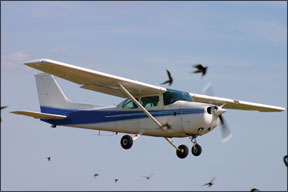
As we practice our license to learn, some hazards demand our frequent attention: Traffic, weather and terrain are the top three. They present varying levels of predictability, and a huge amount of brain power and economic investment has been poured into keeping pilots out of the teeth of these hazards. But what about the less predictable living hazards that share the airport-and sky-with us? Plenty of critters live on and around airports, and as for sharing the sky with birds, well, they got there first. Sometime in the 1980s, a Japan Airlines-bound ab initio student at Napa Airport, Calif., (APC) had a rough time understanding the tower controllers by-the-book NOTAM. She warned, “Aircraft in the vicinity, be aware of large waterborne fowl in and around the airport environment.” After several futile rounds of the hapless student pilot requesting that she say again, she finally bellowed, “Birds! We have birds on the runway!” Birds in the aviating environment are far from the cute critters alighting on Cinderellas hand. A brown pelican, for instance, can pack a punch, weighing up to six pounds (and lets hope you never encounter the 33-pound Dalmatian pelican). Turkey vultures weigh up to 10 pounds; however, the mass generated by a closure rate greater than your en route cruising speed can be incredibly destructive. Size doesnt always matter: The tiny starling is a feathered bullet, with a body 27 percent more dense than the herring gull.

Read More »

Causes of Hypoxia and Flying Non-Pressurized Aircraft at Lower Altitudes

Twelve thousand five hundred feet. Fourteen thousand. Fifteen thousand feet. If youre a pilot, you immediately recognize the significance of these altitudes. Each triggers different requirements for supplemental oxygen use. Most of us learn the FARs associated with these requirements early in our primary training so we can spout them back on written exams and in the oral portion of the Practical Tests. After that, we may never think much more about them. But like most FARs, the oxygen rules are a minimum standard of safety. Of what real-world relevance are the oxygen requirements of FAR 91.211? From the standpoint of safety, when should you be using supplemental oxygen? Supplemental oxygen, for those not familiar with the term, is additional oxygen added to ambient air. The goal is to provide enough “added air” to bring the O2 users oxygen intake up to the same level it would be at a target altitude (usually sea level). The need for additional oxygen increases with altitude, since (obviously) the higher you go, the more O2 you have to add to give the breather sea-level air. For example, one aircraft manufacturers automatically regulated oxygen system meters supplemental air at the rate of 0.5 liters/minute/person at 5000 feet, scaling up to 2.8 liters/minute/person at Flight Level 250.

Read More »

Aircraft Takeoffs and Landing on Shorter Runways

Early on in my flying career, taking off automatically meant, absolutely free, one mandatory dead-stick landing. Thats because I was flying hang gliders and developed an easy appreciation for fitting into small spaces. Later, after someone thought to put a small engine and propeller on one and dub the results an ultralight, my well-honed, dead-stick landing skills proved handy too frequently. Thankfully, the engines used on ultralights in those early days have improved greatly but-like a catchy tune you just cant shake after hearing it on the radio-I still think in terms of whether a nearby field is large enough for landing. Coincidentally and for the same reasons, short-field takeoff skills with an ultralight received equal attention. After all, once you “land out” in an ultralight and resolve whatever caused the engine to fail, you still need to get back to the car. Best of all, the better our short-field skills, the more options we had for operating, powerplant status aside. Once I moved up to flying larger, heavier, faster airplanes, those same instincts came with me, as did the comfort of knowing I had the ability to safely operate from fields that might make a knowledgeable passenger utter an audible, “Whoa….”

Read More »

Pilot and Air Traffic Controller Communication

When you think about it, the IFR system is really a wondrous thing. For example, every airport, navaid, fix and procedure has certain basic characteristics shared by all other similar facilities. For another example, a unique name or identifier is assigned, helping eliminate confusion between ATC and pilots. To navigate from one to another, the operator requests a route, naming the various facilities to be used. A flight plan is filed, or a radio request is made, a controller compares the request to his or her needs and a clearance is issued. On one level, its a simple system. On another, its incredibly complex. So complex, in fact, errors are found every day by pilots and controllers, and then corrected. The result is a relatively safe and efficient national airspace system. One of the keys to making it all work, however, is pilots and controllers cross-checking each others work. Most of the time, no errors are found. Sometimes, though, someone forgets something, or the system proves too inflexible. In those situations, operators and ATC sit down to figure out what went wrong and develop procedures to consider each others needs. This is my tale of finding an omission in the system, and how little effort it took for a fix to be implemented.

Read More »
Pilot in aircraft
Sign-up for newsletters & special offers!

Get the latest stories & special offers delivered directly to your inbox.

SUBSCRIBE