Aviation Safety

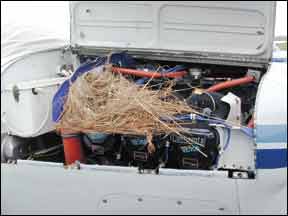
May 18, 2011, Rock Springs, Wyo., Bellanca 17-30A

At about 1130 Mountain time, the airplane impacted terrain, sustaining substantial damage. The private pilot/owner and his passenger were killed. At the time of the accident, the pilot was flying through an area of multiple layered overcast and broken cloud formations, with light rain. When the aircraft did not arrive at its intended destination, an alert notice for a missing aircraft was issued.

Read More »

May 3, 2011, Fort Pierce, Fla., Cessna 172P

The student pilot was on his third solo flight; the airplane was stable on final approach. He increased the pitch of the airplane and began to flare when the stall warning horn sounded. He then released back pressure, the airplane impacted the runway and the nosewheel “bounced heavily.”

Read More »

Avionics Gone Wild

As an avionics guy, Im often asked if I would rather deal with total avionics failure in an all-glass or round-gauge aircraft. My preference is all-glass because total failure is pretty unlikely. And even if it did happen, the situation shouldnt be debilitating. With dual batteries, dual electrical systems, standby instruments and a portable GPS, theres little reason why you couldnt put down safely. But for an older retrofit panel, the risks are elevated. You dont have to be an avionics tech to understand what makes your panel tick, but you do need to know what can make it a ticking time bomb. Perhaps you pushed the wrong button sequence for an autopilot-coupled approach, or maybe an encounter with ice has turned your Aspen PFD into an expensive tic-tac-toe game.

Read More »

Deviation Avoidance

If youre like many of us, the back-and-forth radio chatter between pilots and controllers leaves you, at times, bewildered and wondering what, exactly, that voice on the radio intended. Especially for new pilots and those simply not accustomed to the phrases and terms used, listening to ATC can be confusing, and occasionally even confounding and frustrating. At its worst, the constant stream of aviation shorthand through our headsets carries with it the potential to cause major problems, both for the pilots for whom the missed instructions are intended as well as the rest of us sharing the airspace. When the clag prevails and we turn to our training, charts, plates and procedures to make our way through a safe departure and arrival, we can ill afford to deal with additional issues.

Read More »

Nailing The Straight-In Approach

A good portion of our first few hours of flight instruction-the ones coming after learning basic control-involve getting to know the traffic pattern and perfecting what little takeoff and landing technique we can muster. Using the traffic pattern is convenient: We stay in a relatively small area yet experience one takeoff, a climb, a descent and turns, along with a brief period of straight-and-level flight. One outcome of staying in the traffic pattern and doing touch-and-goes is we get to practice many of the basic VFR skills-along with takeoffs and landings-in a relatively short period of time. The educational law of primacy tells us learning to fly a traffic pattern also teaches us it is the only way to properly approach a landing area in an airplane and-to some extent-it is.

Read More »

Unapproved Mod

Almost any airplane more than a handful of years out of the factory has been modified to some extent. These pages have, on several occasions, discussed the difference between minor modifications requiring only a logbook entry, major mods accomplished as a field approval with an FAA Form 337 and more complicated additions necessitating a supplemental type certificate (STC). For my own airplane, which has been in service coming up on 50 years, I keep a three-ring binder documenting and preserving the Forms 337 and STC paperwork. The binder isnt full, but it wont take much before Ill need to find another place to keep all those important forms.

Read More »

Will Training Reform Help Reduce Fatals?

The mantra “train the way you fly and fly the way you train” has been popular recently, yet we continue training pilots merely to pass the knowledge and practical tests, rather than on how they will operate in the real world. These tests emphasize rote knowledge and performance of specific maneuvers, rather than instructive scenarios emphasizing higher order pilot skills. This results in a pilots all-too-frequent failure to properly manage the risks inherent in typical general aviation flight operations. In an effort to bring focus to these issues and chart a course for beginning the reform process, the Society of Aviation and Flight Educators (SAFE) conducted a Pilot Training Reform Symposium in Atlanta, Ga., on May 4-5, 2011.

Read More »

Preflight Lessons

Kick the tires, light the fires.” So goes a popular, flippant saying about preflight inspections. Most of the time, thats what we and various accident reports would label an “inadequate preflight inspection.” Sometimes-immediately after stopping long enough to drop off or load a passenger, for example-it might be adequate. After all, we just flew it in here-its a perfectly good airplane; why bother risking burnt fingers to check the engine oil or soiling our clothes to check tire pressure? Indeed, we dont go to such trouble when getting in a car; why are we conducting an inspection at all? Thats easy: Because despite the overall safety of general aviation, regardless of our comfort with flying and/or with the specific airplane, the hard truth is that airplanes are terribly unforgiving of mechanical imperfection.

Read More »

DenAlt Denial

Today, Im flying as PIC aboard a Citation II air ambulance, with another captain as my co-pilot. We carry a nurse, medic and enough equipment to handle any critical-care situation. Every flight requires weight and balance calculations based on actual weights, checking weather to not only confirm its flyable, but is comfortable for a patient on a life port and allows the medical crew to work on the patient in flight. Temperature considerations for power settings and takeoff/landing distances are critical, and a constant eye on changing weather conditions goes without saying. Although we train in our primary lessons on weight and balance, and how temperature and altitude play on the performance of our airplanes, we tend to rush through those calculations when we fly the same plane all the time.

Read More »

Game-Changer?

As we put the final touches on this issue, searchers ended their efforts to retrieve bodies and wreckage from Air France Flight 447, an Airbus A330 flying from Rio de Janeiro to Paris, which disappeared over the equatorial Atlantic Ocean in the early morning hours of June 1, 2009. All 228 passengers and crew died in the accident. This May, searchers using deep-sea equipment found the wreckage after three other expeditions failed. They retrieved the all-important cockpit voice and flight data recorders and, amazingly, the information stored in them for almost two years under more than 12,000 feet of water was retrieved.

Read More »
Pilot in aircraft
Sign-up for newsletters & special offers!

Get the latest stories & special offers delivered directly to your inbox.

SUBSCRIBE