











Aviation Safety

Cracked, Failed, Fractured

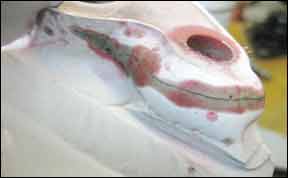
After takeoff on a post-inspection flight, the pilot heard a “snap” and the aircraft pitched up. Control was regained by reducing power and using elevator trim. The aircraft returned for a successful high-speed wheel landing. The elevator cable (p/n 414-187097-1) broke at the pulley above the tail wheel, at bulkhead number 14. The pulley was free to rotate but exhibited signs of wear-possibly from over-tensioning of the cable. Further inspection revealed broken cable strands in the area of its attachment to the elevator control bull wheel.

Read More »

Fictitious Forces

Februarys article, “Horizontal Lift,” is correct in stating the horizontal component of the lift vector turns the airplane. But as a long-time flight instructor and physics teacher I would prefer to explain the airplane turns because there is a net inward force acting on it. This is an unbalanced force, acting toward the center of the circle about which the plane is turning. And yes, the plane is accelerating even though the pilot may be maintaining a constant airspeed, his direction is changing and therefore the plane is accelerating.

Read More »

April 4, 2011, New Orleans, La., Airbus A320-232

At about 0725 Central time, the airplane, operating as United Airlines Flight 497, exited the left side of a runway after returning due to automated warnings of smoke in an equipment bay. The airplanes nose wheel exited the side of the runway upon completing the landing roll and an emergency evacuation was conducted. The airplane, with 109 passengers and crew aboard, had departed about 20 minutes earlier. The passengers and crew exited the airplane via slides.

Read More »

April 4, 2011, Ridgely, Md., Piper PA-28R-180 Arrow

The airplane was substantially damaged during landing at about 1800 Eastern time. The flight instructor (CFI), commercial pilot receiving instruction and commercial pilot-rated passenger were seriously injured. Visual conditions prevailed. The CFI was providing instruction to the two commercial pilots. A witness driving past the airport saw the airplane making a “tight” left approach to the runway and was “very low.”

Read More »

April 5, 2011, Okeechobee, Fla., Cessna 172RG

At about 2130 Eastern time, the airplane was substantially damaged when the main landing gear collapsed during the landing roll. Neither the flight instructor (CFI) nor the private pilot aboard were injured. Visual conditions prevailed. On downwind, the CFI read the prelanding checklist to the private pilot, who extended the landing gear. The CFI put his hand on the landing gear handle to verify it was down, given he could not see the green light from his seat.

Read More »

April 9, 2011, Stow, Ohio, Cessna 152

The solo student pilot reported airspeed was too fast during the landing flare and touchdown. The airplane bounced on the runway. She did not take corrective action and the airplane continued to bounce. She let go of the yoke and “hit” the brakes. The airplane nosed down and its propeller hit the runway, bending the firewall.

Read More »

April 9, 2011, Camarillo, Calif., Beech 35-B33

At about 1324 Pacific time, the airplane sustained substantial damage during a forced landing. The student pilot, flight instructor (CFI) and one of the two passengers sustained minor injuries. One passenger sustained serious injuries. Visual conditions prevailed.While on approach to landing and at about 2500 feet msl, the engine lost power. The CFI took control and began troubleshooting.

Read More »

April 10, 2011, Millville, N.J., Cessna 172N

The pilot, with two other pilot-rated passengers, was practicing a no-flap landing. The pilot flared the airplane about halfway down the runway, bounced and then pitched up. The airplane drifted to the left, while the tail tiedown contacted the runway. The pilot-rated passenger in the right front seat took control of the airplane, lowered the pitch and added full power in an attempt to go around.

Read More »

April 10, 2011, McComb, Miss., Cessna 310R

At 0434 Central time, the airplane was destroyed when it collided with trees during approach. The commercial pilot and two passengers received fatal injuries. Instrument conditions prevailed. The flight was in radar and radio contact with ATC at 4500 feet msl. At 0423, the pilot reported he had the airport in sight and discontinued flight following. The airplane continued on a northwesterly track and overflew the airport for about four miles.

Read More »
Pilot in aircraft
Sign-up for newsletters & special offers!

Get the latest stories & special offers delivered directly to your inbox.

SUBSCRIBE