Aviation Safety

Getting Disoriented

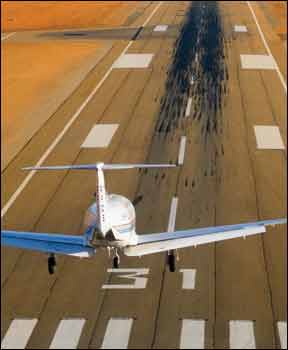
You just broke out of the clag on final, late in the day, with the weather at minimums, when illusion strikes. Are you low on the approach? High? Not sure? At the last moment you realize you’re high and long; time to go missed. Maybe it worked the other way around; you’re on approach and as you get to where you expect the threshold marks to pass below you realize you’re low, short and about to touch down—short of the runway. At its worst, these vision deceptions can contribute to spatial disorientation in VMC that’s more confusing than the dizziness of becoming disoriented inside the eggshell of IMC.
Read More »

Zero-Zero Departure

Part 91 operators have a lot of flexibility in their operations not available to commercial flights conducted under Parts 135 or 121. Whenever persons or property is being carried for compensation, different rules apply. One of them involves minimum weather requirements for takeoff under IFR. The non-commercial Part 91 operator, however, has no such restrictions. We can blast off into any weather conditions we want without needing to meet a visibility minimum or having an alternate airport nearby in case of a problem developing shortly after takeoff. With that flexibility, of course, comes some responsibilities.

Read More »

Five Reasons Your Landings Suck

Landings are typically the pilot’s biggest challenge, presenting great frustration when we screw them up even as recognition of doing it right is as rare as $2.00/gallon avgas. Apparently, the act of returning to terra firma is one we simply can’t seem to master consistently. One of the reasons is each day’s conditions are different from the previous flights, and applying what we remember from them—if anything—won’t always work. Another reason is the pilot may not have enough experience to know how to gauge conditions and modify the pattern and approach to compensate for today’s conditions.

Read More »

Finding A CFI

In a perfect world, all flight instructors would be smiling, retired airline captains who would patiently and benevolently impart the benefit of thousands of hours of safe aircraft operation to the eager minds of the less experienced. Unfortunately, ours is not a perfect world. Most Aviation Safety readers are already certificated pilots, but we all need a CFI for recurrent training and required flight reviews.

Read More »

Low Time, High Anxiety

Our primary training accomplishes many things. It helps us explore the many things we need to know to safely operate an aircraft, gives us the opportunity to develop previously unknown skills and teaches us how to perform simple tasks. By the time we earn a pilot certificate, many abnormal or emergency situations should be second nature, something I learned the hard way.

Read More »

Mixed

One of the year-end rituals in which most of us engage is looking back on what was and thinking of ways we can make improvements during the next 365 days. Although the official NTSB statistics aren’t yet available, there’s enough available evidence to say certain civil aviation segments are wrapping up a pretty good year. Others, not so much.

Read More »

November 2, 2011, Frederick, Md., Cessna 172R Skyhawk

The student pilot experienced a loss of control during landing at about 1715 Eastern time. Visual conditions prevailed and the airplane sustained substantial damage. The solo student pilot was not injured. During landing practice at a different airport, the student noticed a “slight shudder…during the landing roll.” Upon touching down at the accident airport, he felt a shudder in the wheels and a pull to the left.

Read More »

November 3, 2011, Key West, Fla., Cessna 550 Citation II

At about 1212 Eastern time, the airplane received minor damage during a runway overrun. The two airline transport pilots and their three passengers were uninjured. Visual conditions prevailed.According to the pilot-in-command, he flew the final approach at 120 KIAS, touching down at 106 KIAS. At touchdown, speed brakes extended but there was no wheel braking using either normal or emergency systems. The airplane then overran the runway and entered the engineered material arresting system (EMAS).

Read More »

November 5, 2011, Williston, Fla., Beech D-45 (T-34 Mentor)

The airplane was substantially damaged when it impacted terrain at about 1644 Eastern time following loss of control during initial climb. The flight instructor and private pilot were fatally injured. Visual conditions prevailed. According to witnesses, the airplane lifted off after a ground run of approximately 400 feet. It then leveled off and accelerated. At the end of the runway, it pitched up “aggressively” to a 60-to-70-degree nose-up attitude, climbed momentarily, then yawed and rolled to the left while pitching nose down.

Read More »
Pilot in aircraft
Sign-up for newsletters & special offers!

Get the latest stories & special offers delivered directly to your inbox.

SUBSCRIBE