Aviation Safety

Crossing Half The Country In One Flight

In 1984, I sold the 1975 Cessna 172 I had operated for nine years and acquired a 1978 Mooney 201. I immediately put the airplane to work on a multi-stop trip around the country, quickly discovering how efficient it was. On the last leg of that trip, from St. Petersburg, Fla. (KSPG) to Mansfield, Mass. (1B9), I flew the 1029 nm nonstop in 6.7 hours using 52.4 gallons of fuel. That’s an average of 154…

Read More »

Basic Equipment Options

According to Scotland-based Trig Avionics, “A UAT solution will often be more expensive” than a 1090ES-based solution because the latter uses relatively common Mode S transponders: The 978 UAT standard employs a separate transceiver—and U.S. operators complying with ADS-B OUT via 978 UAT still will need a Mode A/C transponder in the foreseeable future, until the FAA says otherwise.

Read More »

Can I get By Without ADS-B?

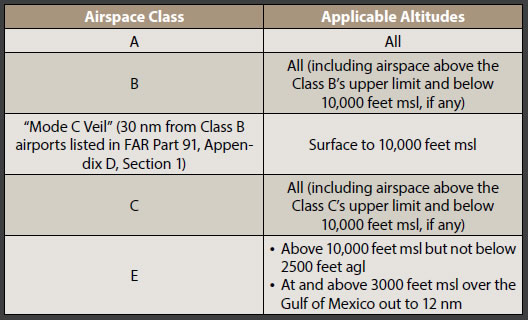
Even though ADS-B will be mandated on January 1, 2020, what does that mean? Where will it be mandated? Can you get a waiver? For the answers, start by referring to FAR 91.225, Automatic Dependent Surveillance-Broadcast (ADS–B) Out equipment and use. The table below summarizes the FAR’s requirements, which basically substitute ADS-B OUT where a Mode C transponder is required now.

Read More »

Hot Water

In response to your October editorial, Hot Water, what I took from these two tragic accidents was that the culture of fear surrounding declaring an emergency is killing people. The FAA needs to change its policy calling for an emergency declaration investigation to address this fear.

Read More »

Some Good News

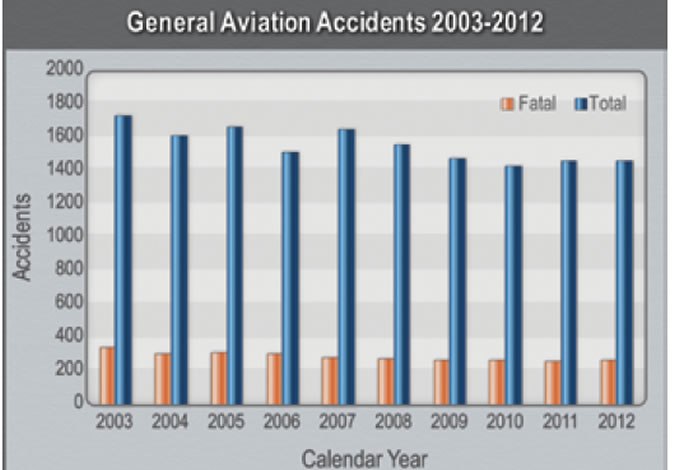
In mid-September, the NTSB released its preliminary aviation accident statistics for 2013, which contained two pieces of good news. First, the preliminary numbers show an overall decline in the number of U.S.-registered civil aviation accidents, which dropped sharply, from 1539 in 2012 to 1297 in 2013.

Read More »

NTSB Reports: October 2014

The student pilot was on final approach for landing when he encountered a crosswind from the left. He corrected for the crosswind and proceeded to land. The airplane ballooned, touched down and pulled to the right. The student pilot applied full power in an attempt to abort the landing. The airplane went off the right side of the runway, became airborne and struck a large hay bale. Post-accident examination revealed the firewall was buckled, both wing leading edges were crushed, the nose landing gear was sheared off and the empennage was damaged.

Read More »

Building Margins

Over the past several years, the FAA and industry have promoted establishing and adhering to personal minimums as a way to manage the risk inherent in personal aviation. These are viewed as self-imposed limitations based upon personal experience, training and certification, equipment or other factors. Some people grumbled and others enthusiastically embraced the concept. Your reaction, as well as mine, depends on how you and I approach the subject. One way to look at personal minimums is to think of them as creating margins separating us from greater risk.

Read More »

Proper Rudder Use

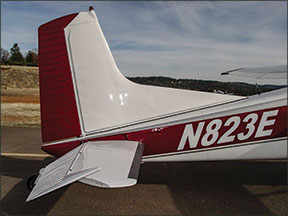
In his seminal book Stick and Rudder, Wolfgang Langewiesche states the rudder “…causes the greatest difficulty for beginners,” and “….even the more experienced pilot often has trouble using it correctly.” Commenting on improper rudder use as a contributing factor in accidents, he states, “In the typical fatal accident, which involves a stall and a spin, misuse of the rudder is almost always partly to blame….”

Read More »

Looking Out The Window

This I know: If you see something with your own two eyes, you probably can avoid it. Happened to me just last month. A regional airliner, working with ATC, was approaching its destination. I was working my way around the Class C airspace, at the center of which the airliner was aimed.

Read More »

Briefing The Takeoff

Compared to landing, taking off is relatively simple. Our instructor lets us make the first takeoff of our very first flying lesson—or at least makes us think we made the takeoff. If everything goes right, it’s easy. But how do you know everything is going right? And how do you know what to do in the scant seconds available if something is going wrong?

Read More »
Pilot in aircraft
Sign-up for newsletters & special offers!

Get the latest stories & special offers delivered directly to your inbox.

SUBSCRIBE