











Airmanship

Survival at the Edge

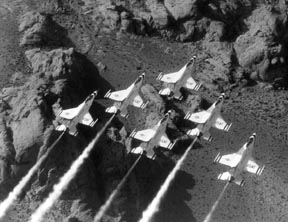
A lot of people who attend airshows think of the performers as death- defying daredevils. It may come as a surprise (although I hope not), that its just not so.

As they race along in brightly painted aircraft, it may seem like theyre mixing aerial ballet with kamikaze maneuvers, but performers know the risks – and know how to minimize them. Airshow flying might be our livelihoods, but its not worth our lives to take what may be inherently risky flying and make it idiotically dangerous.

First off, its important to note that regulations dont create safe pilots. For example, I dont think spin training should be required of all pilots, but I think anyone whos serious about being a s…

Read More »

The Lost Horizon

Looking toward the horizon isnt just the province of sailors looking for land or of preteens daydreaming their way through history class.

Pilots use it on virtually every flight to take off and land, certainly, but also to keep the airplane upright. When a natural horizon isnt available, an artificial one inside the cockpit allows pilots on instruments to keep the airplane under control. Basic stuff, certainly, but loss of control due to disorientation remains a leading cause of accidents in aviation.

Anyone with a pulse was inundated by the coverage of the crash of John Kennedy Jr. off Marthas Vineyard in July. Regardless of your opinion of the quality or the saturation of the med…

Read More »

The Myths of Ditching

If you fly much over the water – even over wide bays and rivers – youve had to quell the uneasiness that arises when the engine goes into auto rough mode the instant youre beyond gliding range of shore. Not to worry; its not just you.

The prospect of going into the water in an airplane terrifies most pilots, chiefly because few prepare for it and, in general, instructors dont know enough about the relevant risks to make well-informed judgments about overwater flying.

As a result, certain myths and half-truths about ditching seem to persist, handed down from one pilot to the next who read something or knows someone who knew someone who vanished without a trace in Lake Michigan…

Read More »

A Graceful Exit

Its a terrible feeling to be in an aircraft when something goes wrong and all you can see are your options narrowing. Although aviation psychologists have suggested a number of techniques for decision making, some seem too complicated for the cockpit.

When forced to make multiple decisions, navigate, communicate, and control the aircraft in a stressful environment, the KISS method – keep it simple, stupid – is probably best. There is a simple concept pilots should employ in their decision making, and it boils down to five words: Keep a safe way out.

This begins with flight planning. Most people would agree that a good flight begins with a good plan, and keeping a safe way out shoul…

Read More »

Flyboy After Dark

Night flight can be deadly, but its also a great experience. Not many small aircraft are in the sky. The air is often smooth and clear. The lights below, of cities and towns are fascinating. Part of the reason you learned to fly in the first place (remember?) was this sensation of being part of a different experience.

Night flying is a part of the whole set of flying skills. If you plan to use the airplane to its maximum potential, youll need to be able to fly it at night. As your skill level progresses, with suitably equipped aircraft to fly, you can venture into safe night IFR flight.

You will need to stay current at night flight if you set your sights on being a competent pilot. I…

Read More »

What a Pushover

The fear of stalls has led many pilots to grief. As they pad their airspeed to avoid stalling in the pattern, for example, they set themselves up for a poor approach and a less-than-optimal landing. Hounded over the years to avoid a low-altitude stall that can lead to a fatal spin, some pilots fear stalls like the plague.

There is no doubt that pilots should have a healthy respect for stalls, but they need not live in terror. Understanding stall factors can mean the difference between extracting the maximum capabilities from the airplanes flight envelope and just getting average performance.

Every pilot has learned, from the first days of pilot training, that an airplane in a bank h…

Read More »

Landing at the Max

The accident record of overshoots and undershoots makes it clear that some people dont practice maximum performance landings enough, but you dont have to review the statistics to convince yourself its true.

Just sit out where you can watch the touchdown zone at an airport with a relatively long runway. Airplane after airplane will show that the pilot cares less about style points than somehow getting the thing on the ground.

Some will dive in at the speed of blazing heat and float halfway down the runway. Some will come in high and land 2,500 feet from the approach end. In either case, touchdown may be followed by the squeal of tires and a half-mile back taxi to the ramp.

A fe…

Read More »

Master, Slave or Partner

A few friends recently had an e-mail discussion on checklist use. It started when one said he had been working on an audiocassette checklist as an adjunct to a speedy but complete check from preflight cockpit to shutdown. The tapes were planned to have background music and a pause tone so pilots would not get ahead of themselves during taxi or takeoff.

Its hard to believe that anyone needs to have another voice in the cockpit (not to mention background music) at critical times in the flight. Its hard enough to keep your attention shifting from one important task to another without an additional distraction.

In more than 30 years as a pilot, Ive never ceased to be amazed at the…

Read More »

Cheating the Turn

A fairly new private pilot recently mentioned that hes read about stalls occurring while turning from base to final but doesnt remember hearing much discussion about it during his private pilot training.

The pilot had done all the approach-to-stall, stall recognition and stall recovery training required to perform the tasks required by his certificate. However, he had no idea why he was doing them – other than to pass the checkride – nor how he might apply this training in the real world.

The central concept never presented to him is that the main reason for stall training, including the spin discussions (which replace the mandatory spin training of the old hairy-chested days), is…

Read More »
Pilot in aircraft
Sign-up for newsletters & special offers!

Get the latest stories & special offers delivered directly to your inbox.

SUBSCRIBE