














Register

Should You Climb to Escape Freezing Rain While Flying IFR?

Whether or not you should depends on the situation.

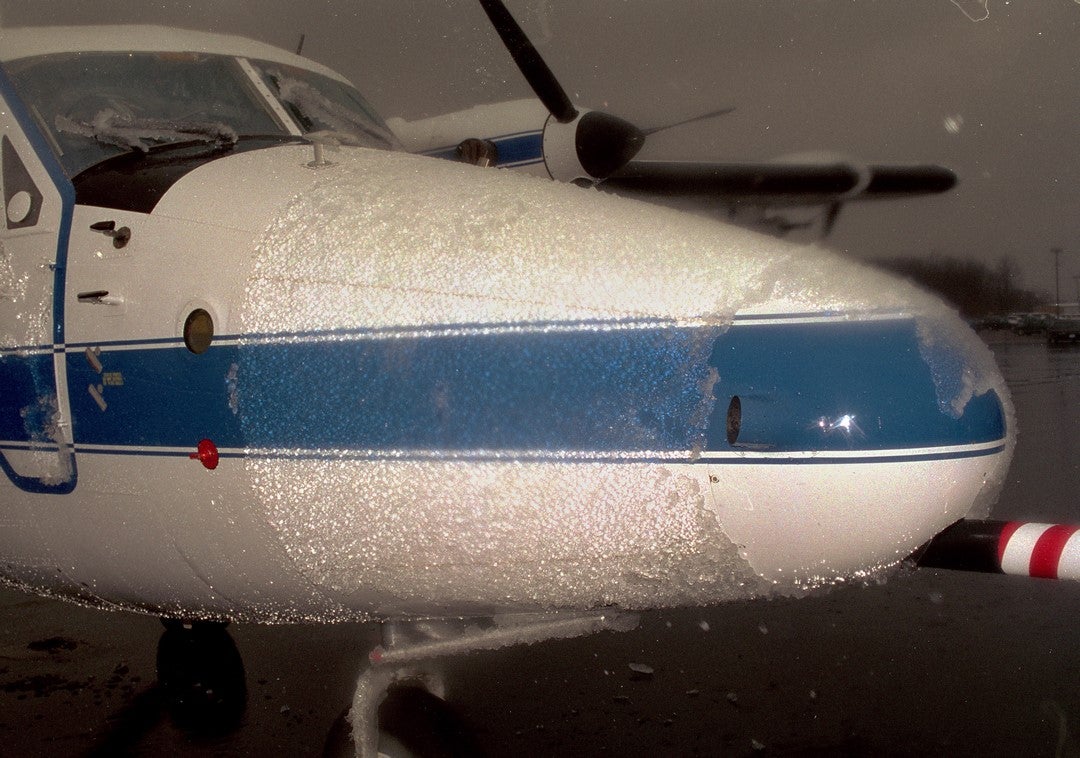
Postflight image shows ice contamination as a result of encountering supercooled large droplet (SLD) conditions near Parkersburg, West Virginia. [Credit: NASA]
Gemini Sparkle

Key Takeaways:

  • Climbing is not a universal solution for escaping freezing rain; the appropriate action depends on whether it's a "classical" or "nonclassical" icing event.
  • The "classical" freezing rain profile, where climbing might lead to warmer air, is rare; most events are "nonclassical" freezing drizzle, which often occurs in entirely sub-freezing profiles.
  • For nonclassical freezing drizzle, climbing may be ineffective and dangerous due to increased stall risk; turning back to an area known to be clear of icing is often the safest strategy, unless encountered during a descent where higher altitudes were previously clear.
See a mistake? Contact us.

If I am flying IFR and encounter freezing rain, should I climb to escape?

Answer: It’s a common misconception that you should always climb when encountering freezing rain. Most pilots are trained that freezing rain occurs when snow is falling through a cold cloud and melts completely as it encounters a temperature warmer than 0 degrees Celsius (C), turning it into rain (this is usually courtesy of a temperature inversion or what meteorologists call a warm nose). Then, those raindrops fall into a subfreezing layer below and become freezing rain (FZRA). So, in this case, there is a layer of air above that is warmer than 0 C.

This kind of temperature profile where the precipitation begins as snow only occurs in about 8 percent of the freezing rain events according to researchers at the National Center for Atmospheric Research (NCAR). If this is what you were taught, then you were taught the exception, not the rule. Aviation meteorologists and researchers call this the “classical” freezing rain profile, where the depth of the weather can be well into flight levels. This allows for the tops to be in the favorable regime for the development of ice crystals and snow. In this case, climbing will put you in a position to at least temporarily escape the freezing rain threat. Even so, this “melting” layer may not have a sufficient depth. 

Scott Dennstaedt, Ph.D

Scott resides in Charlotte, North Carolina, and flies regularly throughout the Mid-Atlantic and Southeast U.S. He is a CFI and former NWS meteorologist. Scott is the author of "The Skew-T log (p) and Me: A Primer for Pilots" and the founder of EZWxBrief.

Ready to Sell Your Aircraft?

List your airplane on AircraftForSale.com and reach qualified buyers.

List Your Aircraft
AircraftForSale Logo | FLYING Logo
Pilot in aircraft
Sign-up for newsletters & special offers!

Get the latest stories & special offers delivered directly to your inbox.

SUBSCRIBE

